



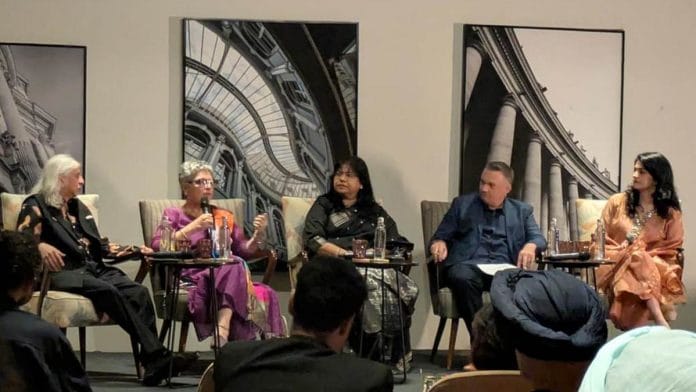

Gurugram: Over a range of gin cocktails at an invite-only “fireside salon” in muggy Gurugram, the Koh-i-Noor diamond took centrestage. Apart from what the gem means to Indians and its repatriation, the discussion also turned to its “prettier” twin, which is locked away in an Iran bank and remains largely overlooked.
The panel discussion on Saturday was titled “Koh-i-Noor: Legacies, Legends, Legalities”. About 50 guests from the art and business worlds attended the event, moderated by Kudrat Singh, co-founder of Itihasology, a public-history platform. She invited the panel and the room to examine the many claims and stories swirling around the contested diamond rather than arrive at a neat verdict.
“I am here to find the Koh-i-Noor,” one guest declared over a ‘Koh-i-Noor Legacy’ cocktail with gin, rose syrup and watermelon juice. The half-joke captured the mood of the room: well-heeled art enthusiasts of the Gurgaon-Delhi circuit, slightly more accustomed to acquiring art than debating its custody, eager to dip their toes into history.
The panel featured historian Rana Safvi; Sanjoy K Roy, managing director of Teamwork Arts, which produces the Jaipur Literature Festival; Lily Pandeya, joint secretary in the Ministry of Culture; and Nick Booker, co-founder of India-focused cultural platform Indo-Genius. Opening remarks came from lawyer Ricky Chopra, one of the evening’s organisers, who framed the diamond less as a gemstone than as an “unresolved case file”. Calling it “the Mountain of Light, the great Koh-i-Noor, which I have the tenacity to call my Koh-i-Noor, or our Koh-i-Noor”, he walked the room through the basic mechanics of a restitution claim.
“If a country is claiming it, they have the burden of proof to approach the court of law and say, ‘I have evidence this asset belongs to me’,” he said, reinforcing that a diamond sitting in the Tower of London cannot simply be summoned home by an Indian court order.
“Without a single binding law compelling return, the fight over the Koh-i-Noor lies in the arena of the law… whatever the room’s collective feelings on the matter,” he said.
Also Read: We’re seen as gods, but we don’t get jobs, says trans activist at Delhi film screening
A prettier sibling
Historian Rana Safvi traced the diamond’s journey from the Golconda mines through the Delhi Sultanate, the Mughal court and Nader Shah’s conquest, and eventually into Sikh and British hands. She gently tried to deflate some of the room’s romantic attachment to it.
“It has a lot of tragedy attached to it also, because nobody who had it flourished,” she said, adding with a laugh: “It’s bad luck… there’s no need for it to come back to India.”
She also pointed to the Koh-i-Noor’s lesser-known twin, the Daria-i-Noor, a pale-pink diamond close in size to the Koh-i-Noor before it was recut. The larger pink diamond is now kept at Iran’s Central Bank in Tehran and draws far less attention despite being, in her view, the “prettier” of the two.
Safvi argued that a stronger case for return could be made for other, less famous objects, such as the Padshahnama, an illustrated court chronicle of Shah Jahan’s reign, still held at Windsor.
“The Koh-i-Noor doesn’t need to come home to matter to us, it already lives in every story we keep telling about it,” she said.
Sanjoy K Roy also questioned whether museums are the best places for telling the stories of artefacts like the Koh-i-Noor, pointing to how digital access and touring exhibitions have changed what it means for an object to be “seen”.
“Stories travel,” he added. “That’s why the Mahabharat and the Ramayan have lasted across millennia, why they’re still being told, in different versions, generation after generation.”
On the subject of repatriation, Lily Pandeya, joint secretary in the Ministry of Culture, said India had received just 13 objects through return and restitution in the first 65 years after Independence. In the past 10 years, she added, that number had risen to 672 and counting.
“Repatriation, at this point, remains an institutional question more than a legal one,” Pandeya said. “The law hasn’t caught up to the will.”
Also Read: Even Shiva isn’t exempt from water management, says award-winning climate author Mridula Ramesh
Looters vs ‘trustees’
The evening’s most theatrical turn belonged to Nick Booker, philosopher and co-founder of Indo-Genius, who introduced himself as “a British man with a British accent”. He started by declaring he would not be defending London’s claim to the diamond.
“We even looted the word loot,” he joked.
Referencing British colonial-era records, Booker argued that Maharaja Ranjit Singh had willed the diamond to the Jagannath Temple in Puri, and that every hand it had passed through since — Sikh treasurer and British Crown included — held it merely in trust rather than as an owner.
“We have a name for a man who holds property that he knows belongs to another and treats it as his own,” Booker told the room. “He does not become the owner. He becomes the trustee. And every hand the property passes through after him, unless it is paid for in good faith, holds it on the same trust.”
He ended with a flourish, reaching into a velvet pouch to produce a replica of the Koh-i-Noor. He offered it up to the room as a stand-in for the real thing.
As the evening drew to a close, Itihasology co-founder Eric Chopra invoked the other pieces of art in the exhibition, still awaiting owners.
“I hope this was an evening that encouraged you to become what Bharat Muni said in the Natya Shastra: a rasika, a connoisseur, who’s curious, who’s always asking questions… and who’s hopefully now drunk enough to buy all the art outside!” he said.
(Edited by Asavari Singh)