





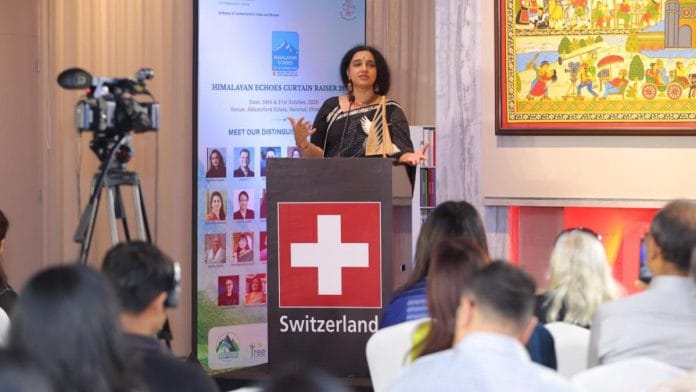

New Delhi: “Water was invisible until it ran out,” said Mridula Ramesh, founder of the Sundaram Climate Institute and winner of this year’s Himalayan Echoes Nature Prize, at her acceptance speech at the Swiss Embassy in New Delhi on 2 September. Her journey and the stories she has told in her award-winning books started 14 years ago, when she ran out of water.
“That’s the problem with nature; we never think about it when it is working,” she said at the curtain raiser of the Himalayan Echoes 2026. “Nature enters the modern consciousness as a failure notice. And this past week, that notice came from the Himalayas.”
The fury of Nepal floods was fresh in the audience’s mind. It was a hand-picked crowd among India’s acclaimed writers, publishers, journalists and climate warriors. So, everyone listened when Ramesh presented her thesis on the situation: nature does not have a powerful constituency.
She was referring to the guarding collectives like the Chipko movement, the people who protect the forest before it is gone. Insurance policies that protect the wetlands before the flood. For more than a decade, Ramesh has been dealing with a problem: just when we need nature’s protective walls the most, “We’re tearing down the walls.”
The encroachment on mountains, the damming, all happens simultaneously with the peaking panic over the worrying state of the environment we live in.
‘India’s water is unique’
To find answers, Ramesh and her institute asked 2,300 people about their personal water reality—what makes them compelled to care about it or not. She found that people near functional lakes are protected even in the worst El Niño summers. They always have water.
In India, these lakes—many of which are rapidly disappearing across the country—are ancient engineering systems perfectly suited to the region’s water reality.
“Let me give you an example of why India’s water is unique. New Delhi gets more rainfall than London does in a year. It’s just that in London, it rains every day, but in Delhi, the rain is squeezed into 30 to 40 days. So that’s a very different engineering brief, right?” she said.
New Delhi, according to Ramesh, is not a water-poor city but one with a storage problem. She is among the historians, archaeologists and fiction writers who have gone looking for the bowleys and tanks of this ancient city of rulers and conquerors. One time, she found the Anangtal Baoli—older than the Delhi Sultanate. It took difficult legwork, wearing heels and a saree, done right after she gave a presentation to a water expert policy committee.
Even the security guard in the vicinity had no idea about it. Then another one led her deep inside the Mehrauli forest—the boali was a dump, overflowing with sanitary napkins, rotting food and all the glary bits. They kept walking. And there it was. Hiding in a clump of trees. A structure holding water. Standing in the middle of all the filth and trash, Ramesh said she was “transported to a different century”.
“It was the perfect analogy for our relationship with water. We’d forgotten about it,” she said. Ramesh then wrote about the Baoli in her book Watershed, and the structure was cleaned in a few years. But then it was deserted again.
Ramesh said the restoration work won’t sustain until the baoli, the lakes, the mountains and rivers are dear to its people. The Baoli was cleaned by an enthusiastic person, but it didn’t help the structure in the long run because people around it still didn’t have any relationship with it. It protects the community’s groundwater, and the community must know about it for it to stay alive. That is why, Ramesh said, we need stories.
Also read: Billionaire Ajay Piramal wants people to have an ‘owner’s mindset’, take risks in business
‘Even god isn’t exempt from water management’
She comes from the temple city of Madurai, the place where great games of Shiva happened in stories. One of the tales is central to the city’s water management culture. As Ramesh told it, the Vagai River flooded once, and the king asked every family to provide a labourer for disaster management. An old lady with no choice went around offering her leftovers in exchange for help. Shiva showed up, promised to help, but he just ate her food and went to sleep. When the king found out, he hit the god with a stick. The entire village felt the blows. To this day, Madurai commemorates the story when the rains arrive in time for the planting season.
“It is to remind people every year about the story and reforge their connection with nature. That even god is not exempt from water management,” Ramesh said.
The nature constituency cannot be built without such stories. These are integral to the water management system. This is how climate conversations leave echo chambers. In the words of Ramesh, “for the sermon to land, you have to move beyond preaching to the choir.”
Perhaps that is why the author has recently ventured into the fiction territory with her new book The Pralaya Prophecy.
“It is a very, very mystical, very deep book, but at the heart of it is the climate, tragedies that are unfolding before us, sometimes for the very wrong cynical commercial reasons, or even evil reasons and how they can be, could be countered by a benevolent universe,” said Namita Gokhale, renowned author and jury member of the Radisson Himalayan Echoes Prize.
Gokhale, along with Janhavi Prasada, has been hosting the Himalayan Echoes literature festival for the last 10 years, platforming authors like Ramesh. Those who weave nature, the mountains, the lakes into their stories. The boutique festival always takes place at the centuries-old Abbotsford Estate in the lap of deodar, walnut and oak trees. The 11th edition too will happen there on 30 and 31 October.
(Edited by Saptak Datta)