






New Delhi: In director Rohit Dwivedi’s film Khejdi, the trans protagonist peers out at the world through a small hole in the wall of her room.
What she sees is gender playing out.
A man bathing naked in public. A woman with soorma-dark eyes. And slowly, experimentally, she begins to emulate what she sees. Gender in Khejdi is performed outside and discovered within. It exists in the privacy of a locked room but is also learned by watching the world.
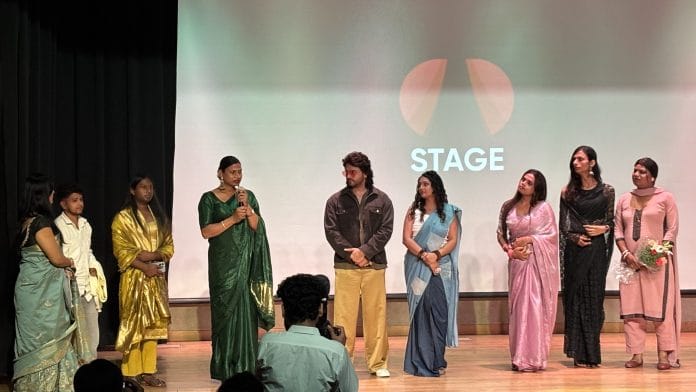
On the evening of 3 September, as the Rajasthani-language film played at Delhi’s BMVK Auditorium, that question—who gets to decide what gender looks like—hung over the room.
The screening came at a particularly fraught moment. India has recently passed the Trans Amendment Act, which mandates the “checking” of a person’s gender by medical boards. In Khejdi, too, the world is engaged in its own kind of checking.
Written for the screen and co-produced by Ashish Sharma and Archana Sharma, the film is based on writer Kiran Singh’s short story Sanjha. Ashish plays the lead character Khejdi, an intersex person born into a world that has no room for her.
The film has travelled widely since its release, with Ashish winning the Best Actor award at the New York City South Asian Film Festival in 2019. The same year, it was also named Best International Feature Film at Mexico’s International Queer Film Festival Playa del Carmen.
Those the world can’t accommodate
A simple question stayed with Archana after she read Sanjha. “What was the character’s fault? Why did we forget we are all humans?” she asked.
That was the thought she carried into the film. “When people watch the film, they should feel, what was her fault? Why are you discriminating against her because of her gender?”
The film does not soften the answer. It is harsh, violent and, at moments, difficult to sit through. But that was deliberate, Archana said.
“We wanted to show a harsh reality. The society we live in, the way we think, we wanted to show that on the screen. There was nothing else. That’s why we didn’t try to soften the story,” she said.
For Ashish, the film is deeply gendered while also reaching beyond gender.
“It is about that one person who tries to fit into society in every aspect, who tries to find themselves, and always has to face obstacles,” he said.
The story had stayed with him for years. His father had handed him Kiran Singh’s short story, and though Ashish eventually forgot about it, it returned to him years later when he was looking for his first film.
“It stayed in my mind for six years,” he said. It took another two years to turn it into a screenplay.
Playing Khejdi, however, required more than preparation. “I think it was more about unlearning than learning. I had to erase everything,” Ashish said.
That interiority is what he believes distinguishes the story. “Whenever we have seen stories about LGBTQ people, the point of view is ours—how we see them, how we want to see them or perceive them,” he said. “For the first time, I read a story that had their point of view.”
“The film is just a journal of a girl,” he added. “Her inner life, her intimate moments, and the life that she was living.”
That was something actor Vineet Kumar, known for films including Masaan (2015), returned to after the screening. When the audience applauded, Kumar said he found himself wondering what exactly they were clapping for.
“It is a topic of embarrassment, and if that is felt, then the film works,” he said. “Because the question mark is on society.”
For Kumar, Khejdi could also be read as a larger symbol of what society does to people it cannot accommodate.
Also read: ‘Arvind Desai’ was the angry young man Bollywood never made — rich, privileged and confused
Silence and applause
Transgender rights activist and founder of Basera Samajik Sansthan Ramkali took the stage after the screening. She brought the film out of metaphor and back into the everyday.
“Where people need blessings, there we are gods,” Ramkali said. “We are blessed there. But when we take our degree and our resume and go to a company, we are thrown out.”
People had seen transgender persons at traffic signals, she said, asking for Rs 5 or Rs 10. But they rarely asked why begging had become one of the few available ways to survive.
“It is very easy to say, don’t beg,” Ramkali said. “But at least accept us. At least give us a job.”
She then invited members of the trans community onto the stage, people she described as fighting their way into the mainstream despite the doors that continued to close on them.
“The biggest thing is that gender doesn’t work for anyone,” she said. “The mind works. The body works.”
That sentence seemed to bring the film’s central question into sharp focus. Khejdi is about gender, but perhaps it is also about every category that people are born into without choosing, and the punishment that can follow for failing to fit inside it.
Vinay Singhal, co-founder of the OTT platform Stage, which is streaming the film, offered his own reading. Years ago, he said, he fell in love with and later married a woman from a different caste.
“I had no role in being born into the caste I was born into,” he said. “She had no role in being born into hers.”
For him, the film is not only about transgender identity but about what happens when society decides a person’s life on the basis of something they have no control over.
“Every person sees themselves in this film,” he said. Perhaps that is why the silence after Khejdi felt almost as important as the applause.
(Edited by Prasanna Bachchhav)