





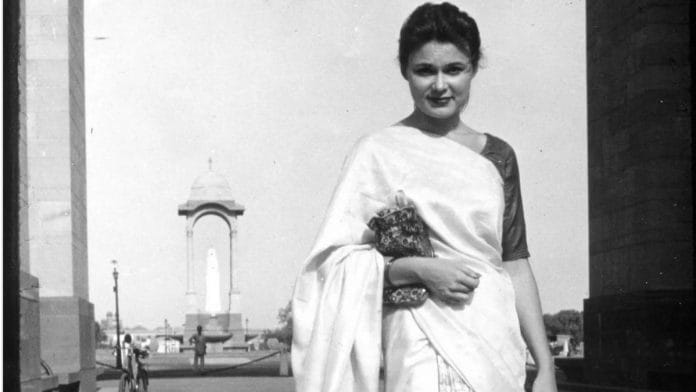

New Delhi: Well before she became known as a feminist icon, Gloria Steinem spent two years in India, including a stint travelling through villages in Tamil Nadu with just a “sari, a cup, and a comb” as part of a Gandhian direct-action group responding to caste violence. It was here, she would later write, that she got “radical advice” from a septuagenarian team leader that changed how she viewed activism. It was her before-and-after moment.
“If you want people to listen to you, you have to listen to them. If you hope people will change how they live, you have to know how they live. If you want people to see you, you have to sit down with them eye-to-eye. Most of us have a few events that divide our lives into ‘before’ and ‘after’. This was one for me,” she wrote in My Life on the Road.
Steinem’s India chapter began in 1956, when the 22-year-old Smith College graduate won a Chester Bowles Asian Fellowship. She was eager to take it, partly as it offered an escape from “a very kind and tempting man” she was engaged to but also knew she shouldn’t marry.
For Steinem, who died aged 92 at her home in New York City on Wednesday, this was the start of an eventful two years in which many of her ideas began to form. She would later become a writer, magazine editor and arguably the most recognised face of second-wave feminism in the US.
Many who paid tribute to Steinem after her death also recounted her time in India — from her appearance in a sari advertisement to the fact that her first book was published by the Government of India.
Also Read: Do feminists ever retire? Gloria Steinem died fighting last century’s battles
Miranda House and first book on India
At Miranda House, Steinem was one of only two Westerners and later recalled her time there fondly.
“They taught me to wear saris and were generally more instructive about India than was the curriculum, which was still shaped by the English system,” she wrote in My Life on the Road.
Her sari-wearing skills were also visible in old photographs shared after her death.
“Gloria Steinem in India, 1958, as the face of a DCM nylon sari ad,” wrote journalist Soutik Biswas, posting one such image on X.
Gloria Steinem in India, 1958, as the face of a DCM nylon sari ad. pic.twitter.com/WX1UifkoIQ
— Soutik Biswas (@soutikBBC) September 3, 2026
Scholar and author Vedica Kant shared another photograph of Steinem in New Delhi, with Rajpath (now Kartavya Path) in the background.
RIP Gloria Steinhem. What a life. I don't think many people know she lived in India for a couple of years in the late 1950s (I believe she studied at Miranda House?) pic.twitter.com/J5R4amB2gk
— Vedica Kant (@vedicakant) September 3, 2026
To support herself, Steinem took on freelance writing assignments, including advertising copy and a book on India. In a Substack tribute, retired IAS officer and columnist KBS Sidhu wrote:
“In her spare hours she wrote her first book, The Thousand Indias (1957), a guidebook commissioned to persuade American students and academics to travel here. The first published work of the woman who would later found Ms. was, in effect, a Government of India tourism publication.”
On her 90th birthday, her alma mater Miranda House marked the occasion by announcing the Gloria Steinem Travel Grant for work on gender issues.
Also Read: Gloria Steinem and the feminism that refused to behave
India activism
While at Delhi University, Gloria Steinem befriended a group of Radical Humanists, many of them former associates of the Communist Party. She later wrote that they made her rethink the idea that “the end justifies the means” and effectively ended her “romance” with Marxism.
She also became involved with Gandhian activists. In south India, she joined one of Vinoba Bhave’s teams and travelled through villages hit by caste violence. It was there that she got the “radical advice” she would remember for the rest of her life.
Steinem later returned to India several times. In 1976, she and economist Devaki Jain interviewed freedom fighter and feminist Kamaladevi Chattopadhyay at her Delhi home. In My Life on the Road, Steinem recalled Chattopadhyay arguing that Gandhi himself had learnt from women’s movements in India.
In an interview with Rajya Sabha TV in 2014, Steinem said she had been struck by the role women played in India’s Independence movement.
“I didn’t know what feminism was,” she said.
Back in the US, Steinem visited women’s shelters, campus women’s centres and protests by single mothers on welfare. She later described the “portable community of talking circles” as “the most important discovery” of her life.
India also appears in her forthcoming memoir, An Unexpected Life. Steinem wrote that the country shattered some of her Western romantic ideas and left her with impressions that were “far more real and less easily forgotten”.
“The teachings of Gandhi introduced me to nonhierarchical thinking, which I came to learn was the most common way of thinking in much of the rest of the world, too,” she wrote.
(Edited by Asavari Singh)