



New Delhi: Union Culture Minister Gajendra Singh Shekhawat has said that whether excavations will continue at Madhubani’s iconic Balirajgarh site in Bihar will depend on the ancient remains and antiquities unearthed from the site.
Shekhawat was responding to Janata Dal (United) MP Sanjay Jha’s 19 May letter, in which Jha requested 10 continuous years of excavation and the creation of a new Archaeological Survey of India (ASI) sub-circle at Balirajgarh.
“The findings emerging from the ongoing excavations will provide the basis for assessing the archaeological potential of the site and determining the need for continuing the excavations under project mode at a subsequent stage,” reads Shekhawat’s response dated July 13.
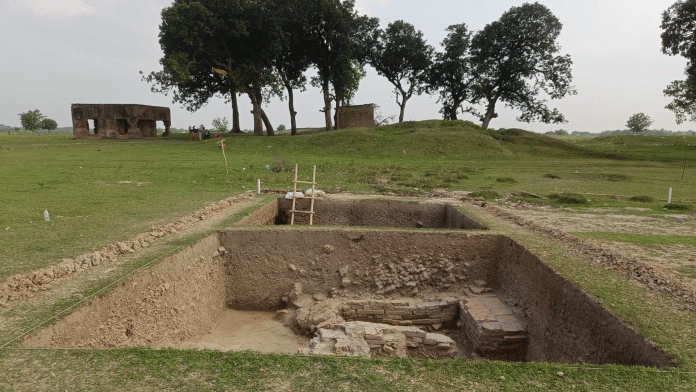
The 176-acre Balirajgarh mound is being dug for the fourth time in the last seven decades. The recent excavation at Balirajgarh started in March this year but was halted in June after a section of the trench dug at the site collapsed due to heavy rain. Two millennia-old antiquities lost due to ASI’s negligence, The Print had reported earlier. ASI is expected to resume excavation at the site post-Diwali.
Also Read: ASI digging Balirajgarh 4th time. Why Ancient Bihar is important to Modi govt
Why Balirajgarh is archeologically important
Balirajgarh is touted as Bihar’s strongest claim to proving that the ancient Mithila region was once a major political and administrative centre. The site is a Centrally Protected Monument (CPM) and falls under the jurisdiction of ASI.
Jha hails from the Mithila region and has been consistently pushing for excavations at Balirajgarh for the last one decade.
In response to Shekhawat’s letter, Jha said he discussed the archaeological significance of Balirajgarh in detail with Shekhawat during a meeting in New Delhi on May 19.
“I also submitted a comprehensive letter urging for phased scientific excavation, the development of necessary infrastructure for researchers, the preservation of ancient remains, the strengthening of the role of the ASI’s Patna Circle, and the establishment of an independent ASI sub-circle at Balirajgarh. The Ministry’s positive response to these suggestions is encouraging,” said Jha.
Jha further said that the Ministry’s assurance that it will give serious consideration to this matter marks a significant step towards preserving Mithila’s rich cultural heritage and securing national and global recognition for it.
“I am confident that once the historical significance of Balirajgarh is fully revealed, it will shed new light on many unexplored facets of Mithila’s ancient civilisation and glorious history,” said Jha.
It is important to note, however, that Shekhawat’s response does not suggest the ministry accepted his demands. It said that continuing excavation works will depend on the antiquities unearthed from the site. In the most recent excavation, ASI’s Patna circle did not find any extraordinary antiquities from the site.
“We have unearthed several human figurines, beads, sling balls, animal figurines and a ring well. We have not reached the natural soil yet to know the earliest settlement at the site. It remains the biggest challenge as excavators have never hit the natural soil,” an ASI official told ThePrint.
Demand for ASI sub-circle at Balirajgarh
Since Independence, archaeology in Bihar has largely been centred on Mauryan sites such as Nalanda, Rajgir and Bodh Gaya. Scholars and archaeologists have long been demanding shifting focus to the Mithila region for excavation work.
ASI created six new circles in 2020. Currently, it has 37 regional circles and a mini-circle at Leh. These circles protect over 3,600 centrally protected monuments across India.
In Bihar, 70 monuments are under ASI’s jurisdiction. Sanjay Jha has appealed Shekhawat to establish a new sub-circle of ASI in the Mithila region.
“Your suggestion regarding the creation of a news ASI sub-circle at Balirajgarh has been duly noted and will be considered in the light of the Archaeological findings, including the nature and significance of the ancient remains and antiquities unearthed, subject to the availability of resources and in accordance with the extant guidelines,” responded Shekhawat.
(Edited by Aakriti Handa)