





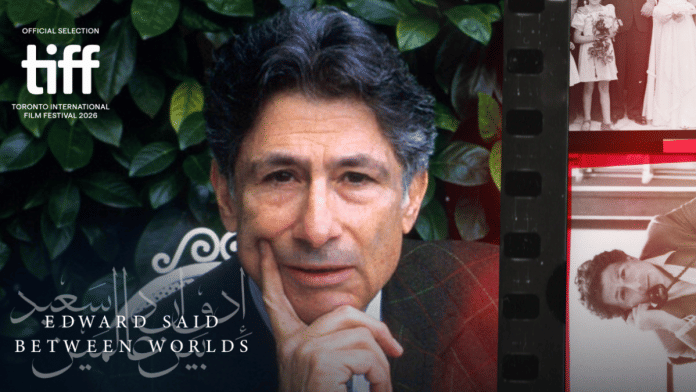


New Delhi: American literary critic Edward Said spent much of his life examining how the West represented the Arab world and how exile shaped the way people understood themselves. More than two decades after his death, a new documentary is turning that scrutiny on Said himself, using previously unseen family archives, home movies and recordings to trace the life of one of the most influential Palestinian intellectuals of the 20th century.
Directed by Maiken Baird, Edward Said: Between Worlds will premiere at the Toronto International Film Festival’s TIFF Docs programme. The acclaimed world film festival runs from 10 to 20 September 2026.
The 107-minute documentary follows Said from his childhood in Jerusalem in 1935 to his death in New York in 2003. The film will be presented in English and Arabic and is built around Said’s own words, drawing on his lectures, television appearances, interviews and other archival recordings.
Baird also revisits the ideas that made Said a central figure in literary and postcolonial studies. His 1978 book Orientalism challenged the ways Western scholarship and culture had constructed representations of the “Orient”, arguing that these representations were closely tied to systems of political and colonial power. His later works, including The Question of Palestine (1979) and Culture and Imperialism (1993), extended those arguments into questions of empire, nationalism and Palestinian identity.
But Between Worlds also seeks to move beyond Said the academic. Baird was granted complete access to Said’s family and estate, a first for a documentary about him, including records from Columbia University’s Edward Said Archive. Said’s daughter, Najla Said, is also a consulting producer on the film.
The documentary follows Said through the experiences that shaped his intellectual and political life—growing up between Jerusalem, Cairo, and Lebanon, becoming an academic in the US, confronting exile and emerging as a prominent advocate for Palestine.
But the film’s timing also places his ideas in a contemporary context. Said’s arguments about representation, colonialism and the power to define other peoples have continued to influence scholarship and political debate, while his criticism of Western portrayals of Palestinians and the Arab world has acquired renewed relevance amid continuing conflict in the Middle East and Israel’s latest attacks on Gaza.
The film has already received recognition in the documentary circuit, winning the Al Jazeera Co-Production Award at the Copenhagen International Documentary Festival in 2025.
“I knew him as a family friend in the 1980s and he inspired me to attend Columbia University. He was a rock star professor, a power-man with charm, deep intellect and wisdom,” Baird told Variety.
She added that, after struggling to secure backing from US financiers, the award felt “overwhelming” and restored her faith. Baird said his story deserved to reach a global audience—and that “we need him.”
TIFF Docs programmer Thom Powers has compared the film’s ambitions to Raoul Peck’s I Am Not Your Negro, a 2016 documentary built around the writings and unfinished work of American writer James Baldwin, suggesting it could introduce the scholar’s ideas to an entirely new generation.
(Edited by Insha Jalil Waziri)