



New Delhi: A curated Durga Puja walk in Delhi’s Chittaranjan Park on Monday evening started with a Partition story.
The route through the colony’s temples, markets and idol-making workshops was also a journey back to the late 1960s, when families displaced from East Pakistan were brought to a rocky, uneven patch of the Aravallis near Kalkaji. There were few houses, little infrastructure and little to suggest that the land would one day become Delhi’s Bengali heartland.
Leading the walk was Archana Jain, who opened with a disclaimer: she is not a historian, only a lifelong Delhiite who loves to read. She is not Bengali either, though she was leading a walk through Delhi’s most Bengali neighbourhood on the eve of Bengal’s biggest festival.
At Kali Mandir, where the walk began at 5 pm, she posed a question that shaped the two hours of the walk.
“What comes to your mind when you hear the word ‘Partition’?” she asked.
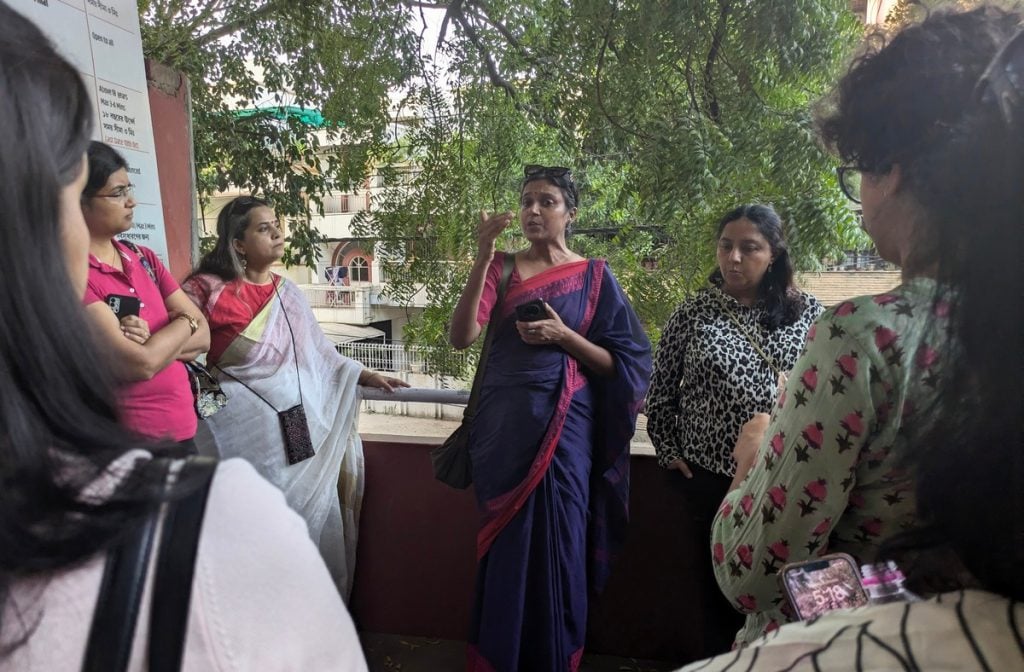
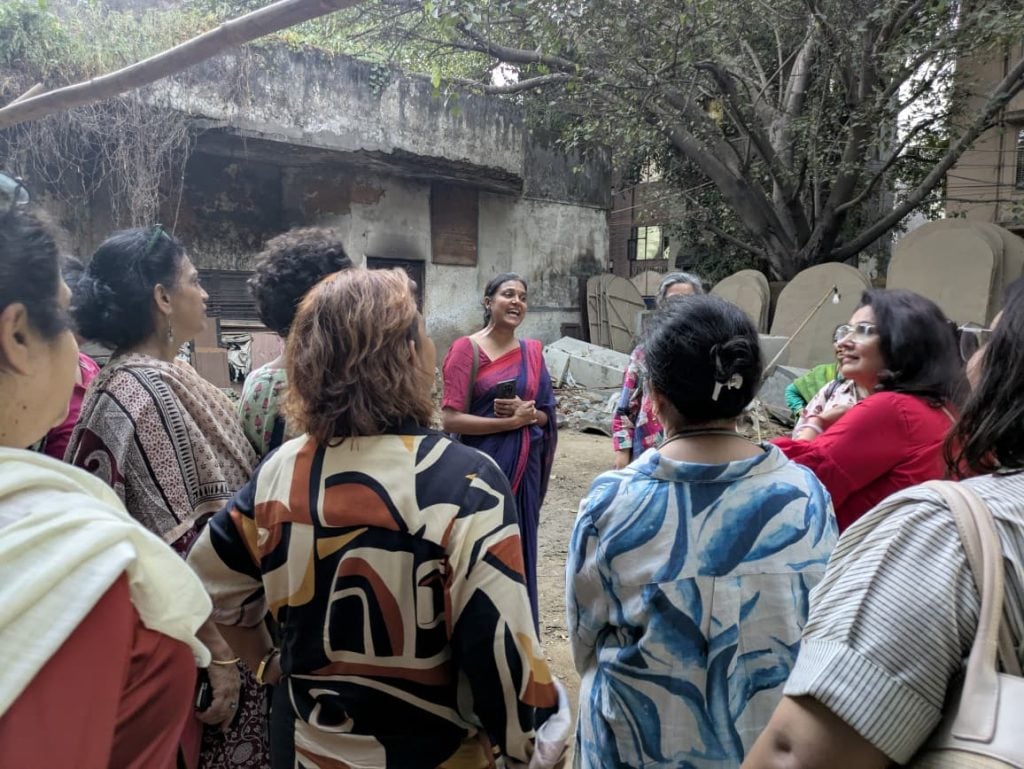
The group of about 20 walkers, only a handful of them Bengali, answered quickly: bloodshed, Punjab, Gandhi, communal tension.
When a Bengali walker began to answer, Jain stopped her. “I know you’re a Bengali, you should not talk about it,” she said, with a grin.
Jain was steering the group toward a part of history less discussed in the North: the partition of Bengal.
“Partition didn’t just happen in the North, it also happened in the East,” she said. And Kali Mandir, where they stood, was part of that story of resettlement.
Also Read: Durga Puja is India’s gift to the world. It is pan-India and global
From Partition to CR Park
Bengal underwent not one but two partitions: first in 1905, when the British divided the province into eastern and western parts, and again in 1947, when East Bengal became part of Pakistan. The movement of people from East Bengal to Delhi continued until about 1970.
“I don’t call them refugees, because refugees are people who are forced out of a country,” Jain said. “They lose their homes, they lose their place, they lose everything.”
She asked the group what makes a home.
“Comfort,” said one walker. “Safe place,” said another. Jain nodded and added her own answers.
“Community, your worship areas, the community belongingness. That’s what actually makes a home, right? The Bengali families who arrived in Delhi had lost all of it.”
The climb up to Kali Mandir is still a reminder of how hilly the terrain of the newly allotted neighbourhood was. At the time, Jain said, few believed the land could be made habitable.
The first house, B-23 in B-Block, remains the colony’s founding address. In 1970, the community’s first Durga Puja was held in a park opposite Market 1.
With the history of the place laid out, the walk itself began—present and origin interwoven at every step.
Making the goddess
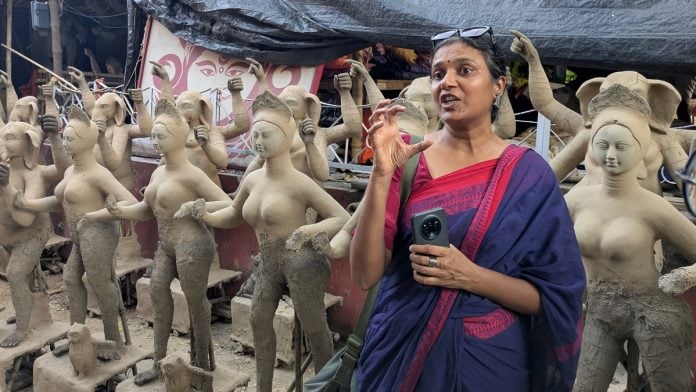
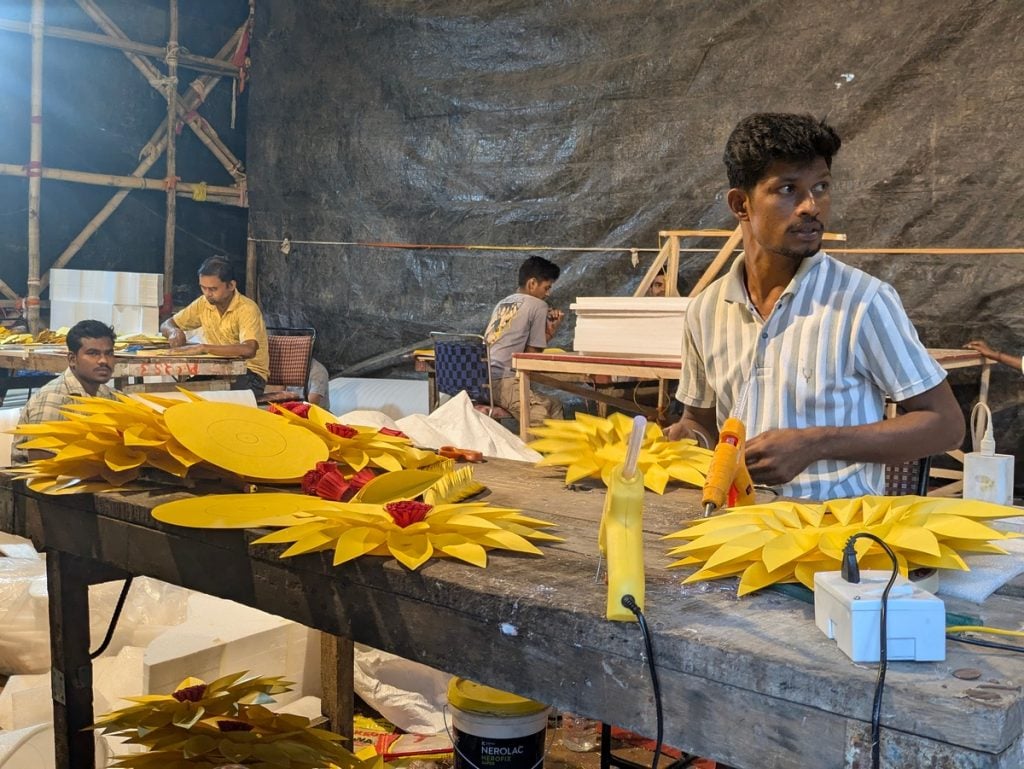
The first stop was the clay workshop beside the temple. Jain calls it the “Kumartuli of Delhi”, after Kolkata’s traditional potters’ quarter. Half-finished idols stood in rows under tarpaulin, some still skeletal frames of bamboo and straw, others already taking shape. Nearby, frames, fabric and paper flowers waited to become pandal décor.
“Making the idol is not a matter of a month or a week, it’s a matter of a couple of months,” Jain told the group.
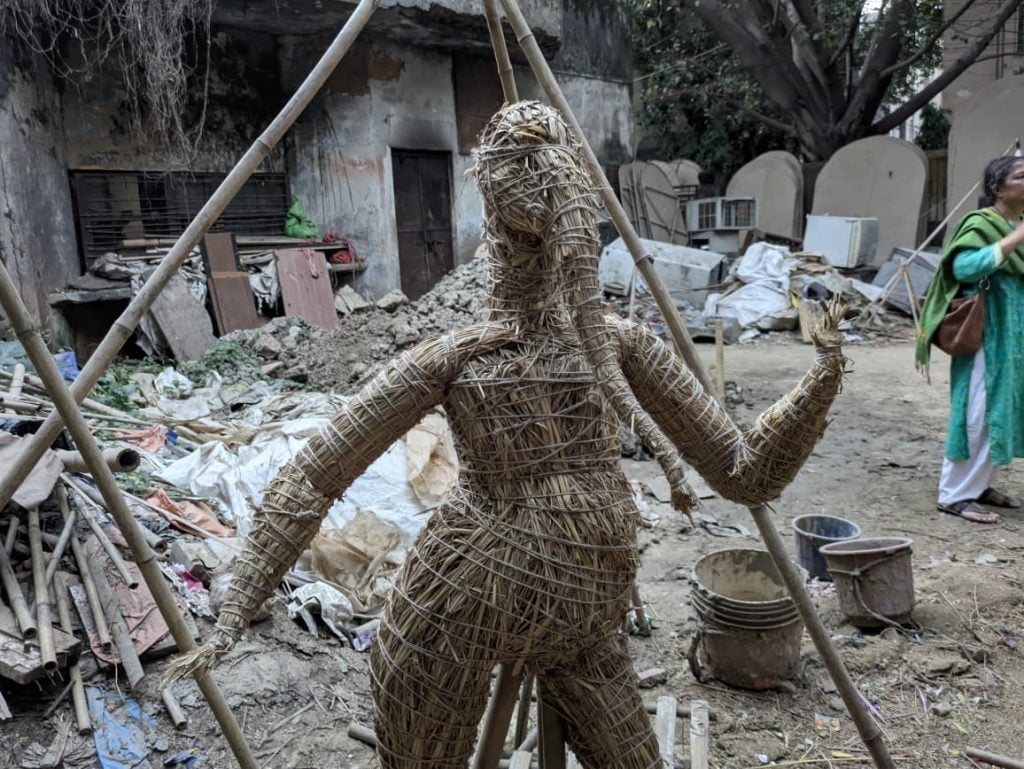
Bamboo and straw form the skeleton, followed by a rough layer of clay and then a finer one. The clay is blended from different sources, and tradition says a handful of soil from a courtesan’s doorstep goes into the mix.
“They were the custodians of art and culture,” Jain said of the courtesans. “They were experts in Kathak, they were experts in literature, they had a lot of knowledge.”
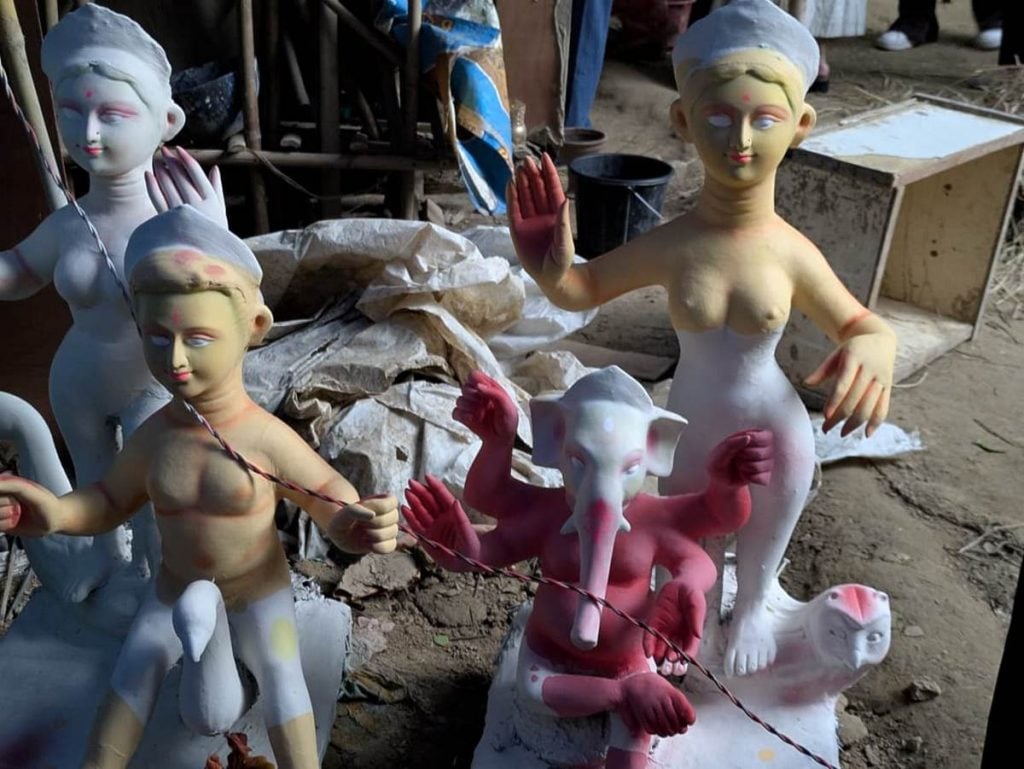
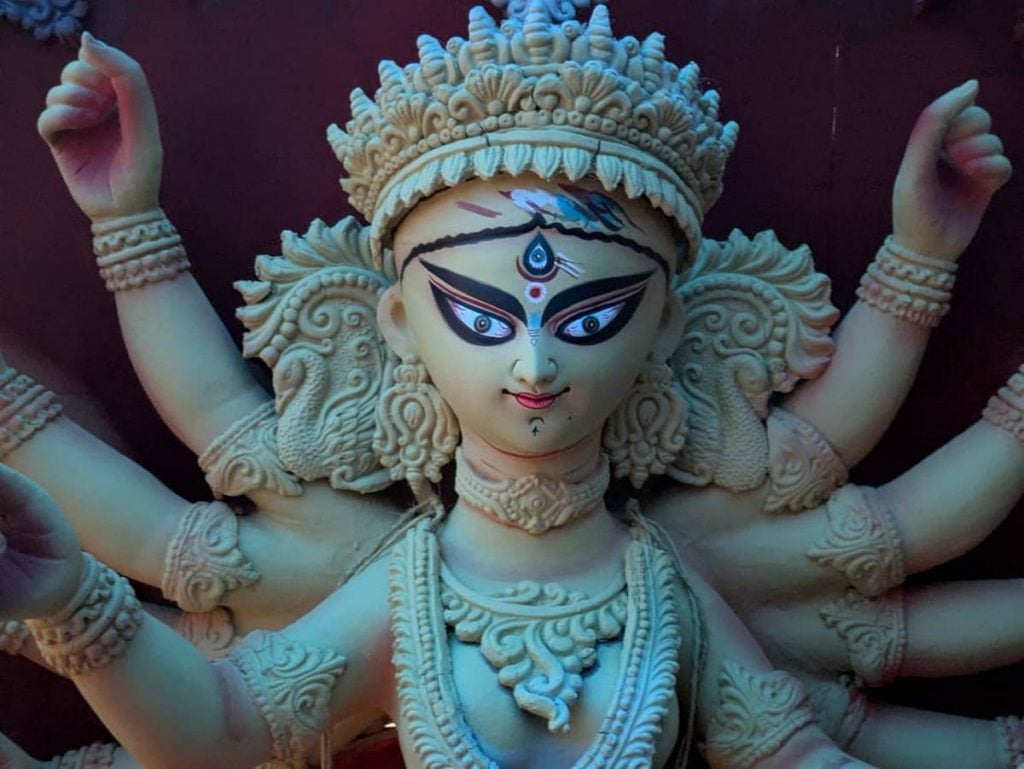
The group gathered as a sculptor attached a hand to an idol. Hands, Jain noted, are made separately and attached later. She also taught them to read the faces: a fierce Durga has red-rimmed eyes and a wide-open third eye; a calm one has upward-gazing eyes and a third eye like a peeled almond. Beside her stand her four children—Kartikeya, Ganesh, Lakshmi and Saraswati—while the buffalo demon Mahishasura lies under her trident.
“The eyes are painted last, on Mahalaya,” she told the group. “The ritual is called chokhhu daan—when the clay becomes a goddess.”
A lingering old name, a closed cinema & adda
As the light softened, the group walked towards the EBDP office. It’s a lingering reminder of the colony’s original name: East Pakistan Displaced Persons Society.
“Honestly, that does not sound very good,” she said.
“Because now they are no longer displaced,” a walker chimed in.
The residents, too, no longer wanted their home to be defined by displacement, Jain added. And so different names were debated. Tagore Garden was considered, after Rabindranath Tagore, but Delhi already had a colony by that name. Other suggestions were rejected.
In the end, they settled on Chittaranjan Park, after Chittaranjan Das, the barrister and freedom fighter known as Deshbandhu, or “friend of the nation”.
The most haunting stop was Chandraloke, the old single-screen cinema near G-block of CR Park. The black metal gates stood open on the crumbling yellow building. Ivy twirled around it, climbing over the ruins.
For decades, the cinema was where the colony’s Bengalis came to watch Bengali films, but it shut in 2002 as multiplexes arrived. Now the roof sags and the building is slowly being reclaimed by time.
Just behind the cinema, though, there is plenty of activity. Every summer, an artisan arrives to make idols at a workshop there, which are then sent to the UK, the US, Canada and Australia. The group peered over at the idols, some painted in vibrant colours, some still incomplete.
At this workshop, Jain also told the stories behind the festival. She shared the tale of Rambha, the demon who fell in love with a buffalo, and their son Mahishasura. Having won a boon from Brahma that no man could kill him, Mahishasura terrorised heaven and earth until the gods combined their powers to create Durga, who fought him for nine days.
“Earlier, pandals were not community celebrations; they used to be private celebrations, hosted by zamindar families in the 18th century,” she said.
Community pujas began in 1790. Today’s pandals, Jain added, have become “temporary art galleries”.
The walk ended at Market No. 1, with the group settling in for adda—the Bengali art of sitting, talking and drinking tea for no reason at all—over a round of puchkas.
(Edited by Asavari Singh)