



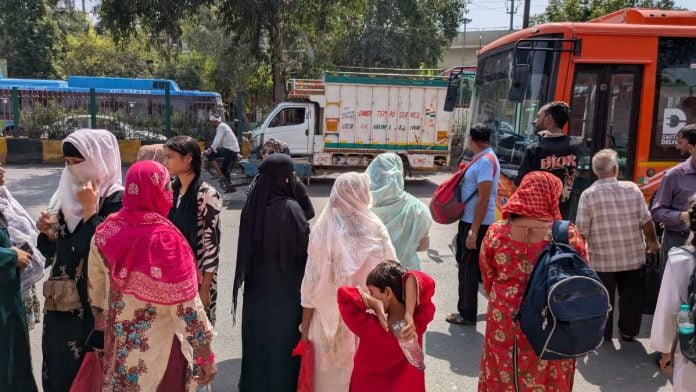
New Delhi: At the Kashmere Gate bus stop, passengers gathered in the October heat to board their buses. The women in the crowd endured the usual press of bodies, many of them tightly clutching their bags or holding their children. The otherwise ordinary morning commute turned into an uncertain one for the women in Delhi.
The paper-based pink ticket, which assured free travel, is no longer valid. It has been replaced by the Pink Saheli Smart Card. But the new rule’s implementation seems to depend entirely on bus conductors and the information relayed to them.
“I took the bus earlier this morning; I had to pay for my ticket. When I switched to a different bus, they gave me the pink pass for free without asking,” 32-year-old Meenakshi said. “It is all very unclear.”
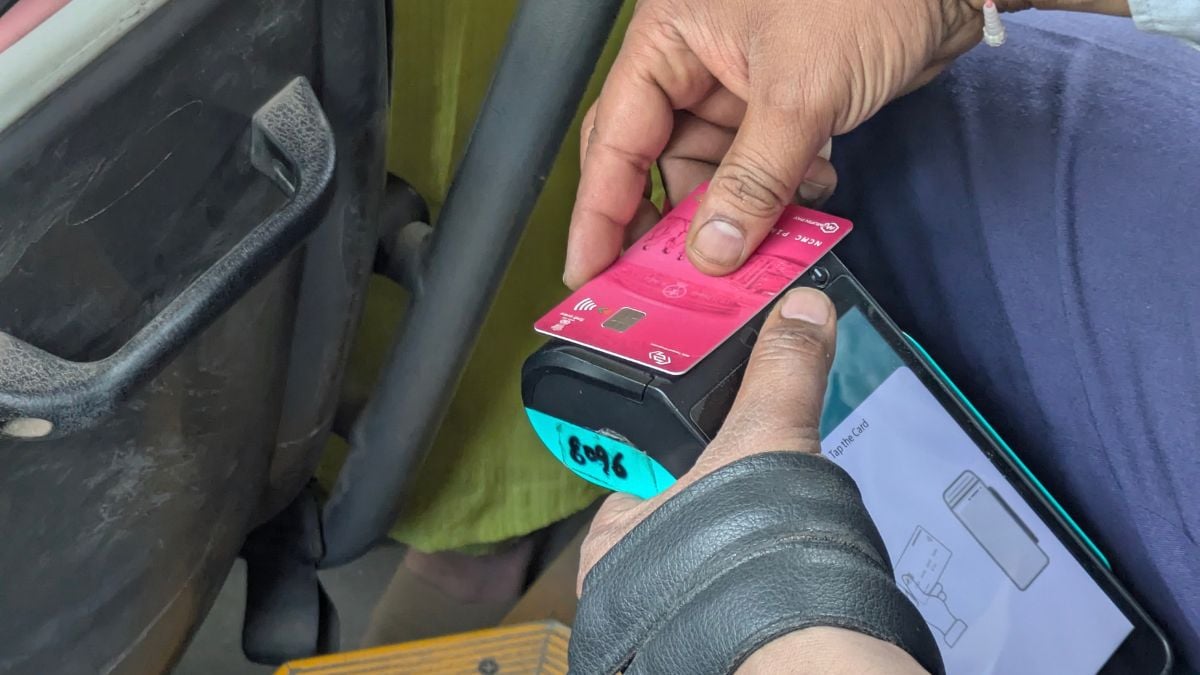
The Delhi government has made Pink Saheli Smart Card mandatory for women travelling free on Delhi Transport Corporation (DTC) and cluster buses from 1 October. The scheme was launched on 2 March 2026 and is run by the DTC. The pink Saheli card works on the National Common Mobility Card’s tap-and-go system and is free of cost. But there is a catch.
Pink Saheli card applicants must be permanent Delhi residents aged 12 or above with valid proof of address.
Migrant women exclusion
For the many migrant women who come to Delhi for work, the rule changes the monthly budget.
“We earn so little and travel so far,” 27-year-old Sunita said. “If the free ride ends, how will women like us manage the fare every day?” Originally from Bihar, Sunita has lived in Delhi for about 10 years. She sews and mends clothes for a living and earns wages per day. Her husband too is a daily-wage worker. Sunita commutes from Loni Gol Chakkar to Kashmere Gate every day; the DTC bus is the only mode of transport she can afford.
“This is the plight of most migrant women in the city. We keep Delhi running, but no one thinks about us when these rules change,” said Sunita, a mother of two. “We also have to worry about our rents and sending money back home. It is becoming impossible to sustain in this city.”
Sunita has been seeking new work, in the absence of which she plans to return to her village. The bus ticket is only a new mounting charge to the increasing cost of living in the city.
According to the 2011 Census, Delhi has the highest proportion of inter-state migrants among major Indian cities. Estimates put the number of domestic workers in Delhi at around five lakh; the majority of them are migrant women. The national capital’s homes, workshops and markets depend on migrant labour, and a substantial part of it is women who travel long distances every day.
Kamla Devi travels for about 15 kilometers from Kanjhawala to Rohini every day, working as a domestic worker. She has lived in Delhi for seven years. She does not yet have the Pink Saheli card and is unsure whether her address proof will be accepted.
“If I have to pay every day, it will be at least thirty or forty rupees one way,” she said. “That is a lot from my wages. I go to work early and return late. The bus is the only way. Without free travel it will be very hard.”
Application process
At the other end of the spectrum is Usha, 74, a retired Integrated Child Development Services (ICDS) Anganwadi worker from Uttam Nagar. She has the card and is the only one in her family of six who still takes the bus; the rest rely on the metro.
“I prefer the bus, it is free and more comfortable,” she said en route to the court.
Getting herself the pink card took effort. A week of trying at Uttam Nagar yielded nothing, so she went to the distribution centre at Kirby Place in Delhi Cantonment. She reached around noon. The staff gave her a token and told her to wait as it was lunchtime. She waited, had something to eat, and was processed within a few minutes after an officer called senior citizens forward.
“The process was a little time-consuming, but I could get it done quite smoothly,” she said of her week-long struggle. “The lines have been cut shorter now that most people have already obtained the cards, so it should no longer take as long.”
Usha said that women from outside the city should get the benefit too. In the paper-pass era, everyone received it; now that it is linked to Aadhaar, it is only for Delhi residents. “It’s good for Delhi residents. It would be great if they provided it for all women.”
‘Pink corruption’
The free-ride scheme was launched on Bhai Dooj in October 2019 under former Delhi chief minister Arvind Kejriwal. Women travelled free on DTC and cluster buses on pink single-journey tickets. The government reimbursed operators with Rs 10 for every free ticket. At the launch, officials said that around 8.5 lakh women took the bus regularly.
When Rekha Gupta’s BJP government took office in 2025, it moved to replace the paper tickets. Gupta alleged in the Assembly that the pink-ticket system was marred by corruption.
“We are committed to providing this service to women. Corruption will not be tolerated. We will introduce digital travel cards for women, putting an end to the ‘pink corruption’ tied to physical tickets,” she said. The card, she added, would “allow women to travel freely on public buses anytime, eliminating corruption linked to ticketing.”
The pink-ticket system never required women to establish Delhi residency before boarding – all women could avail free DTC bus travel.
The Aam Aadmi Party has opposed the change.
In a video message on X earlier this year, AAP Delhi unit president Saurabh Bharadwaj called it a “new mockery” by Chief Minister Rekha Gupta.
“Why does the BJP Government want to incur the expense of making Pink Cards?” he questioned. “To get the card made, they will demand a Delhi Aadhaar card. But lakhs of women from Bihar, Uttar Pradesh, Haryana and Purvanchal who live in Delhi still have Aadhaar cards from their original states.”
He accused the BJP government of corruption.
“In a system where there was no scope for corruption, the BJP has now created new avenues for corruption.”
The Delhi government has defended the move, stating it will cut misuse and corruption linked to ticketing, and that free travel is meant for women who can prove Delhi residency.
According to the website, applicants must complete Aadhaar verification and link a mobile number to their Aadhaar during the application process.
“Depot managers have instructed conductors to issue tickets by tapping the Pink Card for those who have it, while encouraging others to apply for one as soon as possible. The enforcement is not as strict as of now,” a PR official with the DTC told ThePrint. “The pink ticket is still being given to women without the cards, but only for some time.”
“Only the Aadhaar card will be considered as the official proof of residence, no other document will be accepted. Only women with Aadhaar cards based in Delhi will get access to the Pink Saheli Card,” he added.
“Women from outside of Delhi will not be issued the cards, once the enforcement starts, they will have to buy their tickets.”
“Nearly 19 lakh cards have been issued till now, which is a good number,” Transport Minister Pankaj Kumar Singh said.
The government has set up 50 authorised centres, and the first card is free. The government has not publicly responded to concerns that women with Aadhaar cards from other states may be excluded.
Non-uniform implementation
The rule was not uniformly enforced across the city – in some buses it was enforced strictly, while in others, it was only mentioned in passing.
The notice shared with conductors instructed them to ask every woman passenger for her Pink Saheli Smart Card before issuing a pink ticket. Those who had forgotten to bring their cards, or had not yet obtained one, were to be asked to get the card made.
“Until further orders, no woman passenger is to be denied free travel. If a woman passenger does not have the card, she shall, under the current instructions, be provided free travel,” the message received on the conductor’s official WhatsApp group read.
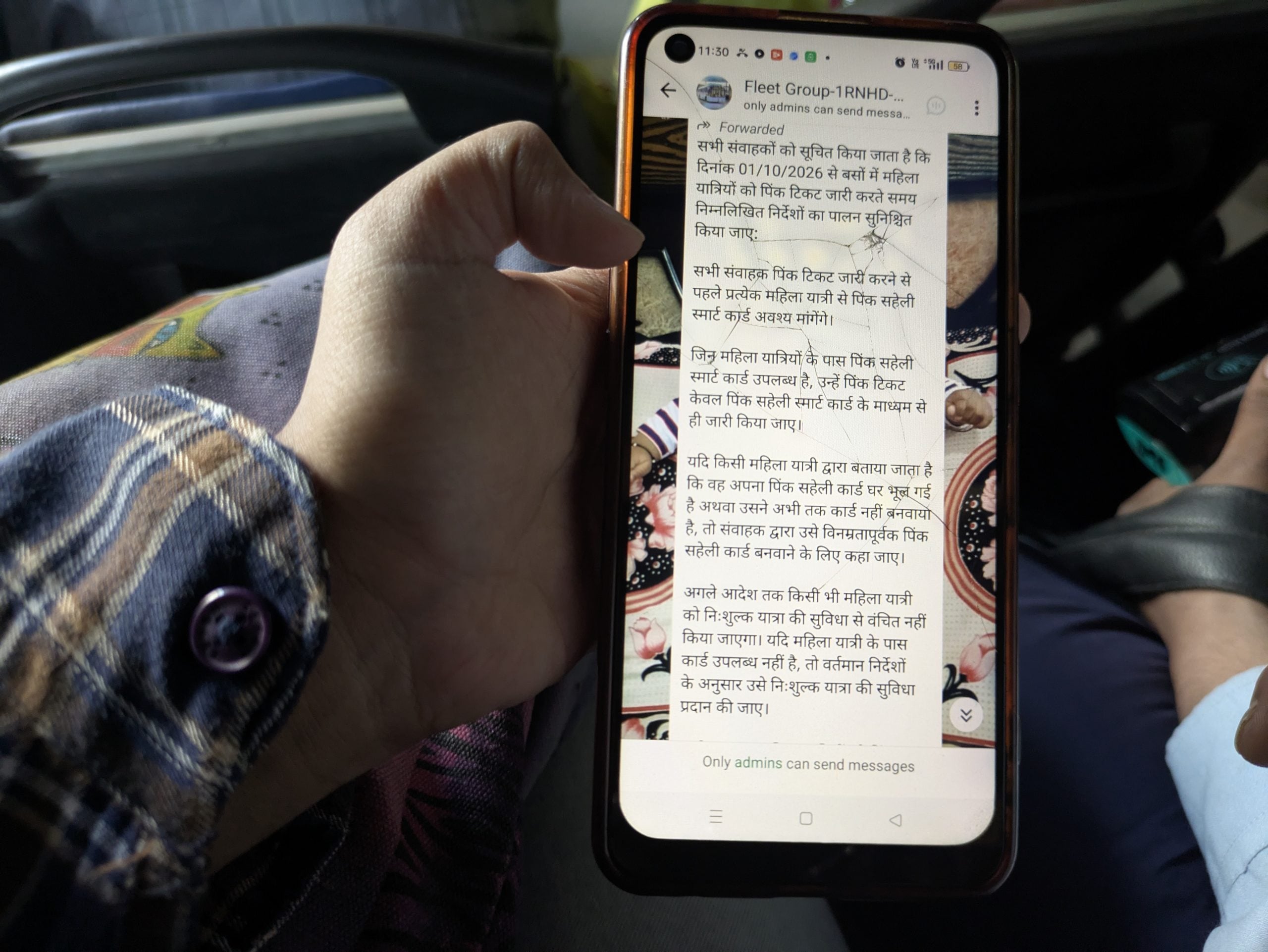
Inspection teams were to be deployed at various locations on 1 October, and conductors were asked to follow the instructions strictly.
“Today, it’s just been said that as far as possible, force everyone to get the card made, because from tomorrow it might be enforced more strictly,” said Ravi, a conductor on the 141 route, running between Rohini Sector 23 and Old Delhi Railway Station. “It is not certain.”
He estimated that nine in every ten women he encountered already had the card but had simply not been carrying it because the old system had worked without it.
Sarman, another conductor, did not expect the deadline to hold. “It has been extended many times before,” he said. “I think the government will surely push it again.”
(Edited by Ratan Priya)