



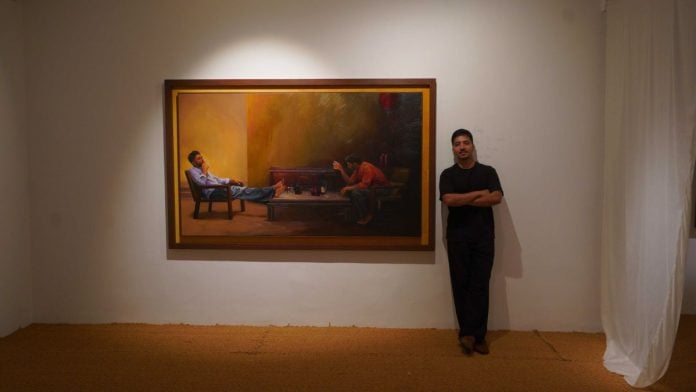
New Delhi: Defence Colony is noisy in the way South Delhi neighbourhoods often are–cars moving past handcarts, people stopping for Chole Kulche and kulfi, customers coming in and out of cafes and shops. But a few steps away from the bustle, a small gate opens into the Pristine Contemporary art gallery.
Inside, the street’s noise feels far away. The exhibition A Sip of Solitude asks visitors to do just that–stop, look and spend a little time with themselves.
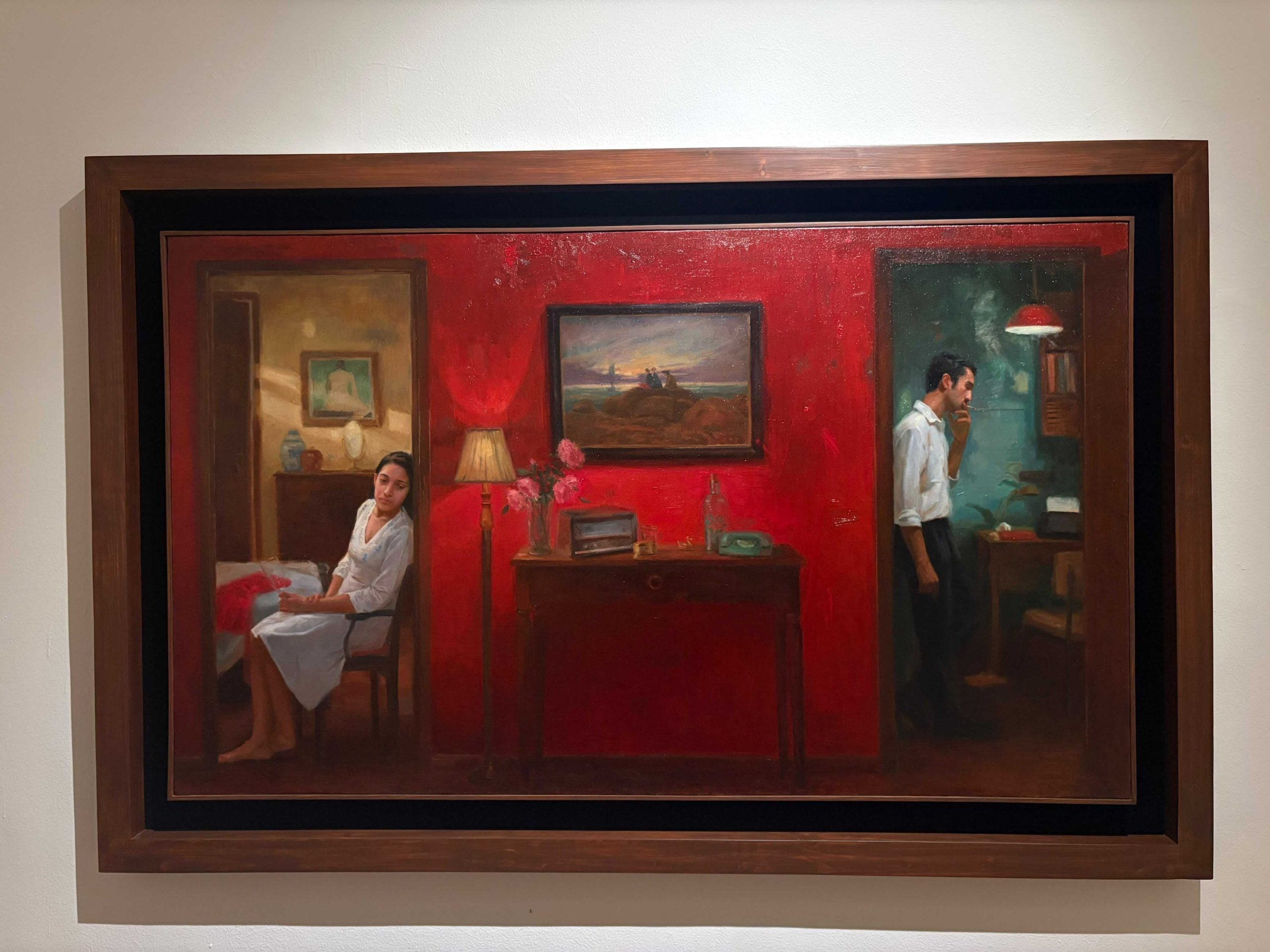
One of the works in the exhibition, Ayush Agarwal’s Two Rooms, captures that pause through two people who are physically close but kept apart. A man sits in one room and a woman in another, each caught in their own moment. A wall separates them. The two rooms become spaces where they can step away from each other and be alone with their thoughts.
Defence Colony now has two very different rhythms: the noise and movement of its streets, and the more contemplative pace of its galleries.
Pristine came to this neighbourhood in 2024 and is one of a dozen spaces gathered within a walkable stretch of Defence Colony. Their arrival has added an art circuit to an area already known for its restaurants, Modern Bazaar and everyday footfall.
The change has been rapid. Defence Colony, once a quiet, tree-lined neighbourhood developed for Indian military officials in the 1950s and 1960s, has become Delhi’s first walkable gallery district in the past two years. This transition began with a handful of already existing spaces and accelerated in late 2024 and 2025 as newer galleries moved in, creating a dense cluster that is now hard to miss.
Within a few minutes, a visitor can leave one exhibition and walk into another, moving seamlessly through very different forms of contemporary art without having to cross the city. Delhi’s tryst with big art began with the Lodhi Art District, Kiran Nadar Museum of Art and the annual ritual of the India Art Fair. Now the Defence Colony Art circuit has given Delhi a distinct, accessible artsy voice that the stodgy government-city otherwise lacked. It also reflects a recognition that Delhi-NCR now has enough conspicuous wealth that desires to own art – something only Mumbai was associated with earlier. The confluence of new money, art and status has now elevated Delhi into a rarefied realm that goes beyond the ‘Don’t you know who my father is’ trope.
The idea of bringing these galleries together became more organised in 2026 with the formation of the Defence Colony Galleries Association. Gallery owners began coordinating their exhibition openings and programming through a common network on Instagram
The neighbourhood also began presenting itself as a single-gallery circuit during the India Art Fair in January 2026, when galleries joined a public Gallery Hop. That later grew into Def Col Art Night, a regular evening when galleries stay open late, host events and bring visitors, artists and curators together. The format takes a cue from Mumbai’s Art Night Thursdays. In Defence Colony, the idea is being adapted to a much smaller, more walkable neighbourhood. On the third Thursday of the month, participating galleries stay open until around 9 pm, with several also hosting new exhibition openings.
It is a significant shift for Delhi. The city has never lacked galleries, but they have largely been spread across different neighbourhoods. With the Defence Colony Art District, gallerists now appear as if they are organising, becoming a platform and a constituency.
“Def Col Art Night was inspired by Art Night Thursday in Bombay, where 20–25 galleries across South Bombay, Kala Ghoda and Bandra coordinate their openings and programming. The Def Col Gallery Association was formally established in July 2026, and 12 galleries are now part of it,” said Arjun Butani, co-director of Pristine Contemporary.
Butani, along with fellow co-director Arjun Sawhney, initiated the idea of bringing the galleries together to create a collective forum.
From residential colony to gallery district
Art was never really absent from Defence Colony. Vadehra Art Gallery, founded in 1987, has been part of the neighbourhood for decades and was among the early galleries to establish a presence here.
What is new is the pace at which others have followed.
Mumbai-based Mirchandani + Steinruecke opened its Delhi space in November 2024, close to Vadehra and Shrine Empire. In 2025 came Method Art Gallery, Gallery XXL, Latitude 28, PHOTOINK and GALLERYSKE, among others.
By early 2026, around 11-12 galleries were operating within a relatively compact, walkable stretch, giving the neighbourhood the makings of Delhi’s first dedicated commercial gallery district. It is also changing who enters these spaces, what kind of art they encounter and how they experience a gallery district.
That shift is particularly visible at galleries such as Gallery XXL, which is deliberately moving beyond the traditional collector-driven model. While older Delhi gallery culture has often been associated with established artists, established collectors and relatively high-priced works, newer spaces are bringing urban contemporary art, street art and younger artists to audiences who may not previously have considered themselves gallery-goers.
“We wanted to cater to a different demographic. Also, because we represent urban art, we’ve also seen that there is generally a different kind of demographic that resonates with the kind of work that we show. So, keeping that in mind, we wanted to open it up, not only to younger audiences, but to audiences who might have a certain kind of budget to buy art,” Malik said.
The response was visible during the Paper and Play exhibition, which drew around 5,000 visitors, including students and first-time gallery-goers.
For Gallery XXL, however, reaching a wider audience is not only about the price of an artwork or who walks through the door. The gallery has taken some of its programming outside. It has organised walks between Lodhi Art District and the gallery, worked with artists on murals in Defence Colony and brought events into the surrounding streets.
The idea is to make the neighbourhood itself part of the art experience.
“And so people get to actually experience the artist’s works both in the streets as well as in the gallery. And that has always been very exciting for us. And that always existed as an artist. And for that to be extended here with galleries has also been quite a great extension, but also I think what the gallery coming together does is it builds community,” Malik said.
Role of art galleries
Defence Colony is not just an established South Delhi neighbourhood, with old families, expensive homes, a busy market and businesses that draw people from outside the colony. The galleries have arrived in the middle of that existing social and commercial life.
On an art night, the crowd can include collectors moving between exhibitions, young professionals taking photographs, students looking around, artists meeting one another and residents stopping at a gallery they may have passed many times before.
The concentration is also changing how individual galleries fit into the neighbourhood. Latitude 28 moved from Lado Sarai to Defence Colony in 2025, while retaining its earlier location as a viewing room. PHOTOINK, which has focused on photography for more than two decades, became part of the cluster in 2026.
Founded by Devika Daulet-Singh in 2001, PHOTOINK has spent more than two decades helping establish photography as an art form in India. It began as a photo agency and publication-design studio, started organising exhibitions in 2003 and opened its own gallery in New Delhi in 2008. Since then, its programme has brought together contemporary photographers, historic collections and photographers’ estates, spanning different generations and approaches to the medium.
For artist Varad Bang, galleries matter because he grew up with little exposure to art.
He recalled visiting only the Ajanta and Ellora caves in his childhood. It was only later, after studying architecture at CEPT University in Ahmedabad and then moving to Florence to study fine art and oil painting, that he began to see art differently.
He said that art gives people a chance to step away from the speed of everyday life and spend time thinking and being with themselves. This idea of slowing down also runs through his own paintings. In his paintings, the walls are often left bare, and he calls the empty wall a “co-character”. It holds the people inside the painting and keeps their emotions from being lost among too many objects.
For Bang, galleries can play a larger role.
“A first visit may feel intimidating, especially for someone who has never been around art before. Events such as gallery nights can make that first step easier because people can come with friends, move from one gallery to another and experience art without feeling that they need to know anything about it beforehand,” he said.
That sense of ease is part of what Jhanvi, a 24-year-old working professional who has visited the galleries, noticed too. The proximity of the spaces made her explore beyond the exhibition she had initially come to see.
“I think that’s what I like about this area. You come to one gallery, and then you see another one next door and think, why not just go in? Sometimes you don’t even know the artist or the gallery, but because it’s right there, you end up looking around. Otherwise, I don’t think I would make a separate plan to go to three or four galleries,” she said.
For visitors like Jhanvi, the gallery visit has become more of a route through the neighbourhood.
Bringing street art into the gallery
At Gallery XXL, Paper and Play looked at how ordinary objects can become valuable when presented as art. Daku’s photograph of a municipal dumpster in Hauz Khas Village, covered in a Louis Vuitton-like monogram, played with ideas of branding, status and luxury.
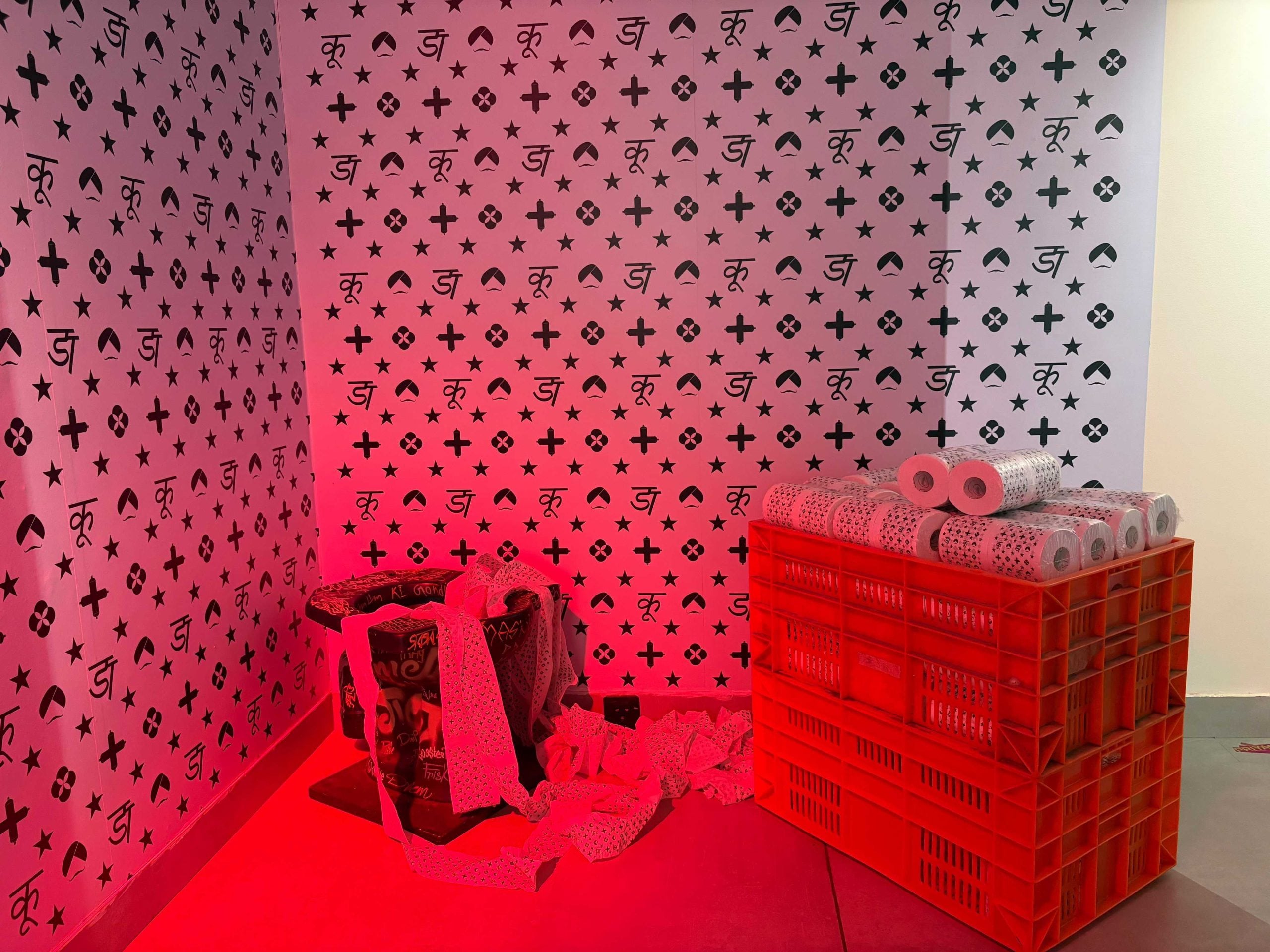
“We had these toilet paper rolls by Daku. Each roll was priced at Rs 500, and people were actually buying them. It was interesting because something as ordinary and disposable as toilet paper was being consumed as art,” said Sarah Malik, curator at Gallery XXL.
Paper and Play ran from 6 June to 22 August and was designed as a space people could enter without knowing exactly what they were supposed to do. Part exhibition and part shop, it invited visitors to browse, linger and buy.
Originally curated by Priyanshi S. for Pulp Society in 2022, the exhibition returned to XXL in a larger and more expansive form. Artists from street art, underground scenes, studios and institutions were brought together, including Daku, AIKO, Christoph Florin, Debashish Chakrabarty, Priyanka Paul, Beer Pitch, DO, ZERO and Khatra.
Prints and posters were placed alongside zines, artist books, games, toys and paper-mache sculptures. New books, objects and publications were added regularly, keeping the exhibition changing throughout its run.
The gallery opened its Defence Colony space in October 2025, after starting with pop-ups in 2023 and a permanent space in Mumbai. It grew out of the Start India Foundation, which has spent the past decade working with street artists and creating public art projects and art districts across India.
“The gallery started as an extension of that vision, where we were working primarily with street artists who had studio works. So what that represents is actually the global phenomenon of the urban contemporary art movement, where institutions like museums and galleries started showing the work of street artists. Our programme has been highlighting urban contemporary art, which is the formal movement that encapsulates the post-graffiti era,” Malik said.
The gallery works with artists whose work is rooted in street culture, urban spaces and everyday life. Malik said bringing such work into a gallery allows people to see it in a different setting and engage with it differently.
“When you bring street art into a space like a gallery or an indoor space, and things are being made available to people, one is that you can keep something with you. It’s something they’re going to take back. It becomes a more concrete memory that one can create for themselves,” she said.
The works in Paper and Play ranged from Rs 100 to Rs 2 lakh, allowing someone buying their first print to encounter the same exhibition as an established collector.
Also read: From art walls to urban forests—New Delhi’s Lodhi Colony gets its first Miyawaki Forest
And the crowds come in
For nearly four decades, Vadehra Art Gallery has watched Defence Colony change around it. In 1987, it was one of the few art spaces in the neighbourhood. Today, it is surrounded by a growing number of galleries, and the area is beginning to draw people specifically for art.
For Parul Vadehra, Director at Vadehra Art Gallery, the biggest difference is the sense of a shared art-going culture taking shape.
“In many ways, the new galleries are building the gallery-going culture Delhi has always needed, while also adding new voices, artists and audiences to the ecosystem. That diversity will only strengthen the city’s art scene,” she said.
The change is also visible in who is coming through the doors. Vadehra said the gallery still attracts an established art-going audience, but is now seeing more “students, young professionals, designers and people who are curious about art but may not yet collect it”.
The concentration of galleries, she added, has made contemporary art more accessible and visible to a wider, younger audience. Visitors can encounter different artists and galleries in a single outing.
“We have been in Defence Colony for almost 40 years, and are soon opening a new gallery space here as well, so it is wonderful to see it evolve into an exciting art destination,” she said.
But not everyone looks at this transformation the same way
For Defence Colony residents, the issue is not the galleries alone. It is how much commercial activity the neighbourhood has absorbed.
“Over the years, restaurants, clinics, doctors’ offices, banks, designer stores, hospitals and other businesses have moved into the 70-year-old residential colony. The result is heavier traffic, blocked roads and growing pressure on infrastructure meant for a residential neighbourhood,” said Major (Retd) Ranjit Singh, RWA president of Defence Colony.
The galleries, he said, are not a particular source of disturbance. But their arrival has added to the footfall and traffic in an area already struggling with both. He does not necessarily see Defence Colony as an art district. The galleries are just the latest addition to a neighbourhood that has, over time, become more commercial.
(Edited by Ratan Priya)