



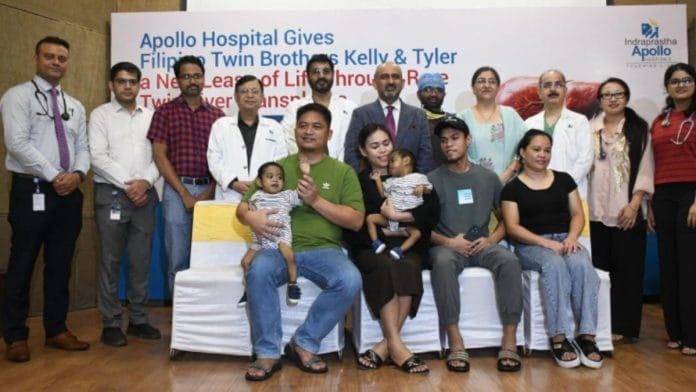
New Delhi: Twin toddlers from the Philippines were given a new lease of life after doctors in Delhi performed rare, 14-hour-long liver transplants on each of them. The 23-month-old twins are now undergoing post-operative check-ups.
Tyler and Kelly, from the Philippines’ Tangdag, were diagnosed with Type 4A choledochal cyst, a rare condition affecting both the bile ducts inside and outside the liver, leading to liver failure.
A team of 10 doctors from Delhi’s Indraprastha Apollo Hospital performed 14 hours of surgery on each child after they arrived in India in May.
In a telephonic conversation, Dr Neerav Goyal, who operated on the infants, told ThePrint that both the children are doing well.
“At present, they have been coming for regular post-operative check-ups every week to 10 days. In another couple of weeks, they should be fit enough to fly back to the Philippines,” he said. Goyal is a senior consultant in transplant & surgical gastroenterology at Indraprastha Apollo Hospital.
Mother and uncle as donors
Doctors from Apollo have been visiting the Philippines for regular camps in collaboration with government hospitals. Goyal was on one such visit when he met the twins.
The twins, a year old at the time, had identical anatomy.
“We found that the same rare condition in both identical twins is what makes this case so unusual,” said Goyal.
In India, Indraprastha Apollo Hospital has treated nearly 200 Filipino children with life-threatening liver diseases, the most common condition being biliary atresia.
The country has recently started liver transplants, but the facilities are limited. Many Filipinos come to India for a less expensive liver transplant procedure. In the Philippines, the transplant costs 2.5 times more than it does in India.
The doctors initially tested the parents as possible liver donors. The father was not found to be a suitable donor, but the mother was. The twins’ maternal uncle then decided to donate his liver, and the two transplants were performed five days apart.
“For the first child, we used about 20 per cent of the mother’s liver. Later, we transplanted a liver graft from the maternal uncle into the second child. Since the recipients were tiny infants, the donor liver had to be reduced further so that it would fit safely inside the child’s abdomen,” Goyal said.
He added that the donors are also recovering well. Once the twins return home, paediatric hepatologists in the Philippines will continue their care while staying in regular touch with doctors in India. Reports will be sent to the Indian doctors every month.
“If any intervention is required, we coordinate with the local doctors. Only in rare situations do we ask patients to come back to India,” Goyal said.
Apollo has performed more than 3,000 liver transplants, including 645 on children. Indraprastha Apollo Hospital performed the first paediatric liver transplant on a six-month-old child in November 1998. The child is now 29 years old and a doctor at an Apollo hospital in Bengaluru.
Goyal said that this case from the Philippines stood out because of the rarity of the situation.
“The case highlights that successful living donor liver transplantation is routinely available in India and can save children with complex liver diseases.”
(Edited by Prasanna Bachchhav)
Also read: One disability certificate, two outcomes for UPSC and UP government