






New Delhi: Walk into DAG’s Windsor Place gallery in the heart of Lutyens Delhi this week, and the first thing you will notice isn’t a painting. It’s texture.
A terracotta plate, the size of a dinner tray, sits under glass. Its warm-toned glaze shines, with two bulls painted across it. Next to it, a brass sculpture curls upward off a dark wooden base. It looks almost like a flame caught mid-flicker.
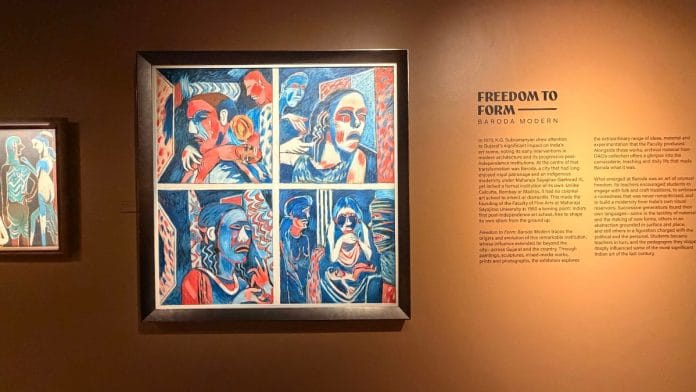
The exhibit is called ‘Freedom to Form: Baroda Modern’. It opened on Friday evening with Radhikaraje Gaekwad, from the erstwhile royal family of Baroda, doing the honours. It will remain open to the public till 3 October.
This time, the Delhi Art Gallery (DAG) has brought together the work of 25 artists across several generations. What links them is that they all studied at the same art school — Vadodara’s Faculty of Fine Arts. The exhibit traces the story of the institution, from its early years to the present but what makes it worth the walk is how varied the works feel. Nothing sits flat on a canvas waiting to be looked at. Every piece of art demands the onlooker’s attention.
One of the walls is titled “Rethinking Abstraction.” Standing in front of the paintings the explanatory text is hardly the “background reading” one often finds in exhibits. It contains arguments in the world of art that are still playing out.
Nothing in the room looks borrowed or inspired from other art styles. The canvases contain the experience of the artists, and are heavy with everyday materials — burnt surfaces, moulded wax, and geometric designs.
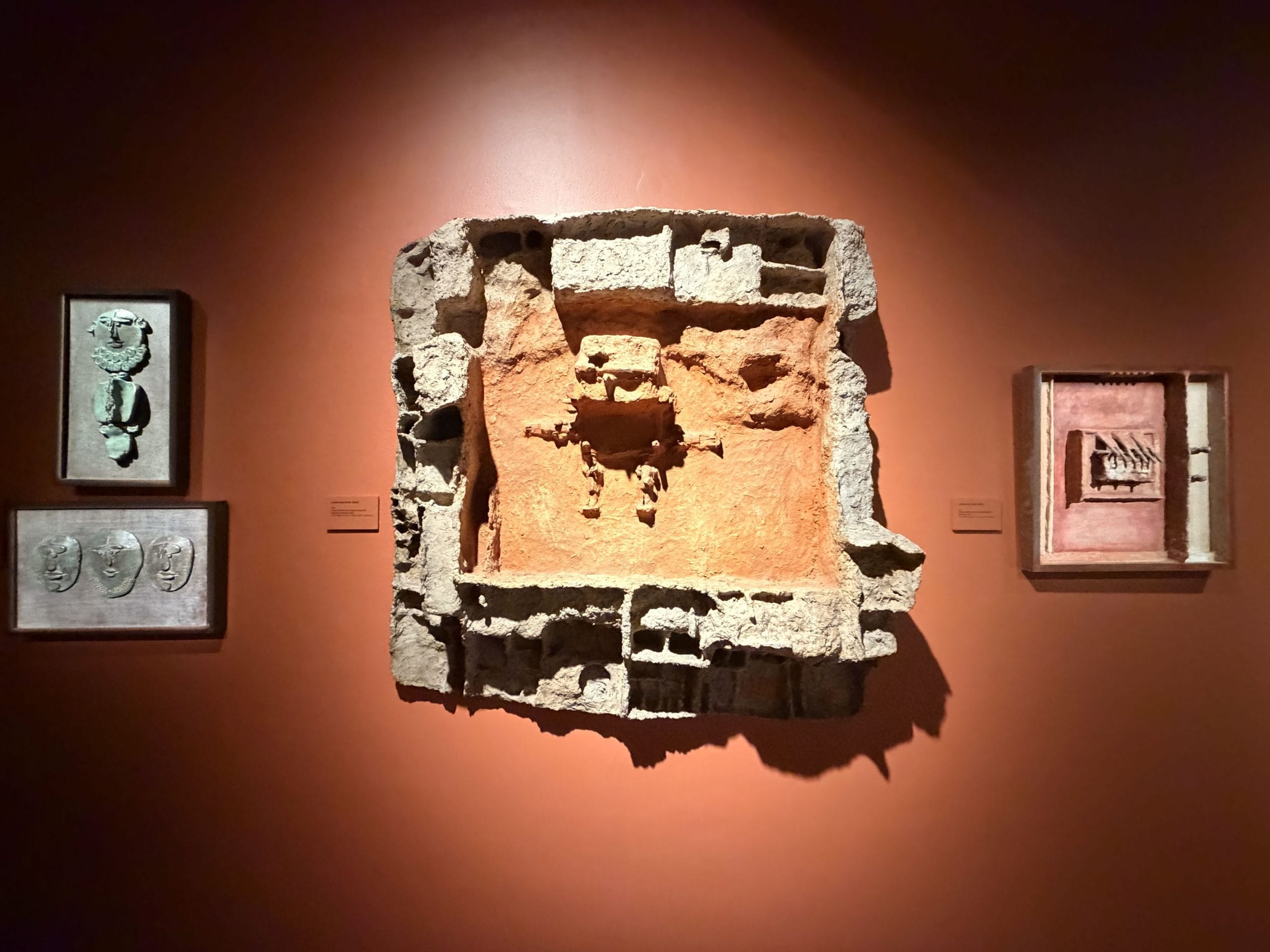
Jeram Patel’s charred wood carries the grain of the blowtorch up close, a texture no photo can capture. Shanti Dave’s canvas looks less painted than dug up with lettering that is half-buried under wax. Himmat Shah’s paper collages sit in tight geometric blocks. GR Santosh’s painting glows gold against near-black.
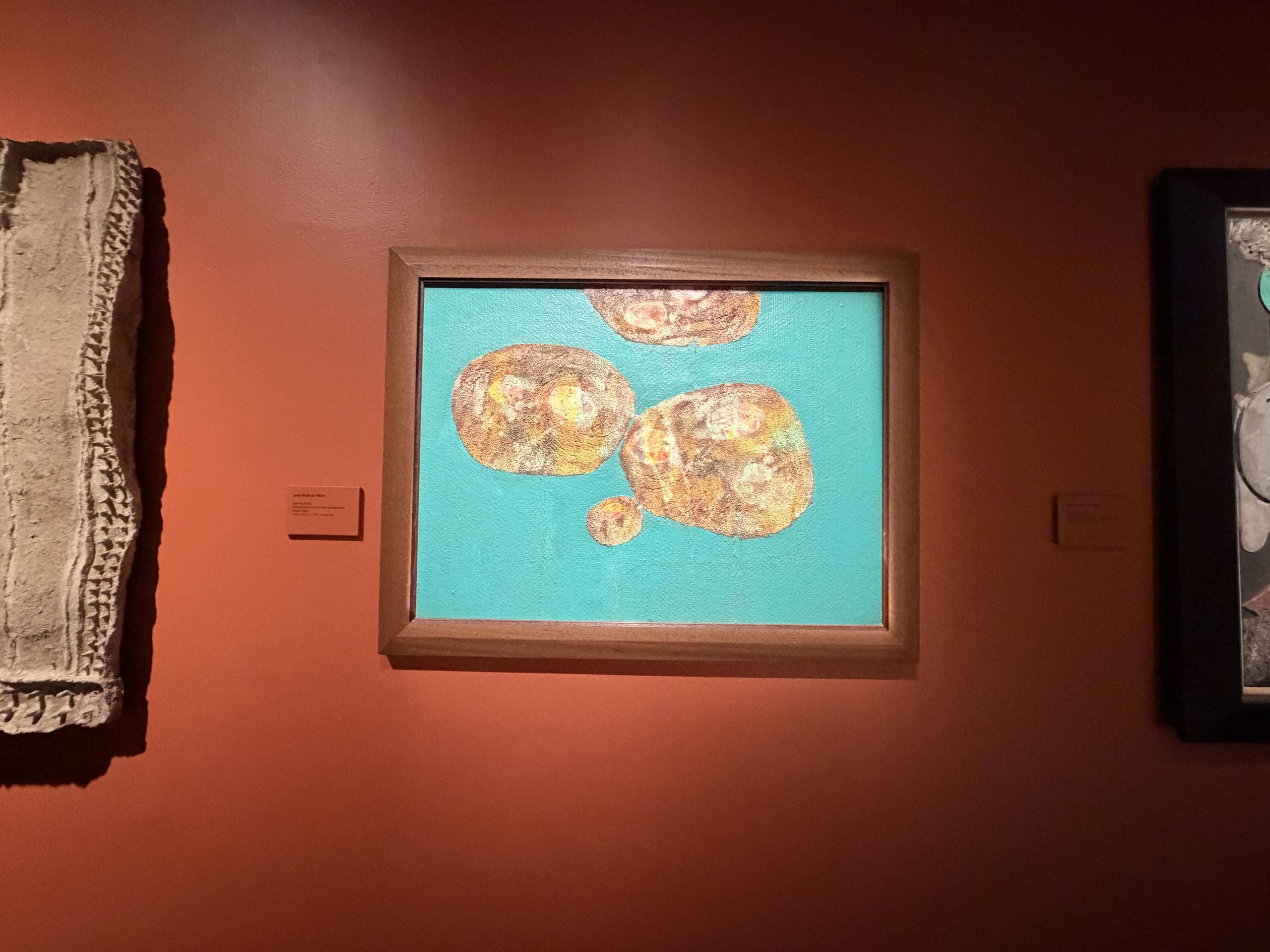
The wall text explains why the artists worked this way.
“By the 1950s, abstraction had become one of the most contested questions in Indian art,” it read.
KG Subramanyan, it says, was worried that Western-style abstraction risked becoming merely ornamental — form devoid of meaning.
Back then, the artists faced a contradiction. On the one hand they felt the pressure to remain distinct and not derivative of Western art, but at the same time there was an equal pressure not to be completely ignorant of what the world had to offer.
Patel’s scorched wood was his way to “make image from erasure”. Santosh pushed his geometry toward what the wall text describes as “the symbolic vocabulary of Neo-Tantra.”
What tied them all together was “an abstraction that was grounded — not decorative or borrowed, but rooted in surface, substance and place.”
Also read: India’s sticky problem with molasses. Old Monk that’s ‘not rum’, whisky that’s rum
A variety of moods
A few steps away, Bhupen Khakhar’s canvas is warmer and more domestic. It shows the everyday life of middle-class neighbourhoods.
The texts also describe the turning point in Baroda’s art.
“In the early 1980s Baroda turned towards a socially, politically and culturally specific visual language,” it read.
It credits the 1981 exhibition Place for People — with an essay by critic Geeta Kapur — as its “landmark statement.” Kapur had brought six artists together to argue “for a return to the figure, storytelling and the body,” a shift many now call “the shift from modernist to postmodernist practice in India.”
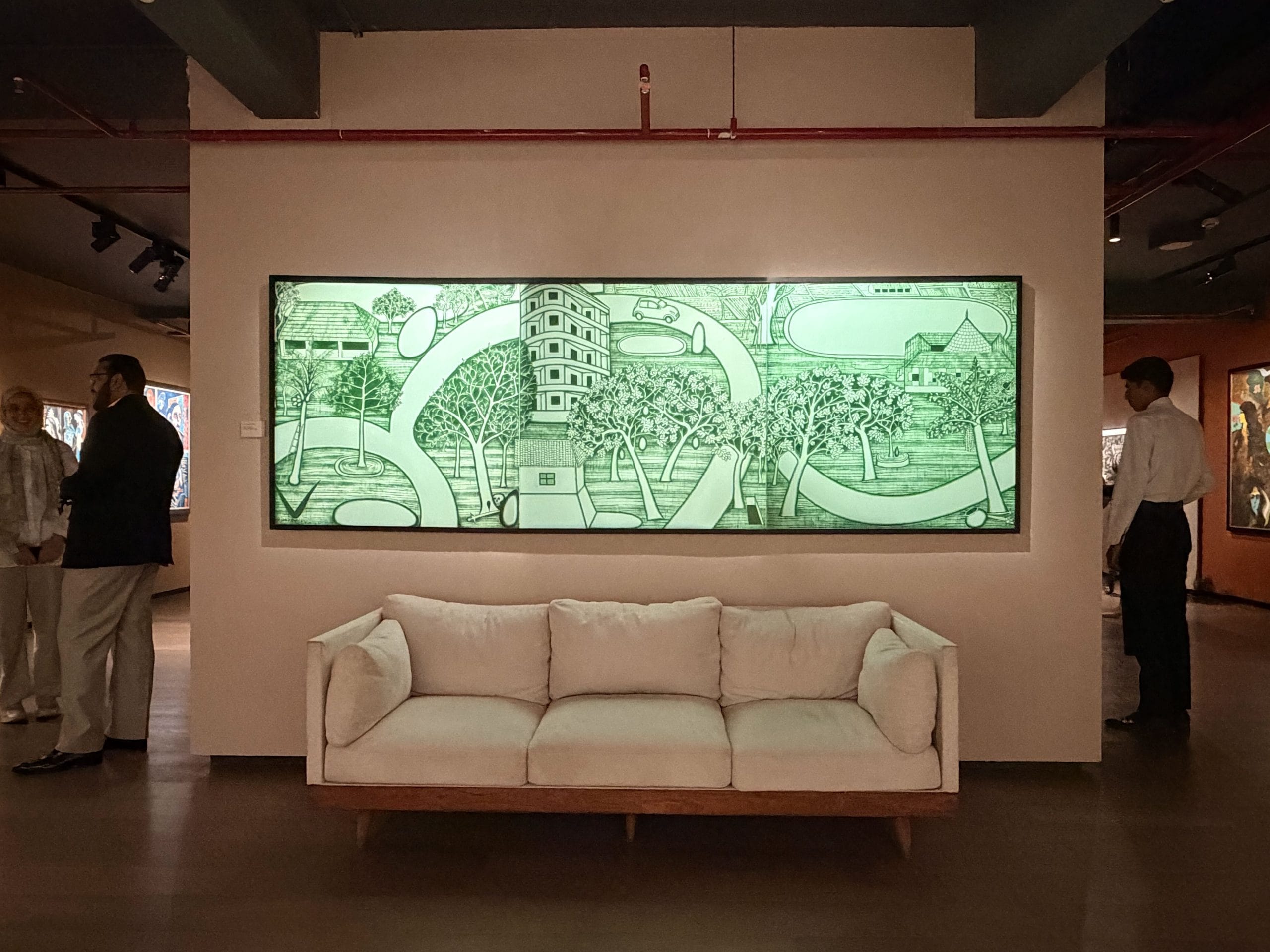
Along the same walls is Sheikh’s work, which dealt with “identity, community and the communal violence that scarred Gujarat,”, and Khakhar’s work which later turned toward “his own sexuality, candidly, on the surface.” Both artists, the panel says, belonged to a moment when “place and the personal became the two axes of their practices, now charged with social critique and a heightened political consciousness.”
By its final line, the text sums it up plainly:
“At Baroda, across generations, painting became an act of witness.”
At a walk-through of the show on Saturday morning, people kept coming back to how the exhibition avoids picking just one story to tell. It isn’t only the famous names like Subramanyan, Sheikh, Vivan Sundaram but there’s also Latika Katt, whose sculpture Sati is built from paper-mache and bamboo, and Pratibha Dakoji, whose etching is far less known.
After the walk-through, several people in the room discussed that mix of artists and their work felt deliberate: the show seemed to be as much about tracing mentorship inside Baroda as about celebrating its famous alumni.
But the underlying thread of the exhibit, not explicitly written anywhere, was glaringly evident for the keen eye: In Baroda, after the Partition, art was never really separate from politics. It was simply where politics became visible — in wood, brass, terracotta and paint.
(Edited by Janaki Pande)