



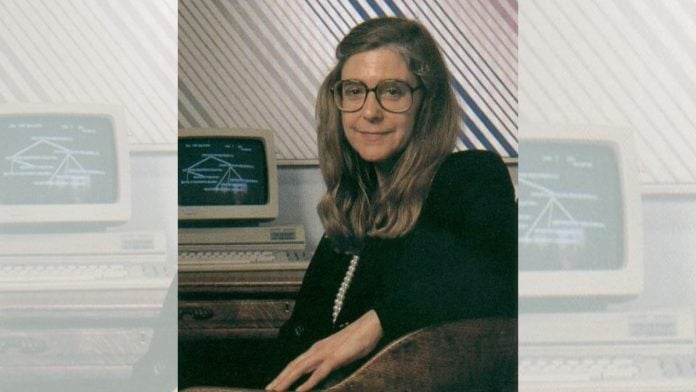
New Delhi: Margaret Hamilton, the software engineer behind NASA’s Apollo 11 Moon landing mission, died at the age of 90 at her home in Cambridge, Massachusetts, on 30 September.
A computer science stalwart, she is best known for leading the team of engineers that developed the on-board flight software for Apollo 11, the spacecraft that carried Neil Armstrong, Buzz Aldrin, and Michael Collins to the Moon in 1969.
Hamilton was working at the Massachusetts Institute of Technology (MIT) in 1965 when NASA contracted them to build the flight software for the Moon mission. She then led the Software Engineering Division of the MIT Instrumentation Laboratory that was working with NASA, becoming the first programmer to be hired by the team, as well as the first female programmer on the project.
The 29-year-old’s work on the Apollo mission was not just critical to the Moon landing, but also to the development of software engineering as a field. She is often credited with popularising the term ‘software engineer’, mentioning in various interviews that she wanted to bring the discipline its own ‘legitimacy’ through her work.
After the Apollo mission was successful, Hamilton stayed on at MIT for a few more years before starting her own software engineering company, Higher Order Software, in 1976. A decade later, she founded one more company called Hamilton Technologies, both based on the software principles developed by her during her time working on the Apollo project.
A scientist and entrepreneur, she also received the Presidential Medal of Freedom in 2016 from then-US President Barack Obama for her work on the Apollo 11 mission.
Also read: Michael Jackson’s iconic ‘Thriller’ jacket, moonwalk glove up for auction again
Hamilton’s computer engineering work
Born in Indiana in 1936, Hamilton studied mathematics at the University of Michigan for her bachelor’s, and then went on to work at MIT under meteorologist Edward Lorenz. Before she could go for her planned graduate studies at Brandeis University, she began working for MIT Instrumentation Lab, and then the Moon mission changed her career.
NASA contracted the MIT Instrumentation Lab, where Hamilton worked, to build the guidance and navigation system for the Apollo spacecraft. This meant everything from electrical and hardware components to the software system that would be the ‘brain’ behind the product — this is what Hamilton was building.
A now-famous picture from 1969 shows Hamilton standing next to a stack of papers and documents almost as tall as she is, showing the code she and her team had written for the lunar module and command module software systems.
She developed unique ‘defensive’ programming, which would detect an error in the system and correct it automatically, and worked on priority scheduling and fault handling in her software, knowing that Apollo 11 would not have a programmer nearby if something failed in the middle of the mission.
Her efforts came to fruition during a critical stage before the Moon landing in 1969, when the computer suddenly produced two alarms and was at risk of failure. However, Hamilton’s software design enabled the computer to respond to the alarm, and prioritise the important tasks at hand, shutting down other tasks to not overload the system.
It was during the Apollo mission work that Hamilton developed the Universal Systems Language (USL), a formal software language that became the basis of her products at her companies Higher Order Software and Hamilton Technologies. It taught engineers how to model a system before building it, and treat software as a part of systems engineering to reduce errors.
In one of her interviews in 2009, with MIT News, Hamilton fondly recalled her time working on the Apollo mission, with a team of young engineers in their 20s.
“We had to find a way, and we did. Looking back, we were the luckiest people in the world; there was no choice but to be pioneers,” said Hamilton.
(Edited by Aamaan Alam Khan)