





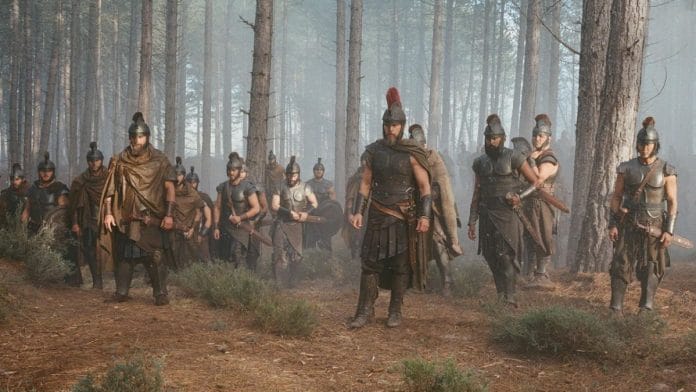


New Delhi: There is no denying that Christopher Nolan’s The Odyssey is the talk of the town. Quite apart from being a long-awaited film with a mega star-cast, historians and academics too are obsessed with the film.
Nolan’s film is an adaptation of the famous Greek classic of the same name by Homer. The Hollywood director is said to have based his film on Emily Wilson’s 2017 translation. It is not just the first complete translation of the epic by a woman into English, but is also a modern interpretation of the ancient Greek text.
An interpretation that scholars and armchair classicists are debating over.
Wilson’s translation
A dialogue from an early trailer for The Odyssey showed Telemachus, played by Tom Holland, using the word “Dad.” The internet quickly latched onto it, saying the word stood out in the ancient Greek setting.
That was only the beginning for what would turn out to be a moment in the sun for anyone who ever read the Percy Jackson series.
Anyone remotely familiar with Greek myths and legends, was contributing their two cents to the movie and to Wilson’s translation, which has since become a topic of conjecture.
The 2017 translation is clear, clipped and fast. It strips the ancient verse of its subtleties and simplifies the language for the modern reader.
However, supporters of Wilson argue that whether she uses modern terminology or Shakespearean it would make no difference, since neither is anywhere close to the ancient Greek. And so, to simply use the term “father” rather than “dad” would make no sense apart from it being more digestible to the reader because they are more familiar with such terms in an ancient setting.
Also Read: Before you watch Christopher Nolan’s Odyssey, here’s all you need to know
Previous translations
Before Wilson, Robert Fagles’s 1996 translation was considered the best for beginners. Fagle’s verse is dramatic with a cinematic feel to it.
For lovers of lyricism, Robert Fitzgerald’s version is better. The 1961 translation is musically haunting and comes closer to a classic epic rather than a modern novel.
Academics and scholars, however, prefer Richmond Lattimore. Lattimore’s 1965 is both structurally close to the original and considered a faithful line-by-line adaptation of Homer’s poem. It retains the repetitions and is written in free verse. It is often a staple for many undergraduate students.
Whereas those who prefer a more prose-like version often opt for EV Rieu’s adaptation. Rieu’s 1946 translation of the great journey birthed Penguin Classics. It is written like a novel and is easy to follow.