



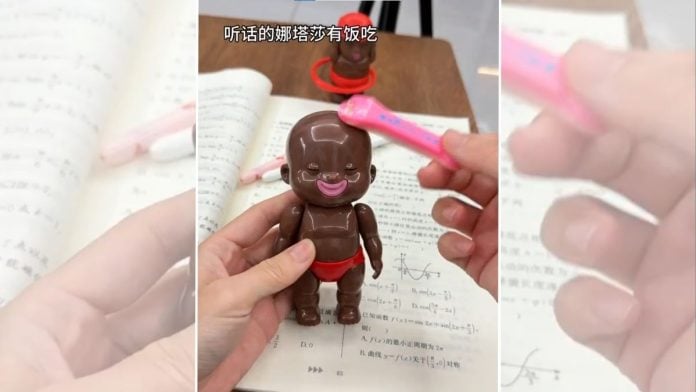
New Delhi: Dark-skinned baby dolls have ignited a fierce racism row in China after videos showing people squeezing, stomping, and stabbing the figures went viral on social media. Named ‘Natasha’ by the internet, the baby dolls are marketed as a ‘stress-relief toy’.
Made from slow-rising memory foam, the dolls resemble children and come in White, Brown, and Black colours. They are available on websites such as Taobao and first went viral after a vlogger nicknamed the dark-skinned version ‘Natasha’, a name that has since become synonymous with the trend, CNN reported. The toys have grown so popular that candy versions have now emerged.
But while all three dolls sit on the same shelves, only the Black one ends up on the floor, hurled against walls, run over by bicycles, flushed down toilets, and stabbed with needles. The Brown version appears occasionally in the footage, while the White one rarely does.
“Because the white one doesn’t have the same ugly vibe as this one. The selling point of one is that it’s ugly, abstract and interesting,” said a popular comment on Rednote as per the BBC Africa report. “The white one looks more human like, which makes people think of a baby, and it feels depressing, so it definitely won’t sell as well as the black or brown ones. Babies aren’t usually this colour, so it feels more like a toy to play with.”
The comments drew instant condemnation worldwide.
“They could have made the dolls green or red. Any other colour,” one Instagram user wrote. “They know what they are doing.”
‘Dehumanisation is not a trend’
The controversy is the latest in a long history of racism in China. In 2016, a television advertisement for detergent brand Qiaobi drew global outrage after depicting a Black man being pushed into a washing machine and emerging as a lighter-skinned Chinese man.
Four years later, during the Covid-19 pandemic, African residents in Guangzhou reported being evicted from homes and refused hotel accommodation. The incidents prompted protests from several African governments, while Human Rights Watch described the treatment as a “textbook case” of discrimination.
While the China Consumers Association and State Administration for Market Regulation have stepped in to remove violent videos, Natasha was still available for sale on Taobao.
China’s government has since issued a warning that selling the dolls in their current form may violate existing laws, and authorities have begun inspecting outlets near schools where the toys are being sold.
Monique Franz, a writer and founder of Kinsman Avenue Publishing—a non-profit which advocates for underrepresented voices—told the Hong Kong Free Press that the doll’s design exists within a long tradition of dehumanisation.
“No design is created, marketed, and sold in isolation of thought and purpose,” Franz said. “The design, manufacturing, and selling of a Black baby doll to abuse at one’s whims is at the root of the existence of movements like Black Lives Matter.”
According to her, the trend is much more than an innocent game.
“By inviting people to take out their stresses on a Black body, we invite populations to abuse our Black bodies at their whims, robbing us of our actual humanity. While this is a game to others, Black people are experiencing widespread global abuse, which is the result of portrayals of us in such degrading ways.”
(Edited by Prasanna Bachchhav)
Also read: Denmark set to to ban azaan—it fears turning into Islamabad