





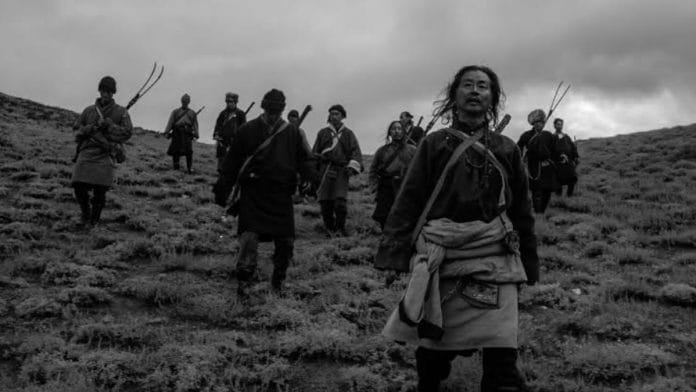

Director Shenpenn Khymsar knew that he wouldn’t be able to get the Nepal government’s approval for shooting Four Rivers Six Ranges, the film based on the journey of Tibetan resistance fighters who helped the Dalai Lama escape Tibet in 1959. So he wrote a fake script called The Himalayan Robin Hood.
“The Nepal government does not allow anti-China activities because of heavy pressure from China. A film like this should have taken 45 to 60 days to shoot, but I shot the entire film in only 19 days,” he told ThePrint.The film is now set to release in India on 11 September.
While the film was shot in just 19 days, Khymsar began working on it in 2008. He spent years researching the Dalai Lama’s escape and the stories of the ordinary people who helped him, including members of the resistance group Chushi Gangdruk, whose descendants, he said, continue to serve in India’s Special Forces.
The film is also partly based on Flight of the Kuckoo’s Behest, a book written by his producer, Tenzin Dewatsang. Dewatsang’s father was among those who helped the Dalai Lama during his escape.
“I also got to meet a lot of the remaining warriors who were in their late 80s or 90s, most of whom have passed away now, as well as their family members,” Khymsar said.
A Tibetan story, resistance from China
Khymsar grew up watching the films of director Martin Scorsese, particularly Kundun (1997), which tells the story of the Dalai Lama. It was films like these that inspired the filmmaker in him.
“Four Rivers Six Ranges is almost like a prequel to Kundun because they’re connected, but my film is focused mostly on the warriors because they deserve this respect,” he said.
Chushi Gangdruk translates to “four rivers, six ranges”, Khymsar explained. The name referred to people from these regions who formed a resistance brotherhood against Chinese rule.
“They were given this name by a very revered Lama at that time, a monk who was the Dalai Lama’s teacher,” he said.
On 20 August, Chinese state-controlled media published an article attacking the film, arguing that Tibet (Xizang) had always been part of China. The State accused the filmmakers of deliberately rewriting the region’s history.
“Khymsar’s attempt to use his film as a platform for separatism is nothing more than an unfounded and ill-conceived narrative,” the article said.
Khymsar, who is Tibetan by ethnicity, said his grandfather moved to India decades ago. Born and raised in India, he has never been to Tibet and cannot travel there.
“To the Chinese government, apparently a simple ordinary guy like me, a filmmaker, is a threat,” he said.
Khymsar added that China’s reaction itself shows how sensitive the Tibet question remains. He argued that Beijing’s biggest concern is not the US or India but Tibet.
“Their biggest threat to the Chinese government is a simple monk. No, Tibet was never a part of China, and this film is proof that it bothers them,” he said.
He accepted the “anti-China” label on his film, but said that is precisely why Indians should know what happened during the Dalai Lama’s escape and the Tibetan resistance. With tensions between India and China over Arunachal Pradesh and Ladakh, he believes such stories are important for India’s sovereignty and security.
“It’s very important for the sovereignty and security of India to be aware of the contribution of Four Rivers Six Ranges,” he said.
Also read: Amrita Pritam was a lifelong romantic. Faiz felt her poems in his soul
Filming with a tight budget
Nawazuddin Siddiqui has lent his voice to the film’s narration. Khymsar has known the actor for nearly eight years after Anurag Kashyap introduced them on the set of Sacred Games (2018).
“Nawaz knew I was making this film, and when I showed him the rough cuts later, he was blown away and said he had goosebumps,” he said.
Khymsar and Siddiqui are also developing a film titled Karna: Running to Stand Still, which Khymsar will direct, and Siddiqui will star in. He recalled that while they were dubbing Four Rivers Six Ranges in Mumbai, Siddiqui himself offered to record the narration.
“Nawaz said, ‘Chal main karta hoon yaar, koi baat nahi,’ and he just knocked it off. I am forever grateful, and I want to repay him by making sure I direct him in one of the best films he’s ever done,” he added.
The film was shot under difficult circumstances, with a tight budget, limited time, and surveillance. Khymsar said he received crucial help from cinematographer Brandon Lee Cox. The two decided not to use artificial lighting and instead shot the entire film using natural light, much of which they created and controlled themselves.
Khymsar had initially wanted to bring an action director from South Korea on board but was forced to abandon the idea because of the cost.
“I went to Seoul, but their action budget was bigger than our entire film’s budget. Disheartened,” he said.
It wasn’t so much of a setback. Khymsar eventually prepared himself for the role and became the film’s action choreographer. He also took on the responsibility of training the actors in horse riding.
“We couldn’t afford a horse wrangler either, and none of my actors knew how to ride, so I taught them myself since I’ve been riding for a long time,” he said.
The actors Tenzin Dhondup, Thupten Chukhatsang, Tashi Kalden, Tenzin Jigme and Tamding Tsetan had only seven days for a location workshop. Nobody was allowed to shower until filming was finished, in an attempt to maintain as much authenticity as possible.
(Edited by Ratan Priya)