



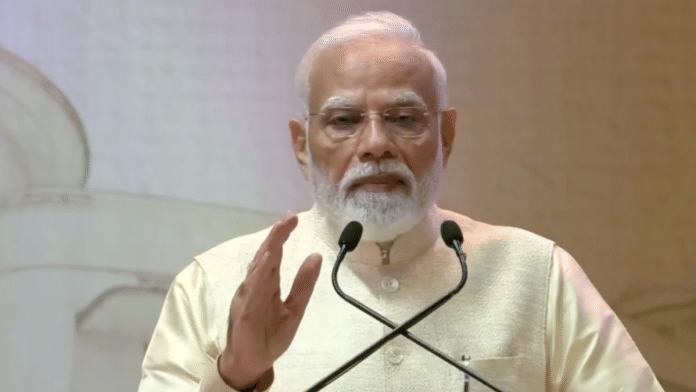
New Delhi: Prime Minister Narendra Modi attended an event to mark the 100th anniversary of the Union Public Service Commission at Bharat Mandapam on 1 October. He released a book on a hundred landmark decisions related to the commission, and also a commemorative coin and a special postage stamp to mark the UPSC’s centenary.
During his speech, Modi spoke about freedom fighter Subhas Chandra Bose appearing for the UPSC exam in 1920 and writing the paper in Sanskrit.
While visiting the gallery at Bharat Mandapam in New Delhi, PM Modi came across a display on Bose that mentioned he had appeared for the UPSC examination.
“I had the opportunity to look at a small gallery. I would urge all of you to visit it as well. So many people have been part of this journey, who have transformed the institution over time and taken it to new heights,” said PM Modi while talking about UPSC and its legacy.
“While I was looking at the gallery, I noticed that Subhas Chandra Bose had also appeared for this examination in 1920. The British were in power at the time, but he wrote the examination in Sanskrit,” PM Modi added.
“Friends, on this historic occasion, I would also like to remember Sardar Vallabhbhai Patel. After Independence, the challenge before him was not merely to secure freedom for the country, but also to run the nation. For the reconstruction of the nation, there was a need for a ‘steel frame’, and Sardar Vallabhbhai Patel gave that to the country,” said Modi, adding that Patel made UPSC a pillar of independent India.
The Prime Minister further said that when the foundations of the UPSC were laid in 1926, the priorities of that time were different.
“When the country became independent, the dreams and institutions of a free India became central. Over the decades, the UPSC has discharged its responsibilities well,” he added.
The UPSC conducts approximately 250 recruitment examinations each year, including engineering, medical, and defence. Its first chairman was Ross Barker (1926-32). The organisation has changed its name twice in 100 years. In 1926, it was named the Public Service Commission; then in 1937, it was renamed the Federal Public Service Commission. After the Constitution came into effect in 1950, it was renamed the Union Public Service Commission.
(Edited by Insha Jalil Waziri)
Bose was not just another freedom fighter or political leader.
He was an intellectual – much more so than Nehru. Nehru was an Anglophile who ‘discovered India’ quite late in his life.
Bose knew India before he got to know the world – always considered Swami Vivekananda his idol.