





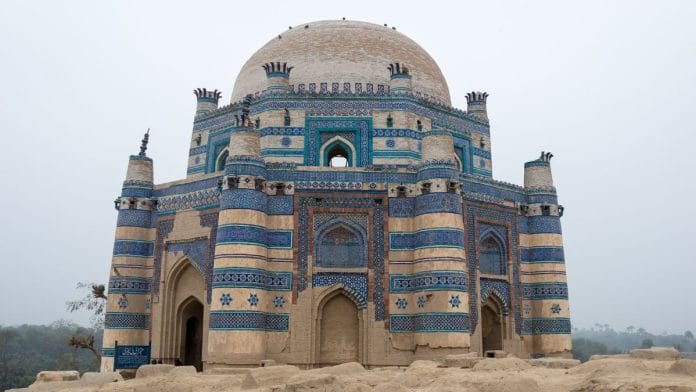


New Delhi: It is World Heritage Day, and though it is difficult to explore heritage in the face of international borders, it’s hardly the case when one travels on Google Earth. It was during one such session of trespassing across the frontiers on the internet that the question first occurred to me: Why is Pakistan home to some of the most exquisite azure and cobalt-blue glazed tile monuments, so reminiscent of the structures in Western and Central Asia as well as along the Silk Road, while Delhi, once the imperial centre that commissioned them, offers almost no comparable structures of its own?
You might be tempted to say, “But there’s Sabz Burj in Delhi!”, or the weatherbeaten Nila Gumbad inside the Humayun’s Tomb complex, or even cite the out-of-bounds tomb of Jamali-Kamali inside the mosque at Mehrauli Archaeological Park in defence of Delhi. However, these are hardly a match for Pakistan’s trove of blue-tiled monuments.
For those confined by borders and uninitiated in the benefits of Google Earth, not only does Pakistan have a dense accumulation of these blue monuments but they are also closer in spirit to the Western and Central Asian monuments than what we have in Delhi.
An architectural puzzle
To give a few examples, in Pakistan, one encounters the Tomb of Shah Rukn-e-Alam, which is on the UNESCO World Heritage Site Tentative list, alongside the Shrine of Bahauddin Zakariya and several cognate structures in Multan; further south, the ensemble of monuments comprising the Tomb of Bibi Jawindi, tomb and mosque of the Central Asian Sufi Jalaluddin Bukhari, and the tomb of Baha’al-Halim near Uch Sharif, also listed on UNESCO’s Tentative List are found; in Lahore stands the Wazir Khan Mosque; in Sindh, you may find the Shah Jahan Mosque, also known as Thatta Mosque, again on the UNESCO Tentative List since 1993; not to forget, the Makli Necropolis, a full-fledged UNESCO World Heritage Site inscribed in 1981.
The look of these monuments raises an obvious question: why does Pakistani architecture lean so unmistakably toward a distinct Persianate aesthetic, while Delhi, once part of the same cultural fabric, is dominated by red sandstone structures? To get some clarity to this architectural puzzle, a paper published in the Journal of Archaeological Science in September 2014 offers a good starting point.
The paper examined glazed tiles used on Mughals monuments in North India during the reigns of Akbar and Jehangir. These tiles were part of a collection that had fallen off the buildings chiefly in and around the Nizamuddin precincts. Through chemical analysis of the tile fragments, the study concluded that the tiles used in Delhi had “indigenous characteristics”. They were made using “materials and technologies of local traditional glass manufacture” and differed vastly in their chemical composition from those of Islamic lands.
In contrast, the tiles associated with Lahore “bear technological similarities with contemporaneous Western and Central Asian tiles”. On the other hand, the tiles on Delhi’s Mughal monuments revealed that “although the bodies of these tiles are similar to their counterparts from central Islamic lands, their glaze compositions are notably different, having a character that is typical of Indian or South Asian archaeological glass.” So, even as there was an emigration of architects and craftsmen from Iran and Central Asia, it appears that the work being done in Delhi followed the inherent local technique and skill that was prevalent.
Furthermore, it was found that while Delhi’s tilework was restrained, used sparingly to highlight and embellish architectural features, prioritising the design of the building itself, Punjab’s (especially Lahore’s) tilework was more lavish with a probable precedence given to colour and visual impact over the building’s form. Overall, “Delhi and Lahore were seemingly independent centres of production, with established workshops manufacturing tiles meant primarily for local or at most regional consumption”, with the former using locally available materials such as glass from Firozabad and cobaltite from Khetri in Rajasthan. The Mughal-glazed tiles, although Islamic in their character and tradition, were equally well attuned to local production.
Now, even as the paper cleared up a good deal in the nature of material usage, technological and stylistic divergence, and regional split in production and craftsmanship within the Mughal world, much still remains unresolved. The most pressing query is this: what prevented the Mughals, who descended from Western and Central Asia and held their culture and architecture in high regard, from carrying more of that Persianate blue to Delhi and Agra, the very heart of their power? Naturally, one might be within reason to point out cost and material constraints. Yet for an empire which, at its height, presided over an economy that accounted for about 25 per cent of the world economy, such architectural rigours are not altogether inconceivable.
Posed with this question, historian Swapna Liddle suggested that the answer has little to do with aspiration and more with circumstances. Tilework, she noted, was neither easily available in the doab nor simple to produce: it posed technical impediments in a region where the local craftsmen were far more familiar with stone than with glazed tile. Following this, the preference for stone seems less as an absence of intent than a matter of practical logic, especially when one considers the scale and refinement achieved in structures like the Qutub Minar and the Humayun’s Tomb. As she put it, “if you’re getting good material, the craftsmen are also there, why bother doing something which you used to do in your homeland but is not practical here (in Delhi)?”
Crucially, Liddle was careful to point out that the blue glazed tile and red sandstone dichotomy also has exceptions. Just as Delhi has the Sabz Burj, Lahore offers its crossovers in the form of the Badhshahi Mosque from the time of Shah Jahan, which draws clear inspiration from Delhi’s Jama Masjid, she observed.
Also read: Delhi exhibition brings together North and South India—through devotional art
‘Mughal architecture’
A conversation with historian Sohail Hashmi complicated just as much as it cleared the picture. Hashmi, echoing Liddle, argued that “you build with what is available”, reducing what is often framed as aesthetic choice to logistical common sense. However, the fallacy of the question of why Mughals did not build cobalt blue tile monuments in Delhi begins to unravel as Hashmi said that the idea of a cohesive “Mughal architecture” is false, and that it is more of a “creation of English scholarship” designed for clear classification of a multi-directional and non-linear reality. What is commonly understood as ‘Mughal architecture’, he pointed out, is less a fixed and distinct style and more a series of regional adaptations, shaped by climate, craft traditions, and the availability of materials.
He elucidated this using two examples. First, he cited Bengal as an example where the absence of sandstone and marble nearby produced yet another architectural language. Secondly, the historian related the example of Kashmir, where timber was plentiful and snowfall heavy, and mosques took on sloping, pagoda-like roofs — such as at the shrine of Shah-e-Hamadan — with no domes or minarets in sight. “Architecture is determined by the weather,” said Hashmi, “and the climate, and the materials available, not religion. Therefore, there is no such thing as Islamic architecture.”
Thus, all in all, it appears that the presence of blue-tiled architecture in modern-day Pakistan and its relative absence from Delhi and environs has more to do with availability of materials, weather, craft, traditions, and supply chains rather than any imperial preference. The imperial aesthetic and ambition is only the chassis, the blueprint of the building; what follows thus, in terms of embellishment and design, is a matter of pragmatism. In this light, what is often perceived as a unified “Mughal style” or “Islamic style” instead emerges as a constant dialogue between highly regionalised, jagged, and adaptive practices, where imperial designs and ambitions are undergirded by local craftsmanship and contingencies.
(Edited by Aamaan Alam Khan)