



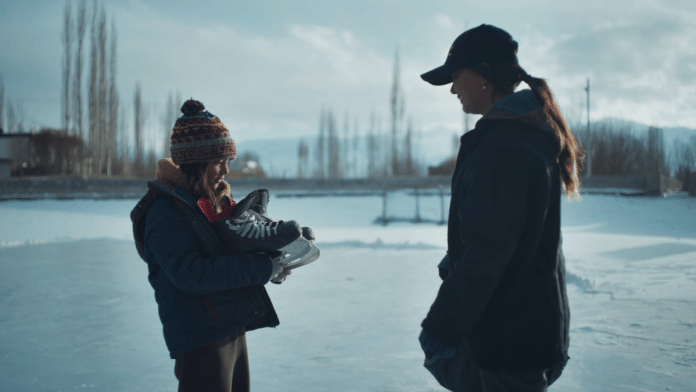
Mumbai: In 2016, filmmaker Sahil H Shah travelled to Ladakh for the Chadar Trek, one of the country’s most challenging and extreme winter expeditions. The people, the landscapes, and the ice hockey on frozen ponds soon made him fall in love with the place. He began returning every winter, meeting players, watching matches and documenting their lives. Ten years later, those visits resulted in Birds on Ice, a Ladakhi-language film that recently had its world premiere at the Busan International Film Festival.
Speaking to ThePrint immediately after the premiere, Shah, screenwriter Shaan Pasricha, producer Tanvi Agarwal and national women’s ice-hockey player Padma Chorol, who makes her acting debut in the film, discussed how the lives of Ladakh’s ice-hockey players turned into a film about dreams, family and everyday life.
Birds on Ice follows eight-year-old Tashi, who lives with her grandfather and wants to play ice hockey. Her friendship with her best friend Norbu, her relationship with her grandfather and the people who help her play the sport gradually become as important to the story as hockey itself.
Making Birds on Ice
It wasn’t the game itself that drew the filmmaker’s attention.
Shah’s interest in the sport began with the conditions in which people played it.
“What excited me most was when I saw a few players playing pond hockey. That visually was really, really stunning,” he said.
As he continued visiting Ladakh, he soon became interested in the players beyond the ice rink. He got to know their families, their difficulties and their relationships. By the time he was ready to make a film, he wanted to tell the story of the players and not the sport.

But this came with its own set of challenges for Pasricha, who was unfamiliar with Ladakh and ice hockey when she was approached by Shah to write the screenplay. She travelled to the region with him, expecting to find the conflicts around which they could build a story. Instead, she was struck by how people looked out for one another.
“We kept looking for conflict, but actually what we took back was community and kindness,” she said.
Soon she was able to see what Shah had discovered: the community, and it became a central part of Tashi’s story. But Pasricha also drew from her own life to write the relationship between Tashi and her grandfather.
She was around 12 years old when her paternal grandparents died. Pasricha remembers seeing her father cry, saying that he was now an orphan. She held his hand, trying to comfort him.
“I just held his hand. I remember that feeling that, you know, you don’t have parents. ‘It’s okay, I’ll be your parent,’” she recalled.
Years later, that memory became a scene in which Tashi tells her grandfather that he is now like a child.
Also Read: ‘Kasab called me badshah’—Ujjwal Nikam on Prahaar, the 26/11 trial & being a ‘gunehgaar’
Discovering a new world
The filmmakers also had to navigate a way to tell a story set in a world they were still getting to know. One of the first questions was whether to make Birds on Ice in Hindi or Ladakhi.
For producer Tanvi Agarwal, the answer became clear during the team’s visit to Ladakh.
“As soon as we went there, it was a no-brainer. We have to make it in Ladakhi because it’s how they communicate, how they emote,” she said.
The decision also meant finding a cast that could bring that world to the screen. For Tashi and Norbu, the filmmakers approached Arts in Motion, a dance school in Ladakh, where they found Samzang Skitdon and Kunga Choskyab. Shah wanted children who were comfortable with physical activity and could learn to skate.
Shah was particular about casting an actual ice-hockey player as Paami, a national-level player who coaches children. The role went to Padma Chorol, a member of India’s national women’s ice-hockey team.

During preparations for the film, Shah attended a match in which Chorol’s team was trailing 2–0. She scored a hat-trick to win the game 3–2. The filmmakers had recorded the match, and the winning goal even features in Birds on Ice.
“When you watch Padma move on the ice, it really feels like a bird is flying,” Shah said.
But Chorol had more in common with Paami than ice hockey. In one scene, Paami confronts officials over the shortage of jerseys, helmets and skates, and asks for a rink to be prepared before the ice melts.
For the 32-year-old, the scene brought back memories of the difficulties she continues to face as a player of a sport which is still finding its footing in India.
“When I first represented India, I was wearing two different pairs of skates because we didn’t have proper equipment,” she recalled.
The film also reminded her of growing up in Ladakh, where children play hockey on frozen lakes.

“Kids in Ladakh, they love this sport. We play on natural ice, on lakes. So the lake is almost full of kids who love this sport,” she added.
Chorol had never acted before, and initially found it difficult. But Shah encouraged her to remember her own experiences while performing, particularly during scenes dealing with the shortage of equipment.
“Every emotion and every struggle in the film is real. It mirrors my experiences,” she said.
Also Read: 3 Mangalore friends, Carnatic roots & many wedding gigs—the making of indie pop band Curry
No mountain too high, nor valley too low
The filming, like the story itself, was filled with highs and lows. Managing the stark, sweeping terrain of Ladakh was no easy feat.
Despite temperatures as low as minus 20 to minus 25 degrees Celsius, with children, animals and crew members from both Mumbai and Ladakh, the camera kept rolling.
Aggarwal recalled one night when they were filming inside Tashi’s house. At around 9 pm, they broke for dinner. The food had been laid out outside, but just as the crew stepped out, heavy snow began falling.

_lifeofpiee
Three members of the lighting team immediately brought out cutters, used to control light on set, and made a canopy over the food. Everyone then sat outside in the snow, eating steaming hot rajma chawal.
Agarwal recalled looking around and seeing the entire crew working together, with people stepping in to help wherever they were needed.
“There was no ‘This is that one’s job,’ or ‘I’m only supposed to do XYZ,’” she said.
The same sense of community that Pasricha had found during her recess to Ladakh had become part of the experience of making the film.
For Chorol, watching Birds on Ice at Busan was emotional. She had travelled internationally as an ice-hockey player, but now she was watching a film in which she had helped tell a story drawn from her own life.

“Being an ice-hockey player, I’ve always thought about big dreams, about how I’m going to play. So this is something very new to me. It’s amazing. It really feels amazing,” she said.
Birds on Ice will have its Indian premiere at the Dharamshala International Film Festival later this month.
(Edited by Insha Jalil Waziri)