







New Delhi: After nearly four years of pursuing protection for Raniwas Mound in Bihar’s East Champaran district, the Archaeological Survey of India has initiated the process to declare the site one of national importance, ThePrint has learned.
The preliminary notification issued by the Centre paves the way for the Buddhist-era mound, located near the iconic Kesariya Buddha Stupa, to be added to the country’s list of centrally protected monuments. It marks a rare addition to the list, the push for which started in 2022, when ASI’s Patna Circle sent a protection proposal.
“The Central Government hereby gives notice of its intention to declare the said archaeological site and remains to be of national importance,” read the Gazette notification dated 8 June, accessed by ThePrint.
The process for the inclusion of a site or monument in the national list follows five steps: assessment and proposal, preliminary notification, public objections, evaluation, and review and final notification.
If no objections are received in two months, Raniwas Mound will be formally protected, paving the way for large-scale excavations that could shed new light on the Buddhist landscape surrounding the world’s largest stupa at Kesariya.
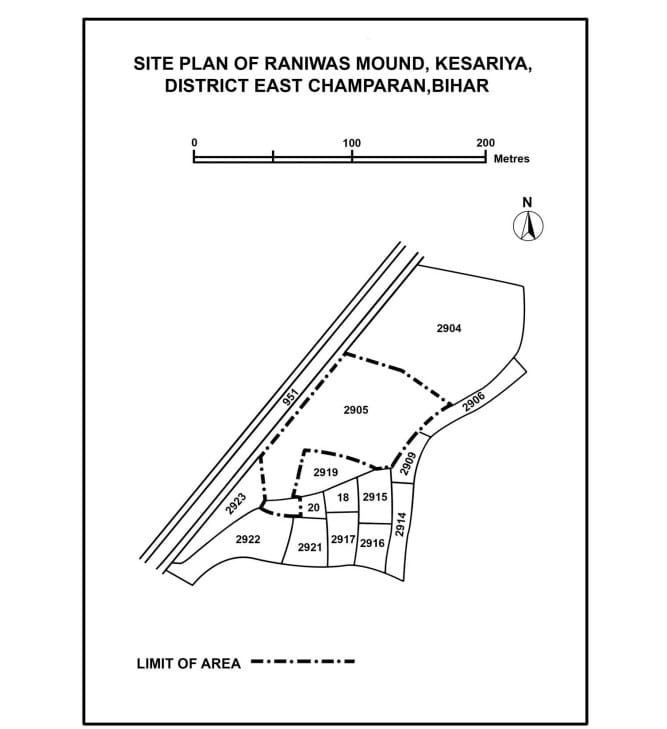
Situated northeast of the world’s largest Buddhist stupa, Raniwas Mound takes its name from local legends. The site is spread across 1.63 acres. Currently, the Bihar government owns the land.
“After this two-month period, if no objection is raised, ASI will release the final notification for Raniwas Mound and add it as a site of national importance. Then a large-scale excavation will be possible at the site,” said a senior ASI official.
Significance of Raniwas Mound
In 1861, when ASI’s first director general, Alexander Cunningham, visited the site, he explored the mound and conducted some excavations. In his report, he mentioned the existence of an old Buddhist establishment with a temple enshrining a huge image of Buddha.
“The excavations have disclosed the walls of a small temple, 10 feet square inside and the head and shoulders of colossal figure of Buddha, with the usual crisp curly hair. The mound which is about 200 feet square is called Raniwas. It appears to me to have been the site of a Vihara or Temple monastery, as portions of cells are still traceable on the eastern side,” Wrote Cunningham in his report titled Four Reports Made During the Years 1862-63-64-65.
Unlike the Kesariya Stupa, Raniwas Mound was not a centrally protected site. So Patna Circle started pushing for its inclusion in the national list, which currently features 3,686 monuments or sites across India.
However, in 2018, excavators dug a trench at Raniwas Mound and found evidence of walls, rooms, and corridors of a monastic structure.
“Cunningham also stated in his report that this Vihar must have some connections with the stupa at Kesariya. Our team wanted to find this Vihar and have finally been able to find its remains,” Gautami Bhattacharya, then head of the excavation branch of ASI in Patna Circle in 2019, told Hindustan Times.
The push for protecting this site started back then, but the formal proposal to ASI was sent in November 2022.
Based on the earlier excavation, Bhattacharya said the cells of the monastery are rectangular and have a beautiful gate and a pillared veranda with a courtyard.
Also read: Want to shoot a film at an ASI monument? New website makes it easier to get permission
Not an easy task
Bihar is home to 70 centrally protected monuments and sites under the ASI, which include Buddhist stupas, medieval mausoleums, and sites such as Nalanda, Vaishali, and Vikramshila.
The addition of a site to this list is not an easy task. In the last decade, few monuments have been added, as ASI has detailed guidelines.
The CAG, in its 2013 report, had noted that the culture ministry had not conducted any comprehensive survey or review for identifying monuments which were of national importance for inclusion in the list of centrally protected monuments.
In the 2022 follow up report, CAG said that during the period from 2013 to 2021, no comprehensive survey to identify monuments of national importance had been undertaken by ASI.
However, in 2024, ASI delisted 18 centrally protected monuments from its national list.
(Edited by Prasanna Bachchhav)