





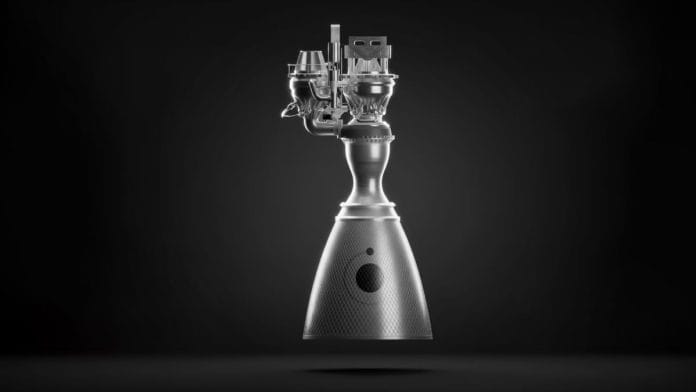


New Delhi: A Bengaluru-based space tech startup, Astrobase Space Technologies, is doing something that has never been done before in India. On Friday, the team will unveil the country’s first domestically integrated 80-tonne-class LOX-Methane Full-Flow Staged Combustion rocket engine. In fact, only SpaceX has ever managed to fly to space on an FFSC-powered rocket.
“Astrobase’s full engine design and manufacturing milestone has been unlocked, and is coming up this Friday. It has taken years of development efforts, including subscale and full-scale powerhead hardware hot-fire validations, to reach this milestone. Next stop — engine hot fire,” Astrobase Space Technologies co-founder Devakumar Thammisetty said.
ThePrint explains why India’s first privately built FFSC engine is significant and why space companies and agencies across the world have shied away from the technology until now.
The tech
The Full-Flow Staged Combustion rocket engine is one of the most advanced, high-performance liquid propellent cycles in aerospace engineering. What makes this technology so efficient is that it uses every bit of its fuel and oxidiser.
In a rocket engine, fuel and an oxidiser — usually liquid oxygen — is pumped into the combustion chamber at extremely high pressure. To power these pumps, the FFSC engine uses two preburners. One of the preburners burns a fuel-rich mixture and the other burns an oxygen-rich mixture.
The hot gases released from these preburners spin separate turbines that fire the pumps. Unlike traditional engines, where some of these gases are discarded after powering the turbines, the FFSC engine sends all of the fuel and the oxidiser through the turbines before they enter the main combustion chamber. This is why this type of engine is called ‘full-flow’.
The design is efficient because it does not waste any propellant.
The fuel and the oxidiser is split between two turbines, and each turbine operates under relatively lower stress, while still delivering very high pressure to the combustion chamber. The result is a rocket that produces more thrust with the same amount of propellant, runs cooler, lasts longer, and can be used multiple times.
While efficient, the technology is difficult to develop. One of the reasons behind its technical complexity is that it requires handling highly reactive hot oxygen gas, maintaining precise pressure and temperature inside two separate preburners, and ensuring that both the streams combine perfectly in the main chamber.
Breaking the glass ceiling
Based out of Bengaluru, Astrobase Space Technologies was founded only in 2024 by tech entrepreneur and IIT-Bombay alumnus Neeraj Khandelwal and a former propulsion scientist at the Indian Space Research Organisation (ISRO), Devakumar Thammisetty, who brings with him over 13 years of experience in cryogenic systems and rocket reusability.
The company said its mission is to “make space travel as routine as catching a bus.”
“Space is the next frontier for defence, manufacturing, and humanity’s expansion, and India needs reliable, frequent access now to lead beyond Earth,” the company website reads.
In September last year, Astrobase Space Technologies hotfired a sub-scale version of its FFSC engine to check its combustion stability and other technical markers. In January, it also conducted tests for its high-speed turbopumps.
The startup has facilities in Bengaluru and Anantapur in Andhra Pradesh to scale up the manufacturing and printing of parts for the 80-tonne engines.
Also read: Who’s Air India CEO Tewolde Gebremariam? He turned Ethiopian Airlines into a profit machine
FFSC use around the world
SpaceX’s Raptor is the only functional FFSC engine in the world to have actually flown to space. The engine uses liquid methane and liquid oxygen, and produces 230 tonne of thrust at sea level, and around 280 tonne in vacuum.
“The Raptor-3 engine represents the current state-of-the-art in SpaceX’s line of FFSC LPRE (liquid propellant rocket engine), capitalising on the successes and design heritage built by its predecessors as the engines which powered the reusable Falcon-9 rocket first-stage booster,” a 2025 analysis of the engine read.
Before Elon Musk’s SpaceX took up the challenge, the erstwhile Soviet Union had tried its hand at the FFSC technology in the 1960s with its RD-270. It was one of the oldest FFSC designs ever, but never flew despite clearing initial tests.
(Edited by Aamaan Alam Khan)