



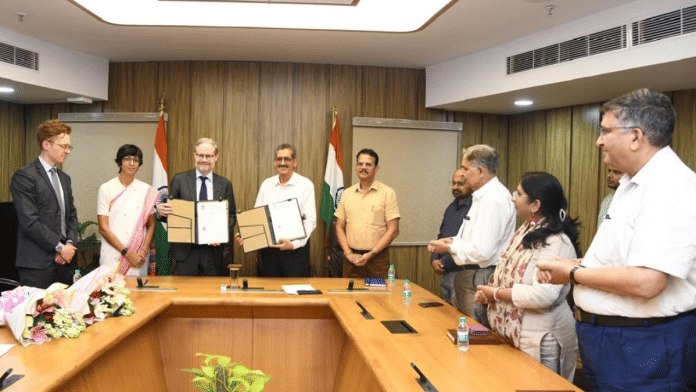
New Delhi: The Archaeological Survey of India has partnered with Denmark for a collaborative underwater archaeological project to locate and document the remains of the 17th-century Danish ship Oresund, which wrecked off the coast of India.
On 15 June, ASI’s Underwater Archaeological Wing (UAW) and the National Museum of Denmark signed an MOU in the presence of ASI’s Director General Yadubir Singh Rawat and Denmark’s Ambassador to India Rasmus Kristensen.
The Danish partnership marks the first time the UAW has collaborated with an international organisation since its inception in 2001.
“The sea does not recognise modern borders and neither does maritime heritage,” wrote Aparajita Sharma, who is in charge of the Underwater Archaeology Wing, in her Facebook post.
Finding Oresund
The Danish ship, Oresund, wrecked near Karaikal in Puducherry in 1619, shortly after its arrival in Indian waters. It was the first-ever Danish ship to reach the subcontinent.
“A shipwreck. Four centuries, one shared story. The Oresund is the first known Danish ship to have reached ASI, making it a landmark in the shared maritime history of both nations,” reads the Danish Embassy’s LinkedIn post.
Under the project, it will use advanced, non-invasive methods to locate and document the vessel’s remains, which will shed light on early trade, navigation and cultural exchanges across the Indian Ocean.
“.. an important archaeological resource for understanding the early maritime interactions between Denmark and India, as well as the broader history of seafaring and trade in the Indian Ocean during the early seventeenth century,” said Ministry of Culture in a statement.
The UAW has explored areas of Lakshadweep, Mahabalipuram, and Dwarka.
Around 2009, this wing went into abeyance because the ASI lacked expertise in this particular field.
Last year, the Modi government resumed its functioning and since then a small team of archaeologists led by Alok Tripathi conducted exploration off the coast of Dwarka.
Tripathi marked this as a historic event in a comment on the ASI DG’s Facebook post.
“For the first time, the Underwater Archaeology Wing has initiated International cooperation in the field of Underwater Archaeology in India. India has a great potential, and every investigation would add to our knowledge about submerged cultural heritage,” wrote Tripathi.
(Edited by Insha Jalil Waziri)