



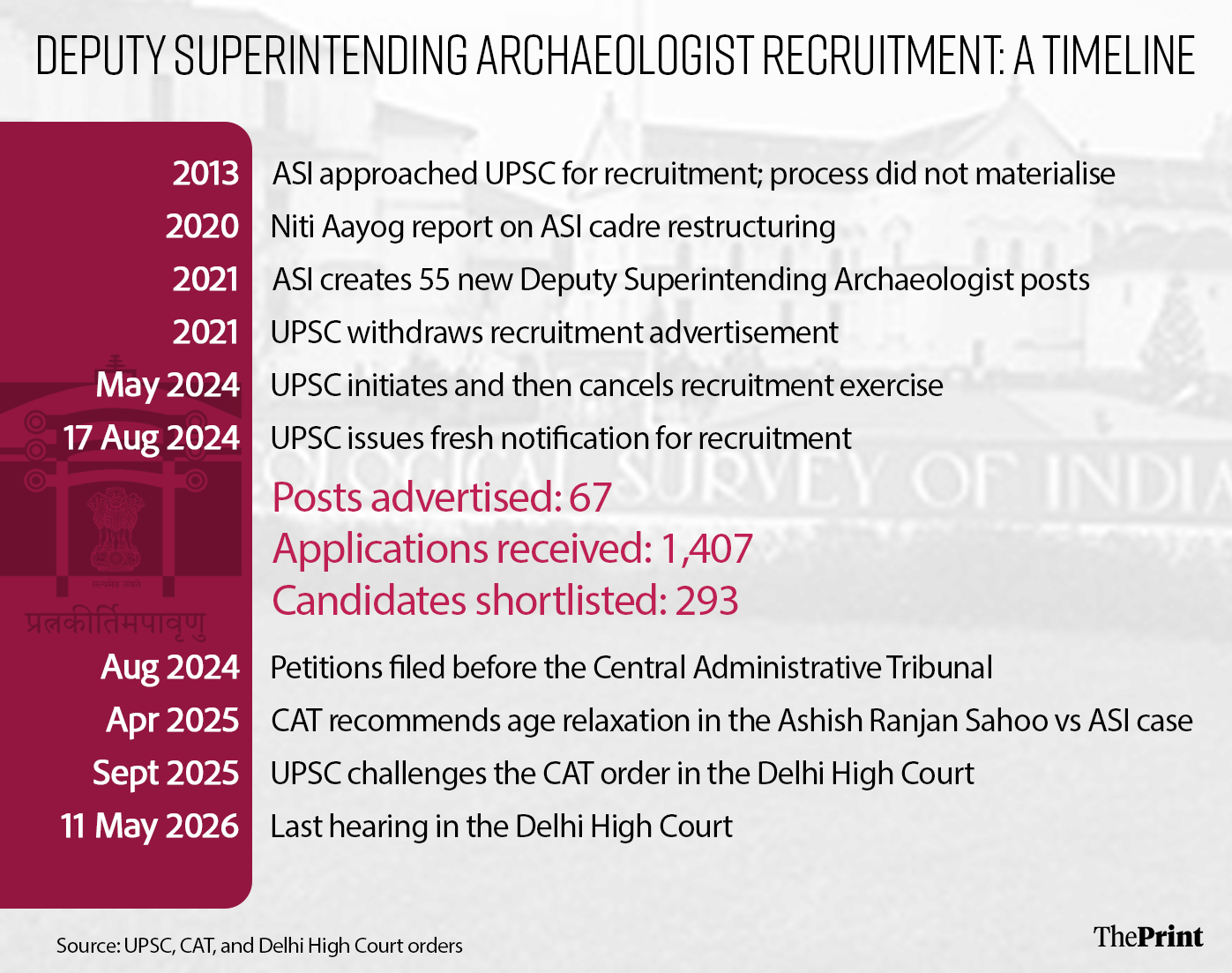
New Delhi: When the Union Public Service Commission advertised 67 posts of Deputy Superintending Archaeologists in August 2024, it was supposed to end a long wait that had stretched for more than a decade.
Instead, it triggered a fresh battle within the Archaeological Survey of India (ASI).
For archaeologists working in the department, the notification represented a chance they had already lost. By the time the vacancies, dating back to 2013, were finally advertised, many Assistant Superintending Archaeologists (ASAs), the feeder cadre for the post of DSA, had crossed the upper age limit for direct recruitment. They responded with petitions before the Central Administrative Tribunal (CAT), accusing the ASI of arbitrarily diverting posts that, they argue, should have been filled through departmental promotion.
“These posts were to be filled by departmental candidates who serve as an Assistant Superintending Archaeologist (ASA) as a feeder cadre. But ASI diverted these posts to direct recruitment which is arbitrary,” said an ASA in the ASI who challenged the recruitment drive in CAT in 2024.
Nearly two years later, the recruitment remains stuck in litigation. The deadlock has worsened an already acute manpower crisis in the ASI, where 2,646 posts are lying vacant nationwide. Of the 120 sanctioned posts of Deputy Superintending Archaeologist, 75 remain unfilled. These are the officials responsible for supervising excavations, conservation work, and the management of protected monuments across the country.
The 67 DSA vacancies advertised include 29 unreserved, 18 OBC, 10 Scheduled Caste (SC), six Economically Weaker Section (EWS), and four Scheduled Tribe (ST) posts.
These vacancies actually belong to the 2013 recruitment cycle. The ASI had approached the UPSC that year to initiate recruitment, but the process never started.
“For some reasons, it could not be done and since 2014, no proposal has been sent to UPSC. Due to this delay, applicants who are serving in the ASI are age barred and likely to lose their chance to compete under direct recruitment. So, they challenged the recruitment,” said a senior ASI official.
Ironically, even the 2024 recruitment drive was itself a consequence of litigation. The UPSC advertisement was issued after directions in the Alka Singh & Others vs Union of India case before the Principal Bench of the CAT.
The recruitment drew significant interest, with 1,407 applications received by the UPSC. Of these, 293 candidates have been shortlisted.
But the selection process has since been held up as multiple petitions seek to quash the advertisement, demand a fresh recruitment notification, and ask for age relaxation for departmental candidates who lost eligibility during the decade-long delay.
ASI officials say the department has little room to act while the matter remains sub judice.
“We have a dire need of staff at our different ASI circles as more than half of the posts of Deputy SA are vacant. But our hands are tied, too,” said the official quoted above.
The stalled recruitment is not the only hiring process caught in limbo. Earlier, ThePrint reported that the ASI has also delayed recruitment to 50 posts of Assistant Archaeologist advertised in 2024, further deepening the shortage of staff.
Promotion, age, and a decade lost
For the Assistant Superintending Archaeologists who have spent years working under the ASI, the fight is about more than just one recruitment notification. They say it is about losing a career opportunity while waiting for the government to act.
Soon after the UPSC issued the advertisement in August 2024, 11 serving ASAs approached the Central Administrative Tribunal, arguing that the recruitment had ignored the department’s own rules.
Under these rules, one-third of the Deputy Superintending Archaeologist posts are to be filled through promotion from the departmental feeder cadre, while the remaining two-thirds are meant for direct recruitment.
The petitioners contend that this balance was not maintained. But promotions are only one part of their grievance.
The larger concern, they say, is that the decade-long delay has effectively disqualified many of them from competing for the posts through direct recruitment. Having served in the ASI for nearly 10 years, several departmental archaeologists have now crossed the upper age limit of 35 years.
“We have been rendered over-age while working in the department and deserve age relaxation so that we can participate in the present selection process,” one of the applicants said.
The issue found some sympathy before the CAT. In the Ashis Ranjan Sahoo vs Archaeological Survey of India case, the tribunal observed that denying the applicants an opportunity to compete would cause them prejudice and permitted them to submit offline applications while the matter was under consideration.
ThePrint reached out to petitioner Ashish Ranjan Sahoo, but he declined to comment.
During the proceedings, the UPSC maintained that it merely acts on recruitment proposals received from the ASI and issues advertisements accordingly.
In an order passed in April 2025, the CAT went a step further, recommending that the UPSC grant age relaxation to the departmental candidates in recognition of the years they had already spent serving the ASI.
“Looking into the matter in its entirety, we are of the opinion that this is a fit case where the recommendations of the ASI… be acted upon by the UPSC by granting the applicants age relaxation… so as to enable the applicants to compete with freshers/outsiders,” the tribunal said.
The relief, however, proved short-lived.
Five months later, the UPSC challenged the CAT’s order before the Delhi High Court, arguing that it cannot grant age relaxation beyond what is prescribed in the recruitment rules or the recruitment advertisement.
The legal battle has once again put the recruitment on hold. The matter is pending in the Delhi High Court, with the next hearing scheduled for 15 July.
Also read: ASI digging Balirajgarh 4th time. Why Ancient Bihar is important to Modi govt
A courtroom battle
For many of the Assistant Superintending Archaeologists now challenging the recruitment in court, the story did not begin with the UPSC advertisement in 2024. It began more than a decade ago.
Most of them were selected as Assistant Archaeologists through a recruitment notification issued in 2009. But litigation delayed their appointments, and many could join the ASI only in July 2013.
They say that delay set off a chain of events from which they could never recover.
Years passed without recruitment to the post of Deputy Superintending Archaeologist. Then came another setback. Between 2018 and 2019, the ASI began revising its recruitment rules, putting fresh appointments on hold. Soon afterward, the Covid-19 pandemic further stalled the process.
By the time recruitment finally resumed, many of the departmental archaeologists had spent nearly a decade in the field and had crossed the upper age limit for direct recruitment.
The prolonged wait also coincided with a major overhaul of the ASI.
In 2020, a NITI Aayog report on heritage management flagged an acute shortage of manpower in the organisation and recommended restructuring the ASI to attract talent while addressing delays in recruitment.
“Induction of best of talents within the organisation with flexibility in engaging professionals,” the report said, adding that there was an acute shortage of “staff-lengthy processes for finalisation of recruitment rules”.
Following the report, the ASI undertook a cadre review to remove anomalies and improve career progression for its employees.
As part of the exercise, the sanctioned strength of Deputy Superintending Archaeologists was nearly doubled — from 65 posts to 120, in 2021, creating 55 new positions.
For serving archaeologists, it looked like long-awaited relief. But It never came.
An advertisement for those posts issued in 2021 was withdrawn. Another recruitment exercise initiated in May 2024 met the same fate. When a fresh notification was finally published in August 2024, it too became entangled in litigation.
The courtroom battle has since widened.
In a separate case, Smt. Alka Singh vs Archaeological Survey of India, 37 Assistant Superintending Archaeologists approached the Central Administrative Tribunal, seeking directions to the ASI to consider them for promotion and to set aside the recruitment notification.
Their argument is rooted in the 2021 cadre restructuring. Since the sanctioned strength of Deputy Superintending Archaeologists had increased substantially, they contend that the promotional quota should also have expanded proportionately instead of the additional posts being diverted to direct recruitment.
“The concept of lateral entry at the middle and senior level through direct recruitment has not worked properly in the ASI. Candidates selected through agencies such as the UPSC often lack the specialised field experience that the organisation requires,” said one of the applicants.
The petitioners argue that they have spent close to a decade with the ASI and working across the country, making them better suited for promotion than outsiders entering through direct recruitment.
According to the applicants, ASI officials had repeatedly assured them that the additional posts created during the cadre review would be filled through promotion.
“It is this diversion of posts from the promotion quota to the direct recruitment quota that we have challenged. The ASI has taken a complete volte-face,” said one of the applicants.
(Edited by Aamaan Alam Khan)