





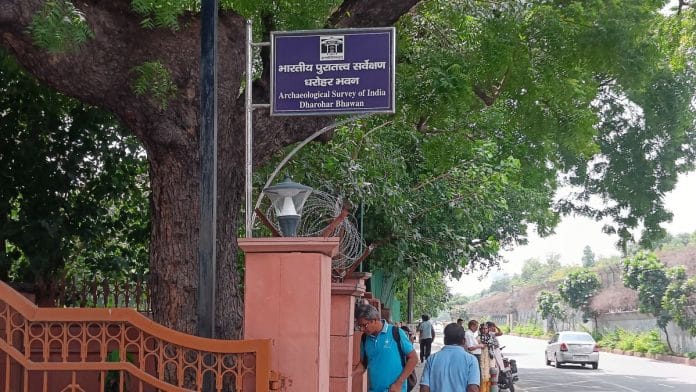


New Delhi: When over 200 young candidates walked into the Archaeological Survey of India headquarters in Delhi for document verification in April this year, many believed the finish line was finally in sight.
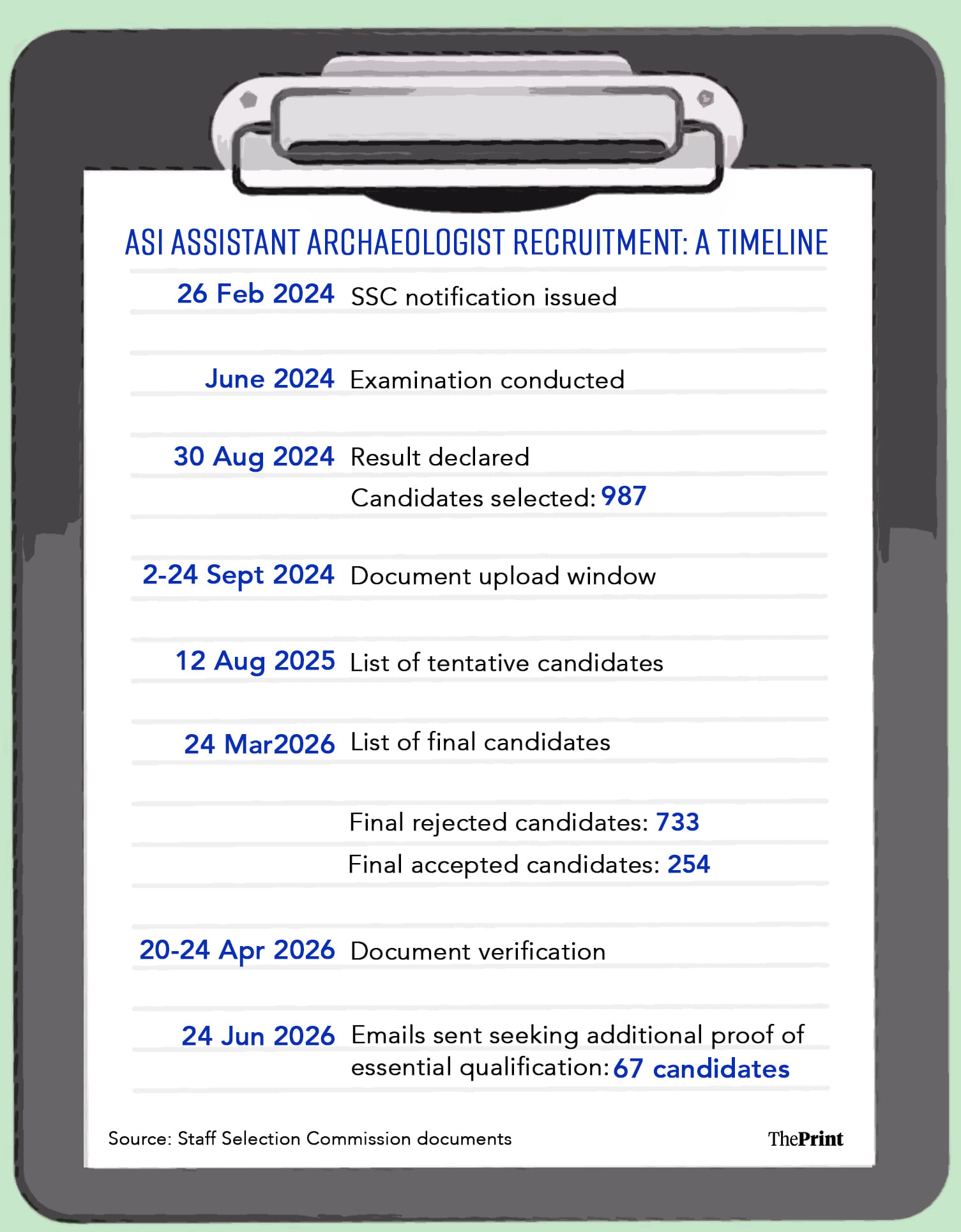
They had already cleared one of the toughest hurdles. The Staff Selection Commission (SSC) conducted the exam for 50 assistant archaeologist posts in June 2024, and the results were declared two months later. After nearly two years of waiting, repeated scrutiny of their qualifications, and multiple rounds of verification, the appointment letter seemed only days away.
What the candidates got was another disappointment in the form of an email.
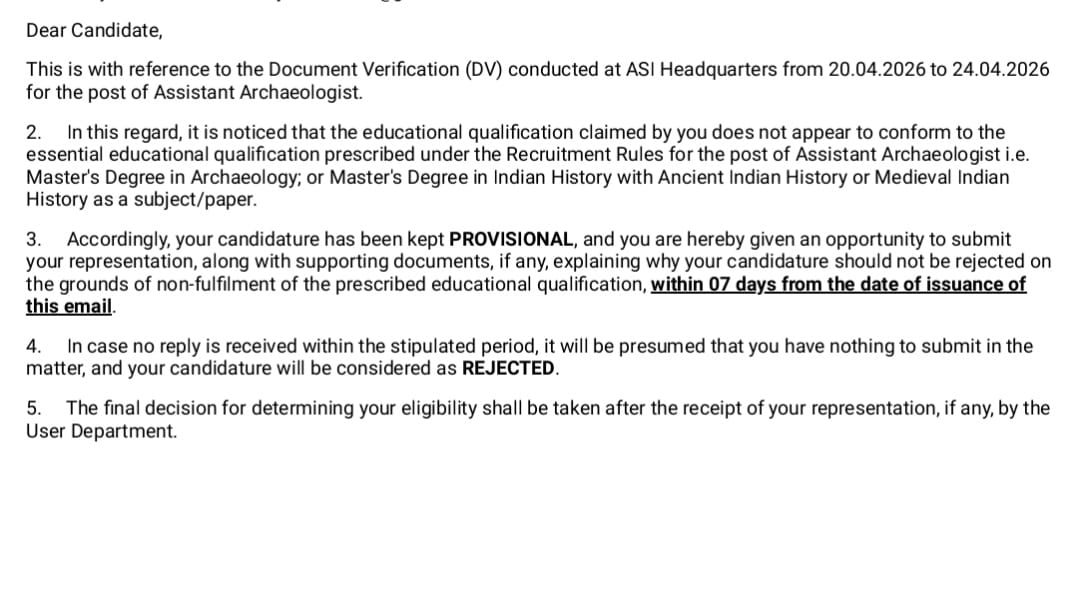
On 24 June, 67 candidates received a fresh communication from ASI asking them to prove once again that they met the essential educational qualifications (EQ) for the post. They were given just a week to submit additional evidence. For history graduates, the requirement has now narrowed down to only ancient and medieval Indian history, complete with specific definitions of what century medieval history begins. When the post was advertised and examinations held, the ASI did not communicate such details.
“It is noticed that the educational qualification claimed by you does not appear to conform to the essential educational qualifications prescribed under the Recruitment Rules for the post of Assistant Archaeologist,” read an email by ASI, accessed by ThePrint.
For many, the recruitment process refuses to end. The delay is triggering frustration among the 250-odd candidates who have endured repeated rounds of scrutiny and fresh demands to prove their qualifications. The aspirants accuse the ASI of shifting goalposts and adopting an overly technical interpretation of eligibility rules. The organisation, on the other hand, says the prolonged verification aims to correct years of recruitment protocol that allowed candidates without specialised archaeology backgrounds into the department—even as it struggles with thousands of vacancies nationwide.
The recruitment drive was conducted in June 2024 and the result released within two months. Since then, the ASI has released tentative and final essential qualification lists of rejected and accepted candidates through the SSC. But it has not finalised the 50 required candidates.
What began as one of the SSC’s quickest recruitment exercises—a duration of 6 months from advertisement to result as opposed to over a year earlier—has turned into one of its longest selection processes.
Out of a sanctioned strength of 150 assistant archaeologists across the country, 79 posts are vacant. The ASI is grappling with a severe staffing crisis. Out of a sanctioned strength of 7,585, 2,646 posts are vacant across the 38 circles of ASI.
Out of the 50 posts, 22 are for the unreserved category, 13 for OBC, seven for SC, five for EWS, and three for ST.
For the candidates, every new list has brought hope, followed by new requirements and demands, and another setback.
“ASI is continuously delaying the recruitment process even after the results were announced by SSC. It creates anxiety and pressure among students who worked hard to crack the exam,” said a candidate who was rejected on the basis of not fulfilling the qualification criteria.
Hundreds of candidates have been similarly rejected.
The recruitment rules earlier required candidates to possess a master’s degree in archaeology, Indian history (ancient or medieval), anthropology (with Stone Age archaeology as a paper), or Geology (with Pleistocene geology as a paper).
Out of the 987 candidates shortlisted by SSC after the written examination, ASI eventually rejected 733 candidates on the grounds that they did not fulfil the essential qualification criteria.
ASI officials say the organisation has suffered because it had earlier hired candidates from non-archaeology backgrounds. It is now trying to fix this problem. But for candidates, this back-and-forth amounts to a colossal waste of time and emotions.
“Scrutiny of candidates takes time. We don’t want to make mistakes in hiring,” Yadubir Singh Rawat, Director General, ASI told ThePrint. “Many of the candidates are not needed by us as they have no archaeology background. But earlier, recruitment rules were flexible and gave space for people from non-archaeology backgrounds to enter. Now, we are changing this pattern and have come up with new draft recruitment rules this year for future recruitments.”
‘Living in constant fear’
The scrutiny itself unfolded over several stages. In August 2025, almost a year after the examination results, the SSC released a tentative list accepting the qualifications of 246 candidates.
“Mere inclusion of name in the list does not confirm their candidature. Candidates will be called for Document Verification as and when scheduled by User Department and all documents in original will be checked thoroughly during Document Verification,” read the SSC (Northern Region) notification.
Seven months after the list was released, the SSC came up with a final EQ list. This time, 254 candidates were declared eligible.
Of the remaining 733, 296 were rejected because they did not upload documents on or before the due date. Four hundred and thirty-seven others were rejected on the basis that some had science degrees while others didn’t have the degrees mandated by the 2019 recruitment rules.
Yet, the final list did not ensure job confirmation.
ASI invited the 254 eligible candidates for document verification at Dharohar Bhawan, ASI headquarters, between 20-24 April.
Several candidates ThePrint spoke to alleged that during document verification, they were told that their postgraduate degrees did not meet ASI’s interpretation of the recruitment rules.
Even within the history subject, there is now a new, narrow demand for specialisation in particular eras.
Mangulun Haokip, who belongs to the ST category, was one candidate rejected for this reason.
“Essential qualification as per RR not fulfilled. Candidate possesses M.A.(History) and does not have Ancient Indian History or Medieval Indian History as a subject or paper,” read the remarks in the final EQ rejected list.
Students alleged that for ASI officials, medieval history started with the seventh century, but they had studied it from the 12th century in their universities. The distinction is not mentioned in their degrees.
“On the basis of these technicalities, candidates are rejected. ASI is becoming hyper-technical in this matter and rejecting the candidates,” said an applicant.
The recruitment advertisement did not specify any particular timeline or period defining medieval Indian history.
Candidates are now frequently visiting the ASI headquarters to check the status of their application.
“I had been waiting for a job for two years, but now I’m living in constant fear that a rejection might ruin my life,” said one.
A third candidate said that the opportunity is not merely a job for him.
“It is the result of years of hard work, dedication, and countless sacrifices made by me and my family,” he said, adding that being kept under provisional status despite meeting the essential qualifications has caused him immense mental anguish, anxiety, and uncertainty about my future.
Also read: ASI to re-examine Keezhadi excavation report on site
‘Correcting an old problem’
For Rawat, archaeology is a specialised subject and the department only needs people who have specific knowledge about the subject.
“Unfortunately, because of some earlier recruitment rules, people from non-archaeology fields entered ASI on the basis of cracking the art of SSC exams. This harms the institution very much,” said Rawat, adding that if people are hired on the basis of earlier rules, the future of ASI would not be good.
Rawat is now on a mission to change these rules. In April 2026, ASI came up with the draft amendment of recruitment rules for the post of assistant archaeologist.
Unlike the 2019 rules, the proposed amendments would disqualify anthropology and geology graduates from appearing for the exam. Instead, future applicants will need a master’s degree in ancient or medieval Indian history along with at least two specialised subjects such as field archaeology, art and architecture, epigraphy, or numismatics.
ASI officials posted at various circles welcome the new recruitment rules.
“In the last decade, people hired through the SSC have lacked archaeology knowledge, which impacts our day-to-day work. We need subject experts, and we hope new rules will improve things,” said a Superintending Archaeologist (SA) posted in North India.
According to Rawat, the new rules will ensure that only specialised people will enter the ASI.
“ASI is currently totally dependent on trained senior people. We have to build a trained young workforce. For this, we changed the rules. This is on me to rectify the irregularities,” said Rawat.
(Edited by Prasanna Bachchhav)