





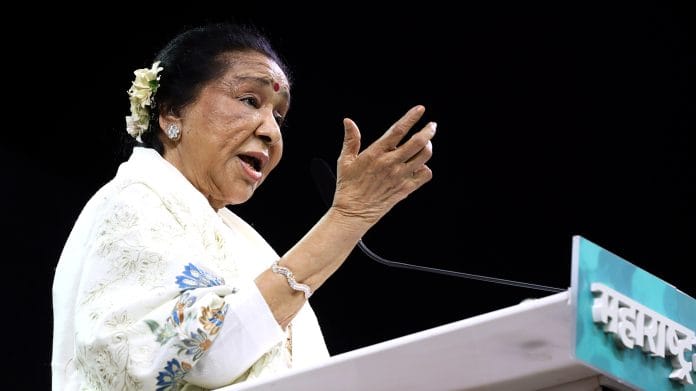


New Delhi: Asha Bhosle is not merely a singer; she is a shared inheritance. A South Asian collective from Pakistan, Bangladesh, Nepal, and Sri Lanka proved it on 26 April as artists sitting in different time zones came together online to remember her and “reimagine” South Asian beats, in her style.
The virtual event, ‘South Asian Beats: Remembering Asha Bhosle, Reimagining a Region’s Sound’ was organised by the South Asia Peace Network or SAPAN. The event traced the arc of a voice that has transcended the lines that divide the region.
The panel comprised Indian Gujarati pop artist Swara Oza, Nepali artist Manoj Gurung, Pakistani singer and activist Jawad Ahmad, and Bangladeshi singer Warda Ashraf.
Bangladeshi journalist Naziba Basher articulated this tension at the outset.
“Today’s event is not just about memory, it is about how a voice travels across borders that politics insists on drawing but culture quietly refuses to obey. Few voices have done it as effortlessly or as defiantly as Asha Bhosle, who sang in languages not her own but made it feel like home,” she said.
Basher went on to say how Bhosle mastered genres even before genre-bending was a concept. She added that this is why she became more of a shared inheritance than a singer.
“Today we begin with her, but we do not stay in the past; we follow her echo,” she added.
Also Read: Asha Bhosle’s last album was with British band Gorillaz. She was a trailblazer
The continuity of music
Kavita Srivastava, founding member of SAPAN and the president of The People’s Union for Civil Liberties (PUCL), placed Bhosle within a much older musical map.
South Asia, she noted, holds within it two broad classical frameworks—Hindustani in the north, Carnatic in the south—but these are only part of a much denser fabric: forty languages, more than a thousand dialects, and a sweep of folk traditions stretching from Afghanistan to Bangladesh to Sri Lanka.
“You can have your borders, you can have dispensations sponsoring hate, you can flatten this richness, but you cannot flatten our unity, you may try dividing us, but you cannot touch music which travels on its own across borders. It has its own rhythm, own flow, own melody, you can’t tamper with that and that is the heartfelt unity of the south asian region that connects us,” Srivastava said.
The event unfolded as a series of interludes — a memoriam by Pakistani journalists, a charter presented by Namrata Sharma in Nepal, a visual tribute assembled by an artist in Dhaka. Threaded through these was a recurring idea — Bhosle’s career, spanning decades and idioms, resists easy categorisation.
“Her career reflects a rare kind of continuity, one built on reinvention. While many artists come to define a particular era, Asha Bhosle moved across them, carrying her voice forward without allowing it to become fixed in time,” the visual note pointed out.
Activist Lalita Ramdas, the founder of Greenpeace India, recalled a moment from a Dhaka workshop in 1985, when Indians and Pakistanis came together in Dhaka to compose a song along the lines, “Darya ki qasam, maujon ki qasam, ye tana bana badlega, tu khud ko badal, tabhi toh zamana badlega.”
In all of this, the lesson was one of unending hope— collaboration across South Asia might one day become less fraught, more ordinary.
The question of legacy or what it means for a voice to endure surfaced more directly. If radio once carried Bhosle’s songs into homes, and cinema amplified them across languages, digital platforms now disperse them in ways both intimate and diffuse. Her voice, Basher observed, has travelled farther than most passports.
Arshad Mahmud, a senior composer and former director of Karachi’s National Academy of Performing Arts, spoke about the late singer with professional admiration.
“She was an artist of such versatility that she was able to illustrate any music,” he said.
Neema Oza, a songwriter associated with the Gujarati Pop (GPOP) movement, approached the matter more personally while speaking of Bhosle and her sister, Lata Mangeshkar.
“Lata ji was someone you worshipped, there was a divinity but Asha ji is someone who touches your heart. She was the boldest voice and no one in that era had imagined someone giving a different touch. She was a revolutionary who pushed the boundaries and took bold steps in music with unexpected music,” Oza said.
Mahmud recalled Bhosle’s renditions of Noor Jehan — and how even in illness, Pakistani legend would listen to Bhosle’s renditions and be moved.
“The era goes beyond,” he added.
He also offered an artist’s perspective: A playback singer, he said, must carry the tune, articulate it, and transmit the emotional life of the actor.
“Why Asha appeals more is because she is daring,” he concluded.
South Asian music then and now
If the first half of the evening was anchored in memory, the latter turned toward the present. From Sri Lanka, Shareefa Thahir pointed to Bhosle’s collaborations with the Sri Lankan pop duo Bathiya and Santhush (BnS) with songs like ‘Dedunna Sedi,’ from the 2010 album Sara Sihina, and ‘Pathum Pem Pathum’ in 2016 as evidence that musical exchange in the region has long been fluid, even when politics has not.
The discussion broadened: How is South Asian music being reshaped now by protest movements, by platforms that compress distance, and by algorithms that quietly curate taste? Increasingly, younger artists are asking not only how to sound, but for whom.
The evening ended not with a formal close, but with a collective gesture — participants singing, each in their own language, their voices overlapping imperfectly through the latency of the internet. With Akhlaq Basheer Khan leading the group in a rendition of ‘Abhi na jao chhod kar, ke dil abhi bhara nahi.’
(Edited by Insha Jalil Waziri)