



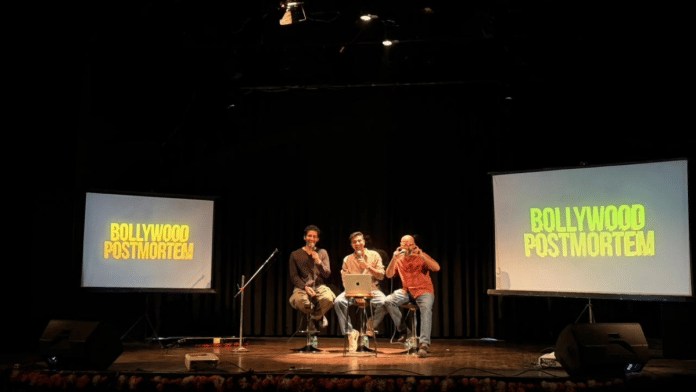
New Delhi: When comedian Varun Thakur described watching Aditya Dhar’s blockbuster Dhurandhar as a “citizenship test,” Delhi’s Bipin Chandra Pal Auditorium burst into laughter and hoots on the night of 13 June. But according to Thakur, the person under the most pressure in recent months wasn’t a politician or a filmmaker; it was Deepika Padukone.
Reflecting on the internet’s priorities, he joked that the biggest concern for many people during that time was: “Why hasn’t Deepika congratulated Ranveer?”
“Unemployed people were stalking her and refreshing her stories,” Thakur said, drawing another round of laughter.
Comedian Kutuk Srivastava then took the joke a step further by displaying search engine results on a large screen. The first several suggestions were all variations of the same query: whether or not Deepika had congratulated Ranveer, highlighting the public’s fascination with celebrity relationships and online speculation.
Thakur and Srivastava were also accompanied by fellow comic Aadar Malik. The trio performed to a packed house, with a majority of the audience arriving nearly 40 minutes before showtime. The performance titled “Bollywood Post-Mortem”, provides a satirical critique of the Indian film industry’s state over the last decade. The comedians highlighted a staggering 85 per cent failure rate for recent releases, blaming a severe lack of originality and an over-reliance on sequels.
With Malik on stage, the evening wasn’t limited to stand-up alone. His musical interludes added another layer to the performance, blending comedy and music seamlessly. But underneath the laughter, Bollywood Post-Mortem was more of a commentary on an industry increasingly reliant on familiar formulas and failing terribly.
“The flag-bearers of Bollywood, including filmmakers and actors, should watch this set with an open mind because it will show them a mirror. These conversations shouldn’t be happening only in comedy shows, but also within the industry,” said Nitya, a self-proclaimed “Bollywood buff.”
The 33-year-old said that in the last decade, barring Dhurandhar, she hasn’t come across any Hindi film which has stayed with her.
“Bollywood needs desperate fixing before it gets too late. In fact, I think it is already too late,” she added.
Suffering from sequelitis, jhaapoing and more
The comedians diagnosed Bollywood’s last decade as a film industry afflicted by multiple chronic “diseases,” the most severe being “lack of originality and an over-dependence on formulaic storytelling.” According to them, much of contemporary filmmaking has become a “version of its own shit”—an endless cycle of recycling ideas that have already been recycled before.
At the top of their list sits what Thakur and Srivastava call “jhaapo-ing”, aka the art of copying. However, Bollywood, they argue, has developed an elaborate vocabulary to make imitation sound more sophisticated.
“‘Remake of’ usually refers to a South Indian film, ‘Inspired from’ refers to Hollywood cinema, ‘based on’ means the filmmakers took an idea and ‘filled the rest themselves’; ‘spiritual remake’ is a film where the title remains the same but the plot is altered, and ‘Inspired by a true story’ means a real-life event that has been modified to include an item number,” Thakur and Srivastava read the definition displayed on the large screen.
The trio said that a recurring example of this phenomenon is filmmaker David Dhawan, whom they dubbed the “King of Jhaapo-ing.” Srivastava even pulled up Dhawan’s Wikipedia page to demonstrate how frequently his filmography is dominated by “Remake of” and “Inspired by” credits. The punchline came when they pointed out that Dhawan has not only remade other films but has also remade his own work, with Coolie No. 1 (2020) and Judwaa 2 (2017), both starring his son Varun Dhawan, serving as evidence.
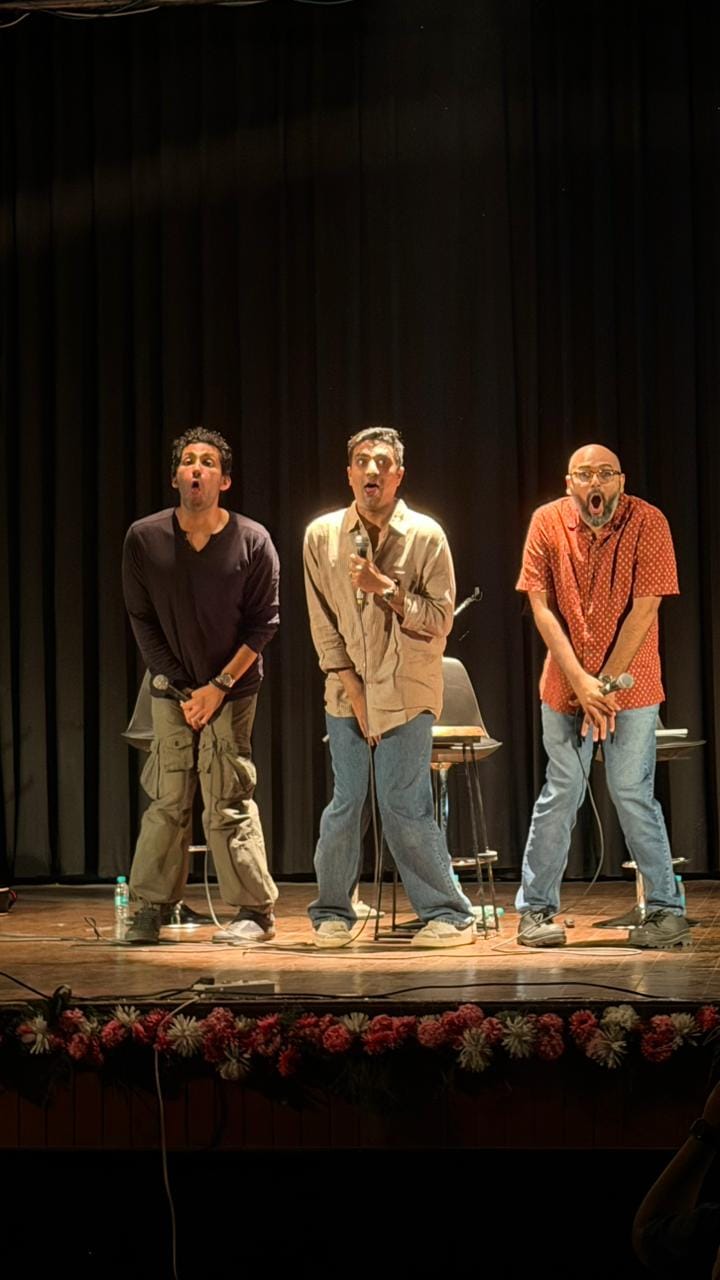
Another disease the comedians identified was Bollywood’s growing obsession with hyper-masculinity. Thakur joked that contemporary heroes like Shahid Kapoor’s Kabir Singh and Yash’s Rocky are more concerned with finding increasingly creative ways to light a cigarette. Whether using guns, explosives, or even a teddy bear. These larger-than-life protagonists also share a handful of common features: oversized beards, military-grade weapons, endless pairs of sunglasses, and a complete disregard for logic.
The comedians also diagnosed the industry with “sequelitis,” a condition in which no successful film is allowed to remain a standalone story. Every project eventually becomes a sequel, prequel, spin-off, or reboot. Franchises such as Housefull, Golmaal, and Masti were cited as prime examples, while Ajay Devgn was singled out as the actor most affected by the condition.
But Bollywood, the comedians argued, has evolved beyond sequels and now suffers from an even more advanced condition: universe-building. Rohit Shetty’s Cop Universe came under fire for its increasingly repetitive titles, Singham (2011), Singham Returns (2014), Singham Again (2024), all starring Devgn, with background scores that “function more like alarm clocks than music.”
Yash Raj Films’ Spy Universe was mocked for its increasingly implausible action sequences, featuring vehicles that transform from boats to planes to cars in War 2 (2025), while spies somehow manage to attract attention everywhere they go, SRK in Pathaan (2023), Salman Khan in the Tiger films and Hrithik Roshan in War (2019).
Also Read: Don’t gush over Alia Bhatt’s Alpha. The scene is a copy of Le Femme Nikita and American Sniper
The ‘N’ word
No cinematic trend escaped scrutiny. The comedians even invented fictional Rajkummar Rao universes, including a “Wedding Universe” where every marriage falls apart, a “Village Universe” dubbed “Rajkummar Rao-pur”, and a “Leaked Sex Tape Universe” inspired by recurring plot devices in several of his films.
Franchises such as Dhamaal and Housefull were also criticised for relying on the same slapstick comedy formulas, recurring character tropes, and repetitive gags across multiple instalments.
But the postmortem wouldn’t be complete without one of Bollywood’s most debated topics—the dreaded “N” word, nepotism.
Here, the comedians introduced what they called the “Same Guy Syndrome,” using Varun Dhawan and Kartik Aaryan as examples. They argued that while one represents industry privilege, the other is celebrated as an outsider, but both ultimately occupy the same space on screen.
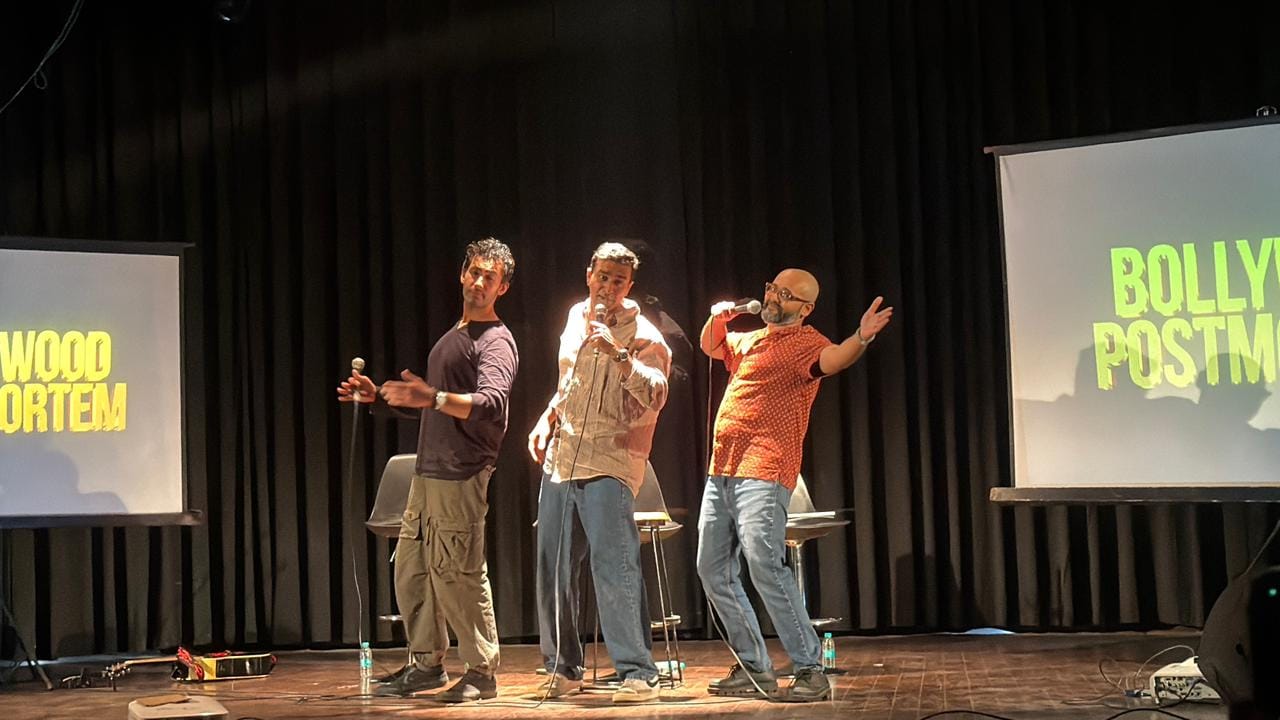
According to Thakur, both Varun and Kartik are just repackaging versions of characters once played by Salman, Akshay, and Govinda.
However, one of the loudest reactions of the evening came when Thakur aimed at Janhvi Kapoor. Referring to her film Mili (2022), in which her character gets trapped inside a freezer and somehow survives, he set up the premise before delivering the punchline: “Because cold temperatures have no effect on plastic.”
The joke sent the auditorium into a fit of laughter, with applause erupting almost instantly. For a moment, the crowd’s reaction drowned out the comedians themselves.
Also Read: Eros introduces Eros Brahmand. It’s a new Hindu mythology universe
Death of music ft Aadar Malik
To break the monotony of a purely stand-up format, Thakur repeatedly ceded the spotlight to Malik, who provided not just punchlines but also melodies that left the audience in splits.
Through a series of musical parodies, Malik skewered Bollywood’s chronic lack of originality, its tendency to chase trends, and its dependence on endlessly recycled formulas.
According to Malik, the industry’s creativity crisis extends far beyond films and deep into its music. He pointed to issues such as the “Remix” and “2.0 epidemic,” noting how a surprising number of contemporary tracks simply revive old hits with an upgrade, from ‘Kya Baat Hai 2.0′ and ‘Illegal Weapon 2.0’ to ‘Bhool Bhulaiya 2.0’ and ‘Dil Chori Sada Ho Gaya 2.0’.
Music composer Tanishk Bagchi, often associated with the trend, became the comedians’ next target. Malik called him the “golden boy” of remixes, adding that “Tanishk and remixes are like Mumbai roads and a municipal corporation”—they are constantly being remade regardless of the result.
The success of these remixes, he argued, is fuelled by Indian weddings as they are repeatedly performed at sangeets. The current formula, Malik suggested, is simple: take an old song like ‘Monica O My Darling’ and add a female rapper to create something that sounds like a “phone fell down the stairs with Ranveer Singh.”
Singer Arijit Singh was another casualty of the evening’s satire. Malik joked that the singer has effectively become “Bollywood’s Band-Aid.” Whenever a film runs into trouble, the industry’s response is always the same: “Aaye, kuch problem chal raha hai, thoda Arijit Singh daal doh (Oh, there is some problem, add a bit of Arijit Singh).”
Among the evening’s highlights was the ‘Matcha song’, which struck a chord with the audience for perfectly capturing Bollywood’s desperation to stay relevant. The parody imagined producers scrambling to combine every trending buzzword into a marketable hit. In this case, blending matcha tea with the Bengaluru slang term “matcha.” The absurdity led to an infectious hook: “Doodh Macha De, Doodh Macha De, Doodh Macha De,” a playful twist on the track Dhoom Machale.
Malik followed it up with a mock preview of Bollywood’s next inevitable trend-chasing anthem, ‘Clock It’, also inspired by social media slang. Its deliberately nonsensical chorus, “Gale laga le mujhko, jaise main hu tera socket (Hug me, as though I am your socket)… clock it, clock it. Clock it, clock it”—had the audience singing along despite, or perhaps because of, how hilarious it was.
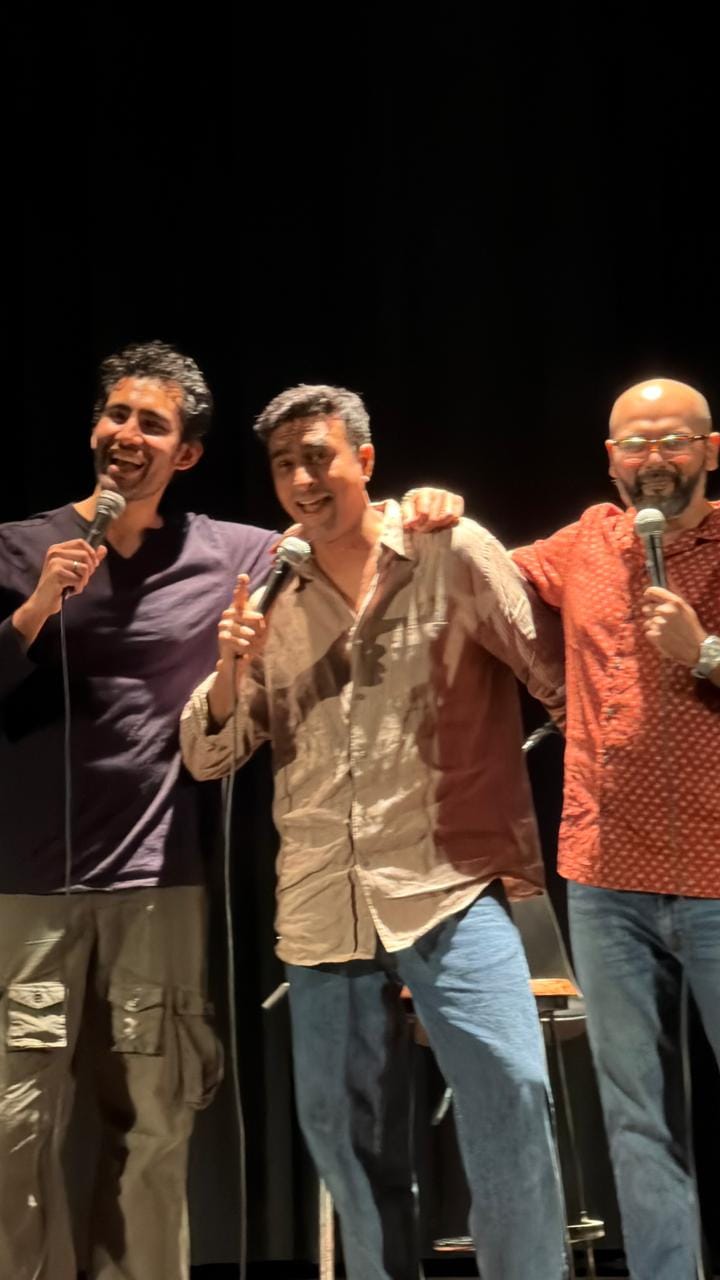
“Bollywood can make you dance to anything. Even if a world war starts right now, Bollywood is going to make a dance song that you would want to play,” Malik said before launching into ‘Nuclear Bomb’, a parody set to the tune of ‘What Jhumka?’ from Rocky Aur Rani Kii Prem Kahaani (2023).
The song brought the house down, but it also neatly summed up one of the show’s central arguments: Bollywood’s greatest talent may no longer be storytelling or innovation, but its uncanny ability to package almost anything, no matter how absurd, repetitive, or catastrophic, into entertainment that audiences can’t stop humming.
(Edited by Insha Jalil Waziri)