



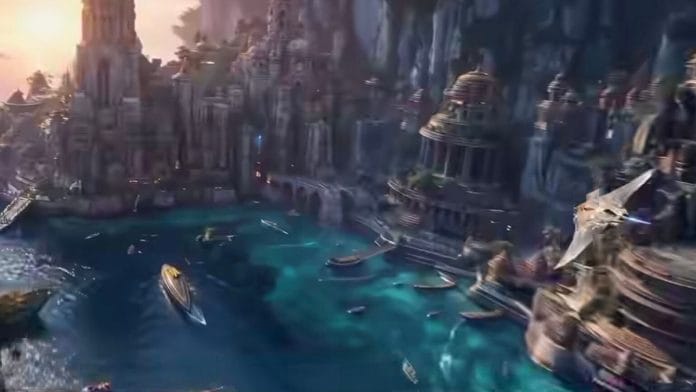
New Delhi: Eros, an Indian Motion Picture company, introduced Eros Brahmand, a multiverse inspired by Indian mythology and folklore, on Wednesday. The universe will comprise eight cinematic worlds where ancient Indian myths intersect with futuristic technology, aiming to appeal to a global audience.
In a three-minute video, Eros showed glimpses of films that fall under Eros Brahmand, including Nandi: War of Kailasa, Dwarka: Gateway to the Universe, Vimaan Wars, Mahabharata 5000 AD, Yakshinis, Brahmarakshak, Garuda, and Kumbhayana. Together, these projects will form a shared cinematic universe rooted in Indian mythology and folklore.
The announcement comes at a time when audiences have shown interest in mythology-driven spectacles. Films such as Kalki 2898 AD (2024) and Nitish Tiwari’s upcoming Ramayana demonstrate that ancient narratives can be reimagined through futuristic universes. While Hollywood franchises such as the Marvel Cinematic Universe and DC Universe have relied on comic-book characters, Eros resorted to ancient Indian texts and folk traditions to create its narratives.
Also read: A movie on Babur? It’s a Pakistan, Uzbekistan joint venture on their shared hero
The three pillars
Eros has divided its universe into 14 distinct realms, with Earth as the border between the Upper Lokas and Lower Lokas. The universe consists of realms such as Satyalok, Tapalok, Janalok, Atala, Vitala, Sutala and Patala. Each of these realms is defined by its own identity, lore, aesthetic and unique time zone.
Unlike previous mythology-inspired films, such as Adipurush, which was criticised by audiences and turned out to be a box-office failure, collecting Rs 290 crore worldwide against a reported budget of Rs 500 crore, the project uses animation as its storytelling tool. Similar to Mahavatar Narsimha (2024), which was made on a tight budget of Rs 15 crore and went on to collect Rs 279 crore worldwide.
Eros has also announced Eros Universe and Eros Remastered, aimed at expanding the studio’s previous films, such as Tanu Weds Manu – The Next Chapter, directed by Mitakshara Kumar, English Vinglish, Desi Boyz, Rangeela and Tere Naam, by adapting them into formats such as animation, micro-dramas and character-driven content. Much of this content will serve as a sequel to the original stories.
The third pillar of the project focuses on remastering films, which starts with Rajinikanth’s Kochadaiiyaan (2014), directed by Soundarya Rajinikanth. Originally India’s first motion-capture film, its characters were based on the likenesses of Rajinikanth, Deepika Padukone and Jackie Shroff.
(Edited by Saptak Datta)