





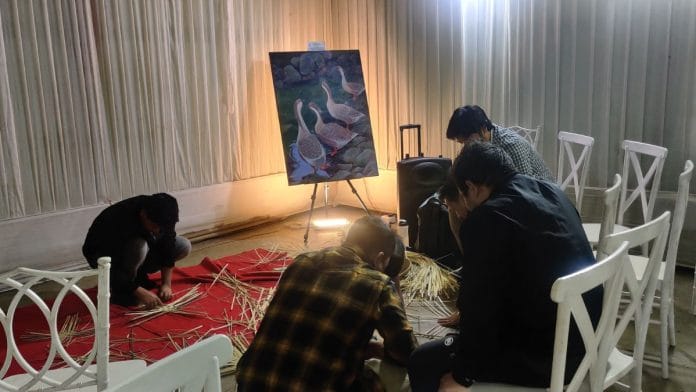


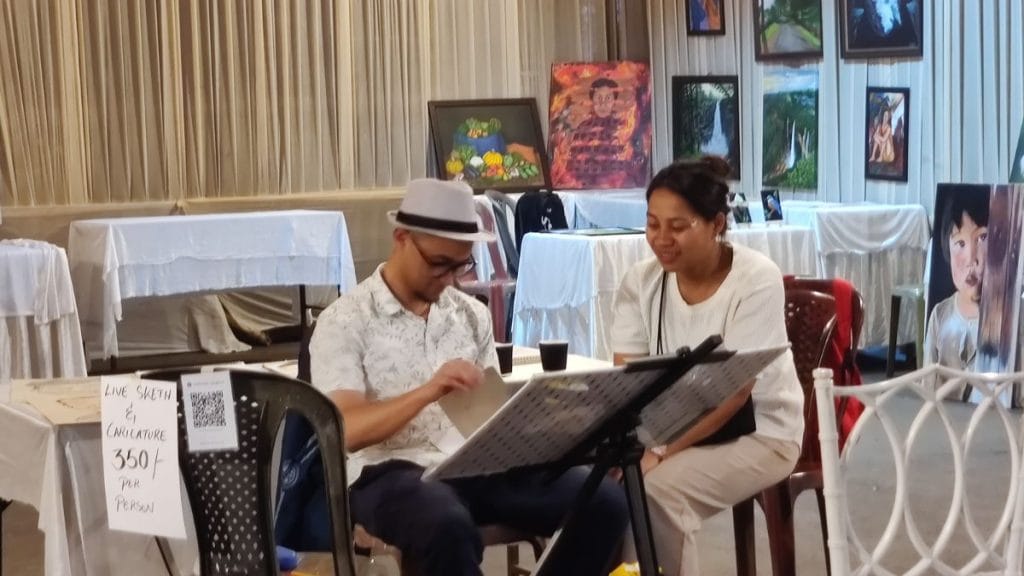
Shillong: A stretch inside the All Saints Church complex in Shillong turned into an open, bustling art fair on 15 April. One section had food stalls, another was occupied by curious onlookers watching bamboo weavers demonstrate their craft, and a third side had visitors queued up for caricature sketches by a deaf-mute artist.
For the first time, what was once a small, local artist-led initiative scaled up into a full-fledged one-day public exhibition, backed by Martin Luther Christian University.
Among many artworks, one theme was on prominent display amid the colour, commerce, and crowd: loss.
For 30-year-old self-taught artist Pynshngainlang Sohkhlet, his works sharpen a fear of what he had been trying to say all along: that what he grew up with is slowly disappearing. One of his most striking paintings shows a dead tree; its branches are bare, replaced by scraps of plastic fluttering like synthetic leaves. The image, he said, comes from an old memory he couldn’t shake off.
“When I was working on an MGNREGA contract, I saw this tree — completely dry, no leaves, only plastic hanging,” he said. “My heart just… I couldn’t explain it to anyone. But I have this skill, so I showed it through my art.”
Across his works — from ‘Threads of Love’, inspired by his grandmother stitching worn clothes into blankets, to ‘Through Her Eyes’, a portrait of rural childhood—the impulse is the same. It is to preserve what feels like slipping away in Shillong.
“All my work is about loss of culture,” he said. “What I saw in my childhood, I want children to see now.”
Also read: ‘Don’t worship us. Give equality.’ Women’s groups petition MPs with 3 demands on reservation law
Free-for-all exhibition
A similar anxiety was visible in glimpses across the exhibition, which brought together nearly 60 artists, many more students, and contributions from community schools. Some works leaned into a distant village life, simple domestic rituals, and portraits of tribesmen. Others turned to ecology—forests, animals, landscapes altered or threatened.
The core of the fair remained rooted in the local; in stories, materials and concerns drawn from Meghalaya and the Khasi people.
Until last year, the collective operated on a much smaller scale—smaller venues, minimal budgets, and fewer visitors. This year, with institutional backing, the exhibition moved into a larger, more visible space, drawing a steady crowd throughout the day.
“Earlier, we didn’t have the budget. The venue would be small,” said artist Careen J Langstieh, part of the cohort. “This time, with the university’s support, we could do it how we always envisioned it.”
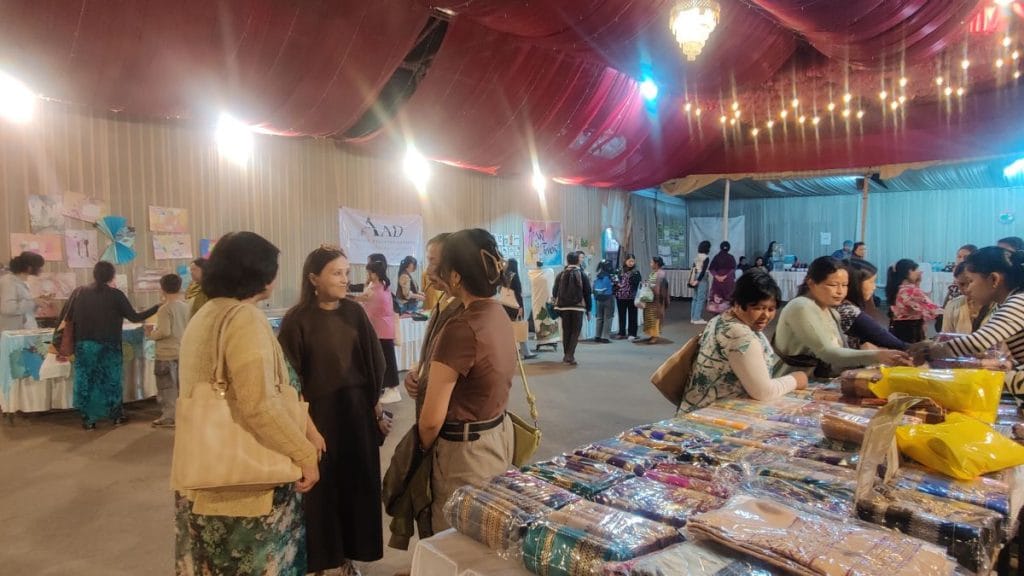
The exhibition is free, set out in the open in a popular spot of the city, pulling in passersby who might never step into a gallery.
“If it’s behind museum walls, art becomes inaccessible,” Langstieh said. “Here, people see it on the main road, they get curious, and walk in.”
Several art students from Martin Luther Christian University and other schools and colleges also submitted their artworks.
Among the youngest was 18-year-old Toshai Syiem, fresh out of school. He presented a portrait of Jesus and a child eating ravenously from a bowl.
A stark change from last year, the fair now has more visibility, more money and more crowds. But the artworks resist polish. They insist on remembering Shillong’s past and preserving what is almost lost now — a grandmother’s hands, a worker in the fields, and a tree that no longer breathes.
(Edited by Saptak Datta)