



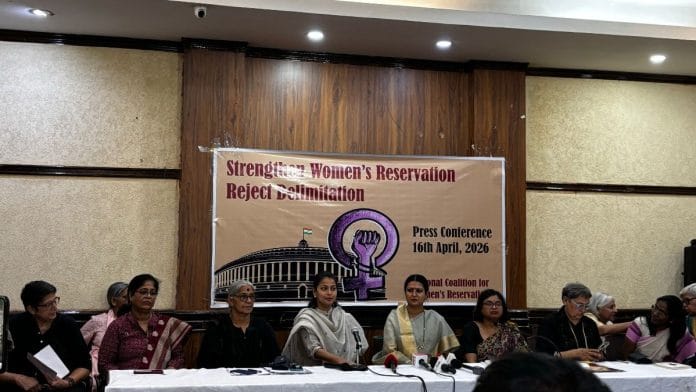

New Delhi: Representatives from more than 60 women’s groups and emerging social movements gathered Thursday in Delhi’s Press Club, urging MPs to prioritise women’s reservation in legislatures.
In the conference, organised by the National Coalition for Women’s Reservation, they also called for necessary amendments to the ‘Nari Shakti Vandan Adhiniyam’, specifically seeking to delink its implementation from Census findings and delimitation.
In line with this demand, members of these groups have sent a petition to MPs attending the Special Parliamentary Session from 16 to 18 April in Delhi. The petition outlines a series of proposed changes aimed at ensuring that the legislation leads to immediate implementation.
Writer Radha Kumar, speaking at the conference, detailed the petition’s three central demands.
First, it calls for the removal of all references to the Census and delimitation from the 2023 Women’s Reservation Act, noting that reliance on outdated data, such as the 2011 Census, would undermine the process.
The petition also proposes new clauses to ensure that the 33 per cent reserved seats are allocated to states in proportion to their existing share of seats. Additionally, it recommends state funding to support election campaigns of women from vulnerable and marginalised communities, including OBC, LGBTQIA+, and denotified tribes.
It further urges Parliament to introduce a separate constitutional amendment in the upcoming monsoon session to extend 33 per cent reservation to the Rajya Sabha.
Highlighting what she described as an inconsistency in the current framework, Radha noted that while the bill ensures “33 per cent representation in the elected houses,” it does not extend this provision to the upper house. She called for new legislation to guarantee parity in representation.
‘Timing of current push raises concerns’
The press conference was also attended by Congress MPs Praniti Shinde and Prabha Mallikarjun from Solapur and Devanagere, respectively, both of whom raised political and regional concerns around the bill’s implementation.
Shinde argued that the women’s reservation bill should have been passed in 2023 without being tied to procedural exercises such as delimitation or the Census.
“At that point, we made the remark that this should not be linked to the delimitation or the census exercise,” she said, recalling her party’s earlier objections. She added that with elections approaching in Tamil Nadu and West Bengal, the timing of the current push raises concerns.
“Very strategically, the ruling party is using women’s reservation to bulldoze the delimitation bill,” she added.
Taking a regional perspective, Mallikarjun questioned both the arithmetic and the intent behind the proposed changes. She raised concerns about how women’s representation in Parliament would translate for southern states, which have performed strongly in education, population control, and economic contribution.
“They are increasing the number of seats and then reserving those for women. So, where is the reservation? The BJP’s dominant bastions are going to be unaffected when the males are going to be dominant in effect,” said Mallikarjun.
The discussion also traced the longer and often contentious history of the bill. Nisha Sadhu, National General Secretary of the National Federation of Indian Women (NFIW), reminded the audience that resistance to women’s reservation has persisted for decades. Invoking the legacy of Geeta Mukherjee, who led early efforts to build consensus around the bill in the 1990s.
“Every time, this bill has run into obstacles,” she said.
Sadhu also argued that the name of the legislation reflects a contradiction in how women are positioned in public discourse.
“We don’t want to be worshipped like goddesses,” she said. “We just want equality.”
Advocate Harsha Azad, a transwoman advocate at the Supreme Court, addressed the legal implications of the bill, pointing out that its implementation is tied to future exercises rather than immediate action.
With the Census expected in 2027 and delimitation to follow, she noted that the bill’s impact may not be felt until as late as 2034. This delay, she suggested, raises deeper structural questions.
“But does this system even work? Should we instead… have it be in direct proportion of the number of people who identify as women in the country? Or should you have a fixed percentage,” asks Harsha.
Also read: Rajma-chawal in the morning? How breakfast exposes the hidden hierarchies of Indian cities
‘The wait has been long’
As the discussion progressed, the call for immediate implementation grew sharper. Activist Kunjamma Mathew, National President of Young Women’s Christian Association (YWCA) of India, urged the Parliament to recognise women’s groups, grassroots leaders, and civil society as “rightful stakeholders” in shaping the process.
Emphasising that the demand was straightforward, she said the reservation should be implemented without conditions. “With the current 543 seats itself, we will be able to do it,” she said, adding that any future expansion could be addressed proportionally.
“The wait has been long for women of the country, and now it is the time to act,” Mathew said.
That sense of urgency was echoed by Shweta Raj of All India Progressive Women’s Association (AIPWA), who framed the issue in electoral terms. “The women of India understand the tactics used to win elections,” she said, warning against what she described as attempts to “divide the country by putting a gun on women’s shoulders.”
While she argued that reservations should ideally reflect women’s demographic strength, closer to 49-50 per cent, she maintained that even the existing 33 per cent must not be delayed.
For Bhavna, the resistance to higher representation reflected deeper structural concerns.
“Why does this patriarchal mindset fear that if 50 per cent of women are elected… what will happen?” she asked, linking the issue not just to policy but to entrenched power structures. She added that the absence of substantive debate on key bills reflects a similar top-down approach, leaving little room for dissent.
Joycia Thorat, a social worker from the Indian Christian Women’s Movement, highlighted the continued underrepresentation of rural communities.
She called for financial support mechanisms to ensure that women from marginalised backgrounds can participate meaningfully in elections, cautioning that without such measures, reservations risk becoming symbolic rather than transformative.
The press conference concluded with remarks by Annie Raja of the CPI, who situated the demand for reservation within a longer democratic history. She recalled that women in the Constituent Assembly had initially opposed reservation, believing that a growing democracy would naturally ensure representation.
That expectation, she argued, did not materialise. By the mid-1970s, women’s representation in Parliament had dropped to as low as 3.5 per cent, prompting a shift in approach.
“The political parties failed Indian women,” she said, explaining why the demand for reservation became non-negotiable.
(Edited by Saptak Datta)