





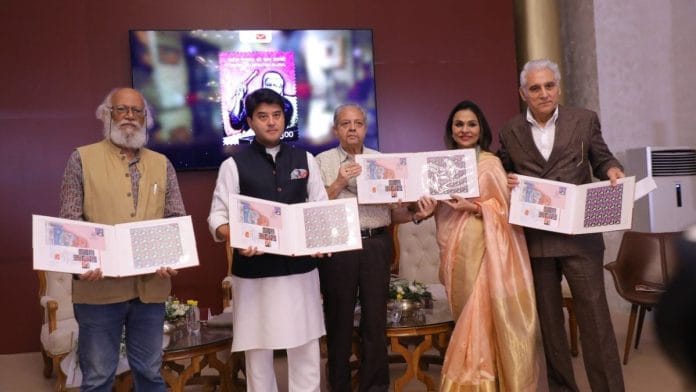


New Delhi: Few artists shaped modern India’s cultural landscape as profoundly as Padma Vibhushan Satish Gujral. He was a painter, sculptor, muralist, architect, and writer. To mark his birth centenary, the country honoured that extraordinary legacy with a commemorative postage stamp bearing one of the rarest images he ever created — a self-portrait painted toward the end of his life.
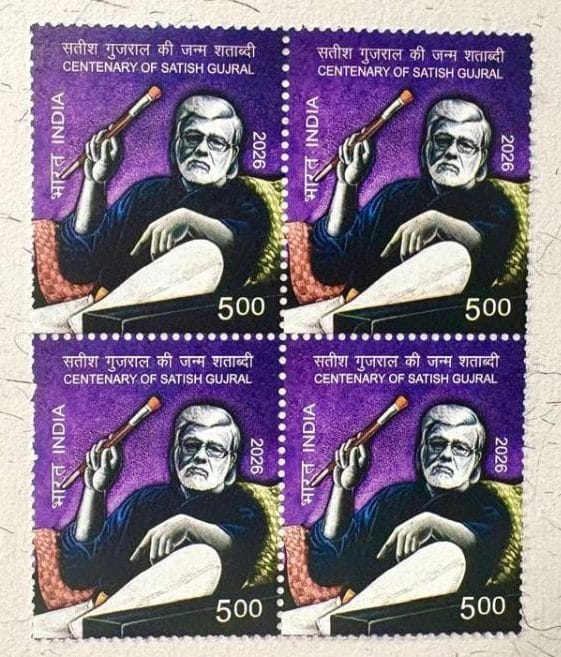
The Department of Posts, in association with Raseel Gujral Art Legacy (RGAL), unveiled a commemorative postage stamp at New Delhi’s Bikaner House on Monday. The stamp bears one of only four self-portraits Gujral painted during his lifetime.
For Gujral’s daughter, designer and curator Raseel Gujral Ansal, the commemorative stamp was more than a national honour for one of India’s greatest artists. It was a deeply personal moment. She said the greatest inheritance he left behind was neither his paintings nor his sculptures, but the values that guided his life and work.
“What I am getting from my father is not an artistic legacy. It is a way of seeing. A way of looking beyond traditions, beyond rituals, beyond success and beyond spectacle. A value of authenticity, courage, and integrity above all else. He taught me to look for the soul within things and the truth behind every act. He never allowed trends. Every body of work came from an inner necessity to create something that demanded its own meaning and expression,” she said.
The event brought together family members, artists, collectors, and friends to celebrate Gujral’s journey, which spanned more than seven decades. Among the speakers were Union Communications Minister Jyotiraditya Scindia, veteran artist Jatin Das, and former National Gallery of Modern Art Director Rajeev Lochan. The ceremony also marked the opening of a week-long exhibition of limited-edition Satish Gujral centenary stamp collectables at Bikaner House, from 4 to 9 August.
“He was more than an artist. He represented, in many ways, India’s capability. His ability to transform inanimate surfaces — whether canvas, stone, brick or empty spaces — into living forms was something very few artists in the world possessed,” Scindia said while unveiling the commemorative postage stamp.
The commemorative stamp coincides with Gujral’s birth centenary and will be available through 72 Philately Bureaux across India.
Painting pain
Few Indian artists moved as effortlessly between disciplines as Satish Gujral did. He continuously reinvented himself without abandoning the emotional core of his work.
Scindia said Gujral never let his hearing impairment define him. Instead, he channelled it into a distinct artistic language that became his hallmark.
“What appeared to be a limitation to mere mortals like us really became the foundation of extraordinary artistic value. His life stands as a testament of how the triumph of human determination can stand against adversity,” he said.
Scindia reflected on how the experience of Partition shaped Gujral’s artistic imagination. Rather than allowing the trauma to define him, Gujral transformed his art in a way that it spoke of resilience, hope, and humanity. Scindia noted that Gujral’s celebrated Partition series became a symbol for artists around the world and demonstrated how art could communicate emotions beyond the reaches of words.
In paintings such as Mourners (1947–48), Desolation (1954), and Snare of Memory (1954), Gujral portrayed figures overwhelmed by sorrow, exhaustion, and loss. Through their anguished faces and tired bodies, he captured the emotional scars of displacement without even a single direct hint of violence. The dark and deeply emotional nature of these works spoke of his own pain. “I didn’t paint the partition, I painted my own suffering,” he said during a 2017 interview.
Rajeev Lochan described Gujral as a rare conceptual thinker whose practice evolved across mediums while remaining rooted in a single creative philosophy.
“His works never stopped exploring different crafts, techniques and materials. His murals reveal a thorough understanding of diverse materials, while his architectural creations remain landmarks in contemporary Indian architecture. It is uplifting that this commemorative stamp gives us another opportunity to celebrate an artist who continued his search against all odds, motivated purely by inner instinct,” he said.
Also read: Daryaganj book bazaar was a Delhi institution. Stories of its ‘ustads’ are now being told
A sharp man
One of the highlights of the exhibition is Self Portrait (2012) that shows the artist in a hushed reflective moment. Seated with a paintbrush in hand, Gujral painted his face in black and white, while the rest of the composition is filled with muted colours. Surrounded by plants and a sculptural form, the painting reflects the many mediums he explored during his career, from painting and sculpture to architecture.
The work inspired the commemorative postage stamp released to mark his birth centenary.
Another painting exhibited is Raas (2017), painted during the final years of Gujral’s career. It is inspired by Indian folk traditions and is full of movement and celebration. Flowing drapery, geometric patterns, and warm, earthy colours speak of the spirit of joy, music, and community without telling a specific story.
The Department of Posts chose the painting as the inspiration for the Special Cancellation Mark accompanying the birth centenary commemorative stamp.
Jatin Das recalled the friendship he shared with Gujral. He spoke of shared meals, teasing conversations, and decades of companionship that survived the changing times.
“Satish was much older than me, but we became very close friends. Amongst all food, he loved roti and dal. Every time we met, we teased each other,” he said.
Recalling Gujral’s hearing impairment, Das said it never diminished his ability to understand people.
“Even though he could not hear, his sensibility was incredibly sharp. Before you finished speaking, he had already understood what you meant. Kiran, his wife, would always add a little spice to every conversation, and together they made every gathering unforgettable,” he said.
The memories eventually led to grief. Das said that his friendship with Gujral, spanning more than six decades, was marked by honesty, openness, and an absence of pretence.
(Edited by Aamaan Alam Khan)