





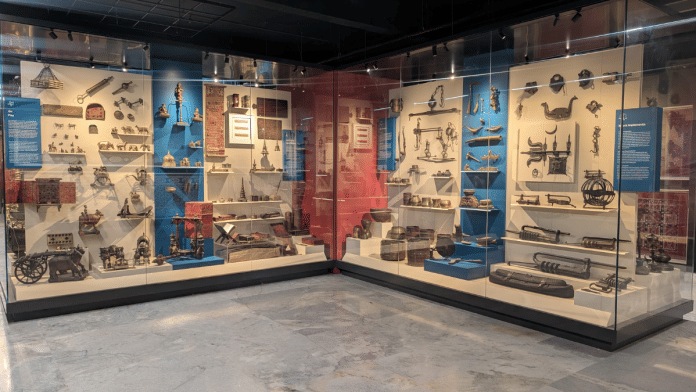


New Delhi: OP Jain’s famous Sanskriti Museum collection has found a new home at Delhi’s Humayun Tomb Complex. Around 2,500 antique everyday objects, from toys, writing instruments, implements of trade and farming, exquisite locks, hand-crafted hookahs and nut crackers to the Indian lota, will be on display at the Humayun’s Tomb Museum.
Belonging to OP Jain, founder of Sanskriti Pratishthan, the collection started in the late 1970s. Jain was a paper merchant but began collecting art and artefacts, including exquisite textiles such as jamdani from Dhaka, phulkari from Punjab, and double ikat from Patan, Gujarat.
“The objects I collected over the decades—textiles, everyday artefacts or works of craftsmanship—were never acquired as possessions. They were always held in trust,” Ratish Nanda, CEO at Aga Khan Trust for Culture, read a letter by Jain at the event.
Jain said that no collection is ever the work of one individual, “It is built through countless acts of trust, curiosity and affection.”
The exhibit was inaugurated by Jain and Member Secretary at Indira Gandhi National Centre for Arts Sachchidanand Joshi. ThePrint’s Editor-in-chief Shekhar Gupta, as well as Louis Mondreal, the General Managers of the AKTC were among the many luminaries present at the event.
For nearly four decades, the artefacts have been on display at the Sanskriti Kendra in Delhi.
In 2023, Jain gifted his collection to the IGNCA. The artefacts were cleaned and the conserved textiles reframed before they were exhibited at the IGNCA.
The AKTC and the IGNCA were in talks to move the collection to Humayun’s Tomb for almost a year. The IGNCA had signed an MOU with the AKTC for five years.
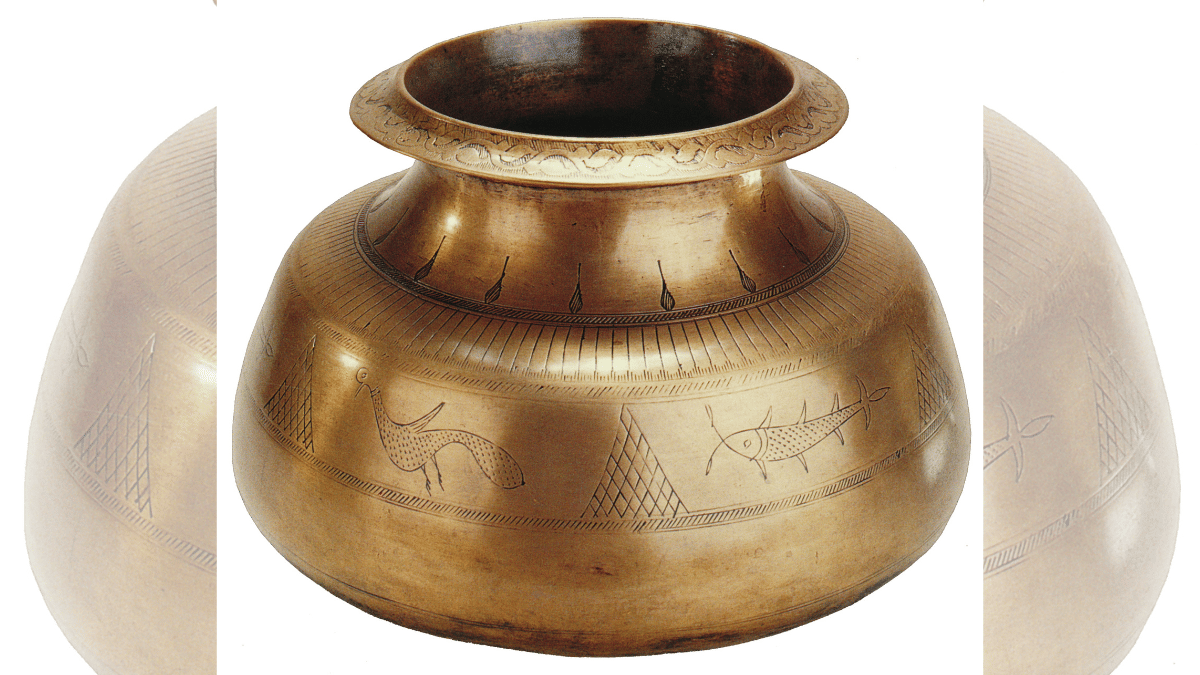
“It’s quite a generous gift. They are all everyday art objects used in Indian households. Everything here is mostly 300 years old, and we are honoured to have this collection,” said Nanda during a curated walkthrough ahead of the inauguration.
Nanda said that annually two million people visit Humayun’s Tomb, adding that the collection will be interesting to almost every visitor.
“For me, what is shocking is this is who we are and look what we have become,” said Nanda. He was accompanied by Achal Pandya, Head of Conservation at IGNCA.
The museum courtyard now displays large clay horses and elephants from Tamil Nadu’s Ayyanar terracotta tradition, connecting it to the original exhibit at the Sanskriti Kendra.
The IGNCA and the AKTC are also planning to hold a lecture series on Jain’s collection.
The Sanskriti Museum gallery will be open to the public from 1 August, with only 50 visitors permitted per hour.
As it was a private collection, many of the objects don’t have any accompanying text.
“It’s a one-man’s collection. So now is the opportunity for both the IGNCA and others to spend time and money to research individual objects,” said Pandya, adding that the IGNCA inherited the artefacts in quite a good state of preservation.
Also Read: Maharaja Ranjit Singh to Afghan nobles—19th-century India through a British woman’s eyes
Treasure trove
Jain’s collection is a chronicle of one’s life, from infancy to adulthood.
It includes plastic toys and pichkaris for children, farming implements, and different styles of hookahs.
“It’s a life cycle approach,” said Pandya, pointing towards the wooden walker used by children in households.
The farming and trade implements section even features a wooden item to keep snakes inside it.
A section called “Smoking” features different hookah basins.
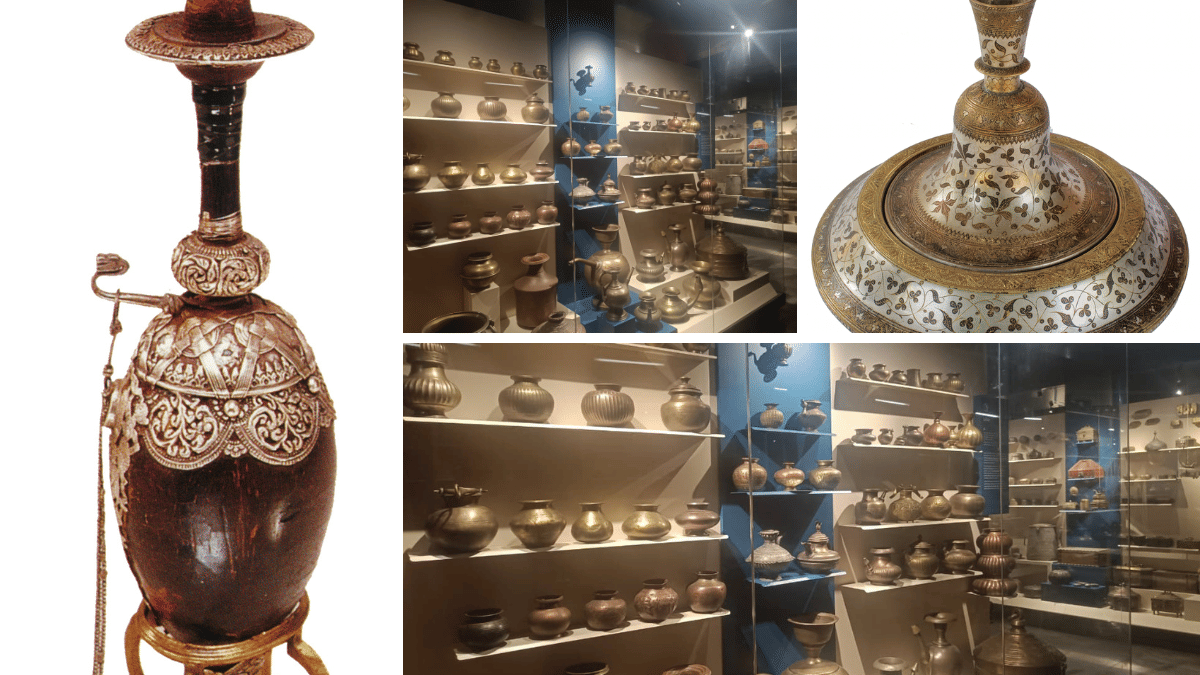
“Smoking of hashish, cannabis, and opium was popular across India for centuries. For opium use, implements for filtering and preparation are found to have been made in brass, wood, stone and iron. Exquisite, beautifully crafted hookah bases are found in diverse shapes—peacocks, mango, urns and in fascinating designs and materials—humble coconut shells covered with ornate filigree to Bidriware, ceramic, terracotta,” one caption read.
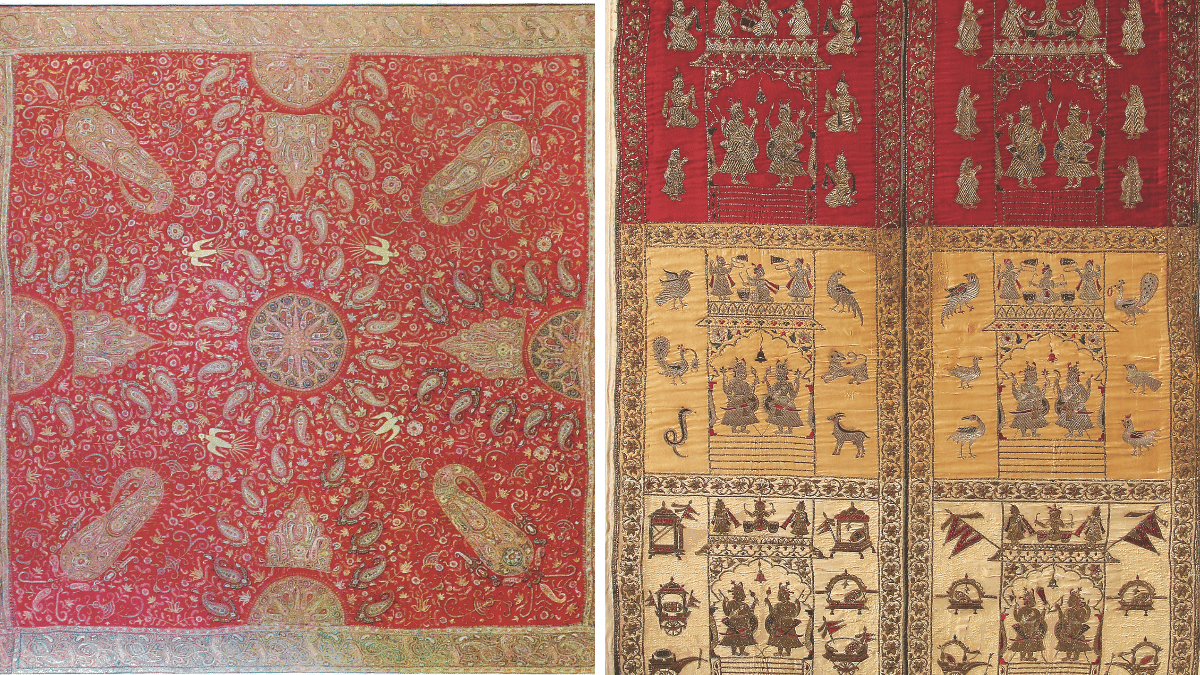
Textile items at the gallery feature an embroidered zari shawl, a pashmina shawl from Kashmir and the Bengali textile craft of Kantha, among others.
“Always created by village women—portraying and celebrating their lives—with discarded fabrics, giving old clothes a new life. This has enabled the craft to survive uninterrupted in Bengal to this day,” the caption for Kantha textiles reads.
Another section titled “Lotas” with a caption saying that lotas for ritual use were often adorned with religious motifs and even spouts to pour ghee or milk.
Pandya said that generally very limited artefacts are displayed at museum galleries. But here most of the artefacts from the collection are displayed.
“We have tried to keep the soul of the display, as it was in Sanskriti. So we have kept it all.”
(Edited by Insha Jalil Waziri)