


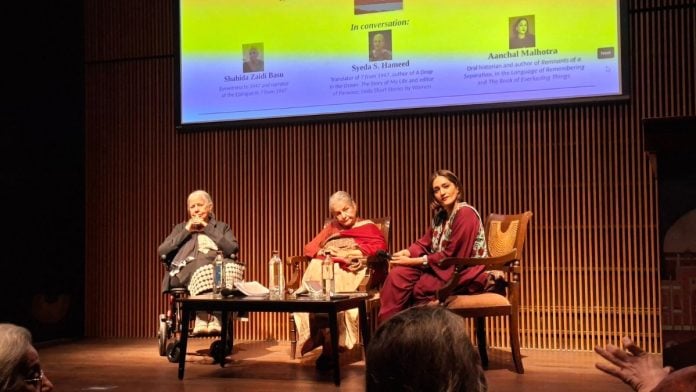
New Delhi: Shahida Zaidi Basu was in solitary confinement in Allahabad jail for days with her three sisters in adjacent cells when India became independent in August, 1947. Their mother, not allowed to visit her daughters, then decided to pay a visit to the only person who could get them out: the brand-new Prime Minister of India, Jawaharlal Nehru.
Basu’s mother reached Delhi from Uttar Pradesh and took a tanga—a horse-drawn carriage—to Nehru’s bustling residence in Lutyens’ Delhi without informing anyone. Then, a young Indira Gandhi interrupted her long wait for the PM and inquired about her grievance.
“You may be your father’s daughter, but I need to talk to Nehru, and I will only talk to Nehru,” said the firebrand mother of five.
The story, recalled by now 84-year-old Basu at a discussion in New Delhi, is among the seven first-hand accounts of 1947, collected in 7 from 1947, a new book by her aunt, writer Saliha Abid Husain. She died in the 1980s but her book, written in Urdu during the Partition months, was translated into English in August this year by her niece, Syeda S Hameed.
When Nehru finally showed up, the mother narrated how her teenage daughters were arrested for brandishing communist black flags at Aligarh Muslim University a few weeks after Independence and how they were taken into solitary cells when they protested against the treatment given to non-political working-class prisoners.
“Your government is no better than the British government,” she told Nehru to his face.
Basu recalled what happened after as a handful of people in the audience leaned in to listen.
“That’s how my mother was. Nehru was sharminda (ashamed) when he heard about us in jail,” Basu said proudly at Nizamuddin Museum on 20 November, adding context to the story titled ‘Loot’ in her aunt’s telling of the story in 7 from 1947.
Moderated by author Anchal Malhotra, the book was discussed in the company of historians, friends and family and young college students curious to learn about the untold stories of the Partition through the lives of women in Husain’s family and of the violence, displacement and resistance that shaped them.
Husain wrote more than 50 volumes of essays, short stories and novels, but 7 from 1947 brings together real-time accounts written as the events were unfolding, rather than in retrospect. The stories feature encounters with figures such as Nehru, Maulana Abul Kalam Azad and Zakir Husain, while recording the upheaval experienced by ordinary people. This is the first time these stories have been translated into English, nearly 80 years after they were written.
‘Khatoon-e-awwal’
Hameed, the book’s translator and author’s niece—who is also an activist and a former member of the Planning Commission of India—was holding the Urdu manuscript of her aunt’s book on the stage. She said that it was found in a ‘tattered state’.
“But if I had not written it, the veins of my brain would have burst,” Hameed read the first lines of the book.
She said she felt a responsibility to bring the stories to a wider readership.
“I thank the spirit of Saliha for making me translate this. She was the khatoon-e-awwal at Jamia Millia Islamia (number one woman of Jamia) and she deserved it,” said Hameed.
Her husband, Hameed recalled, told Husain that writing on hangami adab (recording of on-going riots, Partition, violence and forming of a new nation) is not literature but journalism.
“He was worried for her that she was writing about what was happening in 1947, with all the violence,” Hameed said.
The nightmares that Husain witnessed during Partition are all on paper now. In one of the stories, she narrates how Nehru was going around Delhi, with a stick in his car, when the post-Partition riots began. He was responding to screams of women, suffering catastrophic costs in 1947. Their bodies, she said, were treated as sites of religious and national ‘honour’, revenge and territory.
Nehru started his job as India’s first PM by rescuing whoever he could find on the streets. In Husain’s telling, he found two sisters in a state that made him “cry and cry”.
Husain says many in her family were in touch with Nehru; Hameed’s father (Husain’s brother) used to work in the Nehru administration as well.
“We as a family have always admired Nehru. We still do,” she said.
Also Read: Tree masks, construction sites and sari frames—Gauri Gill captures the cost of urbanisation
‘Loot’ and the Partition
‘Loot’ starts with Basu and her sister’s chaotic experience of being hurled into a truck and being almost forcefully sent to Pakistan.
In resistance, the sisters stuck chits on their cupboard, leaving notes on the lines of “We will be back, we have not left forever.” Rioters had already stolen them blind; all their favourite clothes—zariwali saree, ghararas, reshmi dupattas—were mostly gone.
By a stroke of luck, they were saved by a Sikh man and then by Maulana Azad. In Azad’s home—filled to the brim with refugees—the sisters survived on barely any food. They would use a few grains of rice to crispen the sartorial treasures they still had left.
Azad managed to send the refugees to Rampur via train, and then the sisters made their way to their college, Aligarh Muslim University.
Soon after, they were arrested.
“We were also missing out on education during that time. When we could leave and reach Aligarh, we were arrested for protesting against a UP minister. A Communist party leader had just handed us black flags and told us to stand in the front. Party ka hukum Allah ke hukum se kam nahi,” Basu said, cracking up.
Things got grim when the sisters—lodged as political prisoners in Allahabad jail—started protesting against the jailers for torturing political and working-class prisoners.
“My sister was badly hurt in the head by the police. There was also a pregnant woman who was also lathicharged. We slept on the floor for three days,” she said.
Police violence is not too unrelatable in 2026. Neither is any kind of violence against women and their resistance toward it.
“I am just glad that people still have the courage to call out what is wrong as wrong,” Basu said.
(Edited by Stela Dey)