


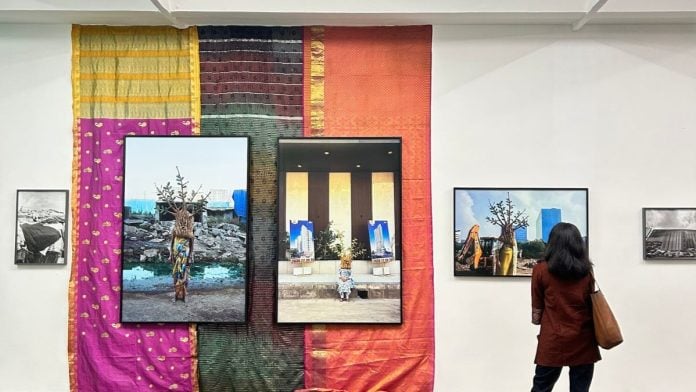
New Delhi: At Gauri Gill’s exhibition, a photograph spills beyond its frame.
In one section, a frame is mounted against a pink-and-purple sari. Inside the photograph, a few chandeliers hang above clothes belonging to construction labourers, suspended as if they were part of the décor. The juxtaposition adds another layer to the image, bringing together the worlds of aspiration, labour and everyday precarity.
Gill started working on ‘Acts of Appearance: The Last Tree’ last year in collaboration with the Adivasi papier-mâche artist community from Jawhar, Maharashtra. The exhibition is being held at Khoj International Artists’ Association in Delhi’s Khirki Extension. It opened for visitors on 21 November and will continue till 28 December.
The artists, who also work as construction labourers at various sites across Mumbai, created papier-mâché masks modelled on mahua, chera, narakhi and palas trees. Each mask becomes a memorial to trees lost to construction and urbanisation.
Gill’s wall-sized frames evoke emotions that expose the irony and absurdity of modernity. The photographer urges visitors to look at all 70 works with a discerning eye, piecing together the stories to understand the changing landscape in which these communities find themselves.
Each photograph invites visitors to confront the “ecological destruction, displacement and invisible labour that accompany the rhetoric of development”.
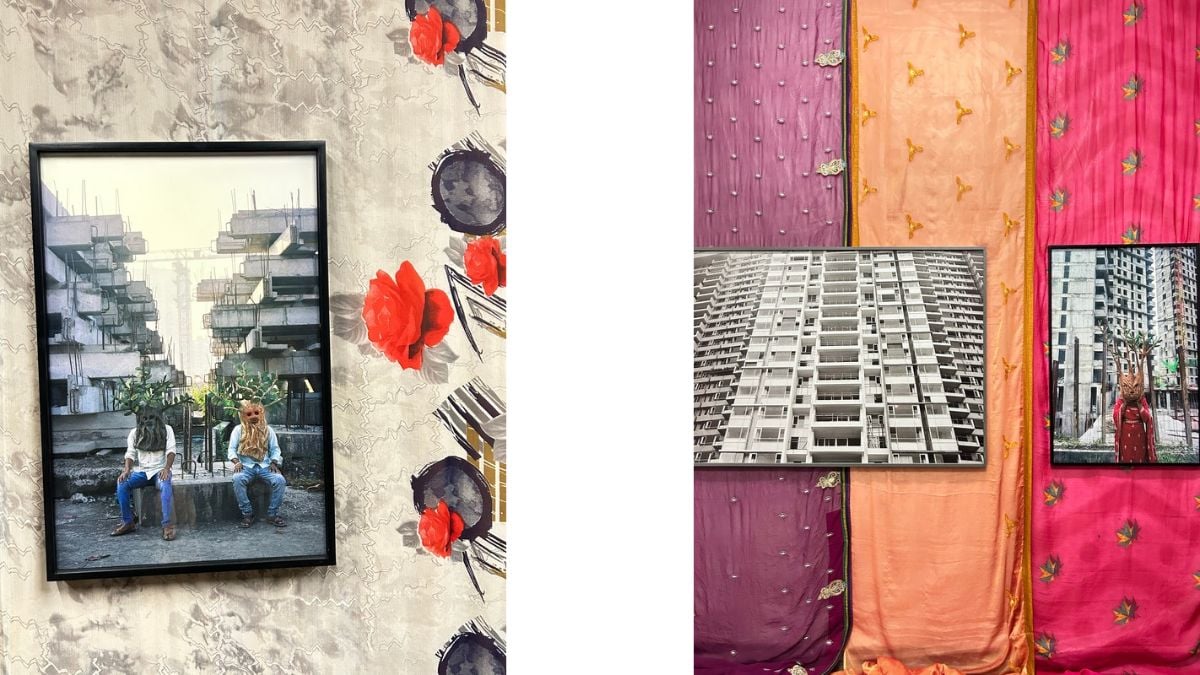
Sarees, cement and tree masks
Inside Khirki Extension’s concrete sprawl and crumbling buildings, Gauri Gill’s photographs offer a glimpse of a world where the relationship between people, nature and the urban landscape is constantly shifting.
Shot in Maharashtra and Delhi NCR, Gill’s photographs find an unsettling resonance in the national capital, particularly in its densely populated neighbourhoods, where green spaces are increasingly scarce and concrete dominates the landscape. However, each frame at the exhibition refused to be drowned out by the bustling city’s cacophony.
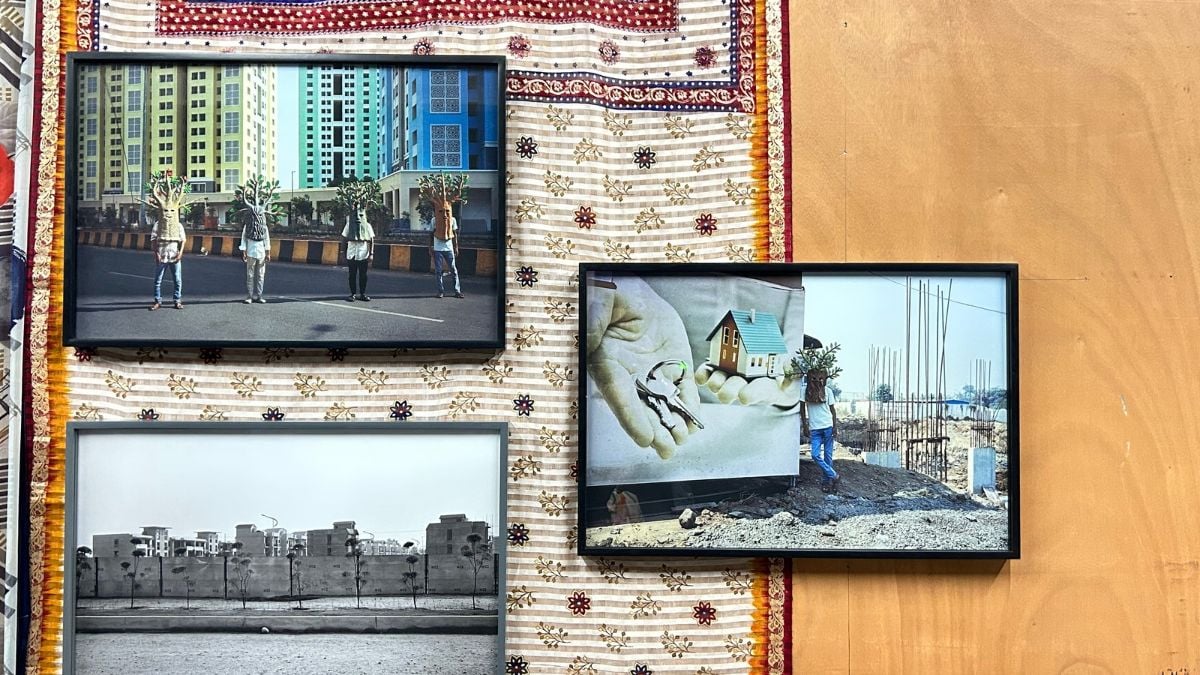
Several trees lost in the artists’ forests are now shaped into paper mache masks, and are eternalised by Gill’s photographs. Gill takes the tree as a metaphor for the vulnerable. Her photographs showcase the dignity of marginalised communities and the fragile relationships between urbanisation, industrialisation, humans and nature.
“The tree is a metaphor for all that is human, all that is sentient, that is small, that is powerless, that is important,” said Gill.
At the gallery, the passage gives way to an open courtyard, its walls lined with towering photographs of Warli and Kokna people wearing tree masks against the stark backdrop of construction sites.
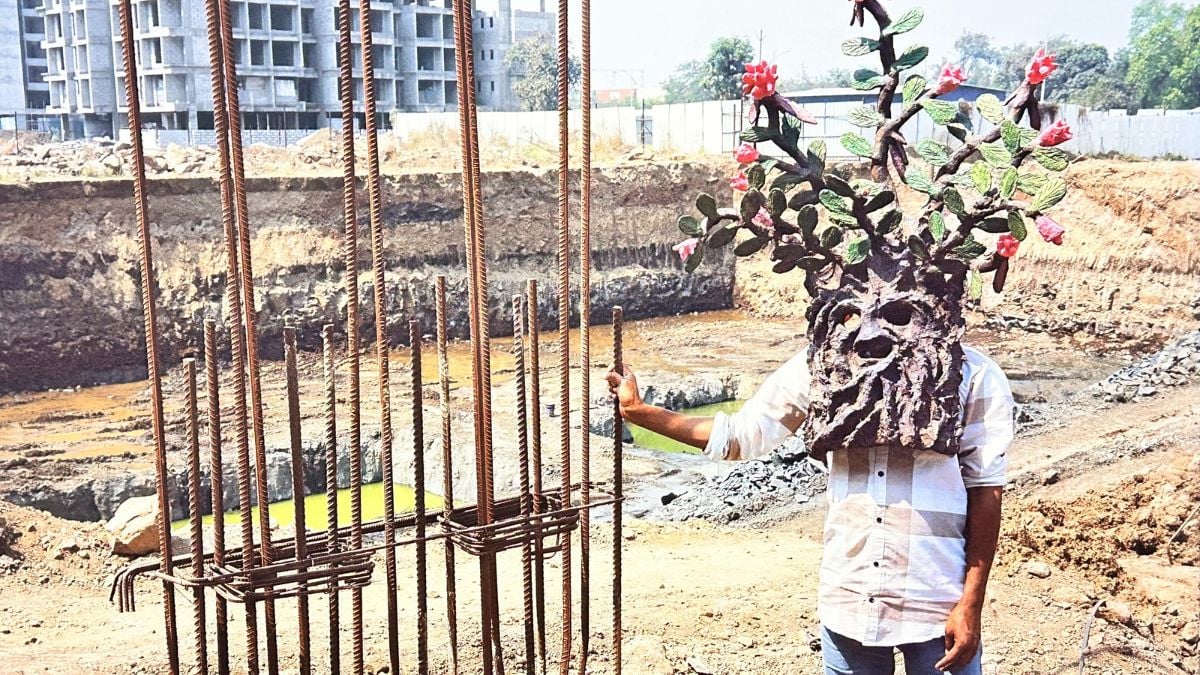
Gill first began exploring this project more than a decade ago in 2015, when she initiated a dialogue with the community of Adivasi paper mache artists from Jawhar. This led to them making new masks and her photographing them inhabiting their artwork while portraying their everyday lives in the village.
Gill said this new series, photographed on construction sites instead of in the village, was not easy, but rather “stressful and arduous”. Along with the artists, she had to transport the heavy, delicate masks in a tempo and hand-carry them around different locations in Navi Mumbai, Greater Noida, Okhla and various other off-limits construction sites on the outskirts of Mumbai and New Delhi.
“We were repeatedly questioned, chased off, and threatened by the builders’ security guards while making the work. We had to work quickly. It was guerrilla photography.” Gill told The Print.
In one of the key photographs, Gill places her subject, a masked tree, on the blade of a yellow bulldozer. Sacks of Adani Ambuja Cement bags placed by her on the wall of the gallery as the background of the image add another layer to the composition, bringing another version of the industrial, construction-site aesthetic to the frame. Gill, with her keen eye for detail, has carefully positioned her subject to lend the frame a sense of realism and authenticity.
Also read: How the Indira Gandhi Memorial Museum captured Sonia Gandhi’s story in pictures
Joy and beauty in precarity
The exhibition opens with an acknowledgement to all the artists with whom Gill collaborates, and a series of essays written by an urban theorist, schoolteacher, economist and environmentalist.
Gill, who stands at the entrance, welcomes the visitors, urging them to go through the exhibition and the essays and to understand the display of the photographs and the essays, which she urges visitors to read as an expression of “precarity but also of joy and ingenuity, and a call to action rather than despair.” Quoting Brecht, she says, “Even in the darkest of times, what else can we do but sing?”
Urbanist and writer Gautam Bhan wrote that Gill and the artists “bring insistent errors” in the grammar of “contemporary Indian metropolis”.
These works for Bhan are meant to “interrupt, unsettle and chasten”.
Gill’s exhibition extends beyond the photographs themselves, bringing elements of the real world into the gallery. Colourful saris donated by the artists, Ambuja Cement sacks and construction materials such as plywood become part of the display, blurring the boundaries between the photographs and the spaces they document.
The installation is an attempt to offer visitors a more layered, immersive experience, allowing them to engage with the images beyond the frame.
Author Kaveri Gill points out the multiple narratives of the frame.
“On the face of it, these are all signs of rapid ‘development’ in the world’s sixth-largest economy of India. But look closer at the images, and another narrative appears strongly, just as when one develops the negatives of a roll of film,” she wrote.
(Edited by Ratan Priya)