





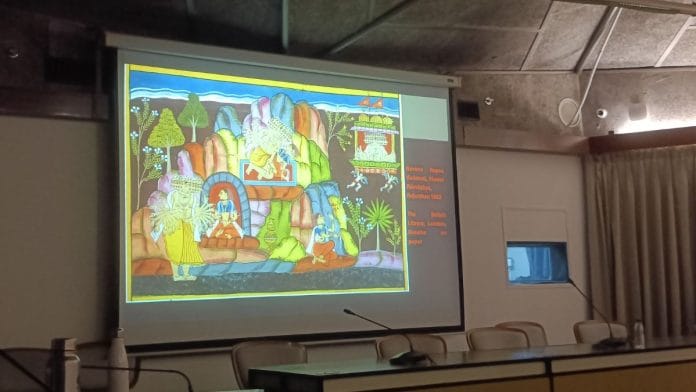

New Delhi: In the 17th century, Rajput ruler Jagat Singh undertook a Ramayana project to rival Mughal artistic patronage. That art took centre stage at New Delhi’s India International Centre on Monday, as historian Anisha Saxena examined what its paintings reveal about sex, power and politics.
At a lecture titled ‘Revisiting the Mewar Ramayana: New Perspectives on the Paintings from Uttarakanda’, Anisha Saxena, associate professor at the Department of History, SUNY Cortland, said, “While the Ramayana holds deep religious significance for Hindus, Jagat Singh’s commission of the Mewar Ramayana manuscript was both personal and political.”
She added that it was the largest illustration of the Ramayana ever commissioned by any Hindu king and served as a strategic assertion of Mewar’s cultural and artistic autonomy, countering the Mughal tradition of manuscript production.
Historian Swapna Liddle chaired the lecture. Among the audience were art historian Naman Ahuja, JNU professors R Mahalakshmi and Rakesh Batabyal, as well as history students.
It took Saxena a year to get images of Mewar Ramayana from the British Library.
“The manuscript is particularly notable for its ambitious scale, grandeur, and quality. The illustrator used a technique where the artist depicted more than one scene from a story on a single page,” said Saxena, adding that the story of Ramayana has always been central to the lives of Hindus.
Sexual assault of women
Saxena said the British Library holds the largest collection of the Mewar Ramayana folios. She examined three paintings from the collection, which depict sexual assault of women.
Saxena explained that there are four stories of female rape that appear in the Ramayana, and three were visually depicted in the Mewar Ramayana manuscript.
The first story of rape that appears is of Vedavati by Ravana, the second of Rambha, the third of Ahilya by Indra, and the last is of Arja by King Danda. The only story of rape that the Mewar artist did not depict is the third one.
Saxena said the rationale for this omission lies in the visual program’s broader ideological aims, positioning Ravana as the Mughals and the Sisodia rulers of Mewar as Ram.
“Within this framework, any image that risked portraying Hindu gods in a morally compromised or villainous role was probably consciously excluded,” she said.
Saxena said the rape of Rambha by Ravana is associated with Sita, wife of Rama. She said after Rambha was raped, her husband Nalakubra cursed Ravana that if he tried to force himself on unwilling women, his head shall burst into seven pieces.
“When Ravana hears about the curse, he loses his desire to make love to unwilling women and hence never rapes Sita,” she said.
Saxena then goes on to explain one of the paintings depicting Ravana’s rape of Vedavati. According to the story narrated in Uttarakanda, one day Ravana was travelling in his Pushpal Viman when he reached the Himalayan forest. There he spied a young woman who was wearing black antelope skin.
The Mewar painter depicts the scene in a continuous narrative style. In the first scene, Vedavati is painted seated on the ground engaged in conversation with Ravana.
“But the placement of Vedavati’s hand, for me, is very interesting. They are, in a sense, covering or protecting herself from the demon. The last scene of the painting is quite gruesome,” said Saxena.
Also read: ‘Umar Khalid’s new book is an opportunity to know him,’ says his mother
Depiction of scenes
The illustrator paints a red mat or a sheet where the rape scene takes place. Saxena explained two reasons behind this.
“First, he may be following the conventions of depiction of scenes of lovemaking in Rajasthani miniature paintings where the couple is always depicted making love on a bed or a sheet. Second, he might have added the sheet to emphasise the scene of assault, making it easier for the viewer to gravitate toward the scene,” she said.
Unlike the depiction of Vedvati’s rape, the Mewar illustrator implies a monsoscenic style to depict the story of Rambha’s rape.
“The choice focuses solely on the act of rape itself, omitting other parts of the story,” said Saxena.
Saxena explained that Ravana, with his ten heads and multiple arms, holds Rambha by her arm with one hand, while the other rests on her thigh and a third gently presses her chin, drawing her face closer to his mouth.
“The inclusion of natural elements in the painting of sexual assault in Mewar Ramayana can be attributed to the painter’s desire to portray the scene accurately,” said Saxena.
She said, in literature, the pictorial and romantic portrayals of flora and fauna and their relationship with the female body seem to justify rape and underplay the gravity of the sexual assault.
“In visual depiction of these scenes, for me, the placement of the rape at the centre of the composition captures the viewer’s attention, making the presence of the beautiful flora and fauna secondary to the scene,” said Saxena.
Also read: At Saree Shastra, the saree was not just on display. It was being lived
Masterpiece of Indian art
Saxena said the Mewar Ramayana stands as a masterpiece of Indian art—a hallmark of Rajasthani painting celebrated for its exquisite illustrations—commissioned by the King of Mewar, Jagat Singh, in 1648, two decades after his coronation.
In the early 19th century, the Mewar Ramayana was presented by the then King of Mewar, Rana Bheem Singh, to James Todd, who was appointed as a political agent in Rajasthan by the British East India Company.
In 1823, Todd gave the volumes to Prince Augustus Frederick, and the manuscript became part of the Duke of Sussex’s vast library.
After Frederick died in 1843, four volumes of Mewar Ramayana then entered the British Museum. The folios of the other three volumes are scattered across the world in various museums.
“The Mewar Ramayana project undertaken by Jagat Singh should be analysed within the context of Mewar’s relationship with the Mughals and was most likely undertaken to rival Mughal artistic patronage and demonstrate Mewar’s capability to undertake grand cultural endeavours,” said Saxena.
(Edited by Saptak Datta)