





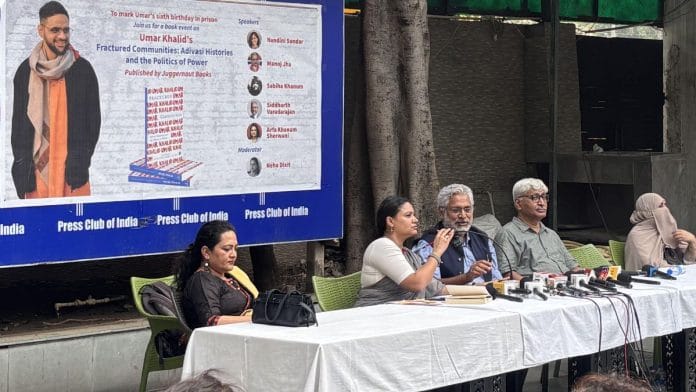


New Delhi: The monsoon clouds hung low over Delhi as the Press Club of India courtyard filled to the brim. There was a book on the table, poetry in the air, and a conspicuous absence at the centre of it all.
Umar Khalid turned 39 on 11 August, his sixth birthday in prison.
His book, Fractured Communities: Adivasi Histories and the Politics of Power, published by Juggernaut, had brought the gathering together. But, as the evening unfolded, it became increasingly difficult to separate the book from the man who wrote it.
The evening began with a message from Khalid, read out by author and journalist Neha Dixit, who moderated the discussion. In it was a poem by Faiz Ahmed Faiz: “Nisaar main teri galiyon ke ae watan, ki jahan. chali hai rasm ki koi na sar utha ke chale..”
The lines speak of a country where people cannot walk with their heads held high. Khalid ended his message with another line: “No one is free until everyone is free.”
The book is based on Khalid’s PhD dissertation at Jawaharlal Nehru University, submitted in 2018. Vineet Gill, executive editor at Juggernaut, said the decision to publish it came from the unusual combination of rigorous scholarship and readability. The book examines the tribes of the Singhbhum region of Jharkhand, tracing the first colonial incursions, the changing relationship between the state and local communities, and the evolution of those power structures.
But Gill said the book is ultimately about more than just history. It is also about how history itself is written. Khalid, he said, remains conscious of the “pitfalls and blind spots” of the historian and argues for a way of writing that leaves room for complexity. “What the historian needs is an honest voice,” Gill said.
Umar Khalid’s ‘biggest crime’
Khalid wrote the thesis while under trial after being charged with sedition in 2016. He spent a month behind bars and also survived an attack in 2018. He could not safely travel for fieldwork. By the end of his PhD, he was expelled from JNU and had to approach the courts to submit his thesis.
His mother, Sabiha Khanum, was among the speakers on the panel. For her, the publication of the thesis was a moment of extreme happiness, but also sorrow. She spoke of the years in which he completed the work amid court proceedings and the mental strain surrounding his arrest and trial.
People defend Umar, she said, but not everyone can know him.
“This is an opportunity through this book to know Umar, to know his thoughts, to know why he stood up, who he was talking about,” she said. “He talks about the tribals, he talks about the oppressed people, he talks about the minorities who are being suppressed. He raised his voice for them, and this became his biggest crime. And this is why he is behind bars.”
For his mother, then, the book was also a way of encountering a side of her son beyond the arguments and headlines that have come to surround him — a chance to know him through what he chose to study, and the people for whom he chose to speak. She finished with a moving poem:
“Umar tha shehr-e-adalat se aaj phir guzra,
Hisaar-e-jabr mein lipta badan sambhale hue,
Koi bhi khauf aaya na tha uske chehre se,
Labo pe uske ajab mauj thi tabassum ki.
(Umar had once again passed through the city of courts,
his body wrapped in the confines of oppression.
There was no fear on his face;
on his lips was a strange tide of smiles.)”
Also read: ‘Muslims have made themselves into ping-pong balls,’ Salman Khurshid says at Delhi book launch
A book capturing more than just history
For a few minutes, the academic discussion seemed far away. There was only a mother, a poem, and a son who was not in the room.
What the poem left behind was the question of who gets to tell a person’s story and what happens when that story is written from within the pressures of the present.
For Professor Prabhu Mohapatra, who was born in Chota Nagpur and was one of Khalid’s PhD examiners, the answer lay in the contradictions at the heart of Fractured Communities. The book looks at the gradual transformation of the region as the colonial state, the government, and eventually big capital entered its social and economic life.
But Khalid, Mohapatra said, does not try to resolve these contradictions. “He looks at them and holds them together and allows them to develop over time,” he said. At the centre is a tension between class and community, and the political constitution of the community itself.
That attention to history, and to the people within it, was also what made the book significant for academic Apoorvanand. The book, he said, was proof that Khalid was not merely the person known for raising slogans, but someone who had spent years thinking and researching.
“Umar Khalid is in jail because he is a thinker,” Apoorvanand said, linking the book to what he described as a larger crisis of academic freedom, sanitisation of curricula, and the shrinking of spaces in which students and teachers can question.
Rajya Sabha MP Manoj Jha saw in it a lesson about the cage in which any history is written.
“If I’m writing about the bulbul which is in a cage, I will write about the cage as well,” Jha said. “Bulbul cannot be separated from the cage she is placed in.”
It was also, he suggested, why Fractured Communities should be read as more than a history of a particular region. For Jha, the book is a guide to research itself, to how archives are accessed, how they are interpreted, and how people are not reduced to convenient sociological categories. Khalid, he said, “is not in a hurry to reduce people to sociological entities”.
Outside the language of academia, journalist Arfa Khanum Sherwani placed Khalid in a different landscape — that of the dissent and political movements of the past decade.
“Mausam hai inquilab ka,” she said, speaking of the generation that came of age around the anti-CAA and anti-NRC protests and of the events of last month.
For Sherwani, Khalid’s significance extended beyond the person himself, especially by the nature of him being someone with a Muslim name. He had become, she said, a symbol for young people who saw in him academia, dissent,and the right to question.
Siddharth Vardarajan brought the discussion back to the circumstances that had surrounded Khalid’s academic life and political activism. He described the present moment as an “era of madness”, speaking of what he saw as growing pressure on students, academics, and journalists.
By the end, the evening had moved far beyond a discussion of a PhD thesis. It had become an attempt to remember Umar Khalid through the questions he asked, the people he wrote about, and the voices that gathered around his work on his sixth birthday in prison.
(Edited by Aamaan Alam Khan)