



New Delhi: What happens to a university when its history begins to spill beyond its campus? At a talk in Delhi’s Zakir Nagar, Jamia Millia Islamia became a way to trace that question through its old publications, the poetry of people associated with the institute, and memories of the neighbourhood that grew around it.
“It’s the Jamia which defines Jamia Nagar,” urban studies scholar and JNU assistant professor Ghazala Jamil said at the DAG’s The City as a Museum programme, held at the Institute of Objective Studies. The discussion, titled “The University and its Publics,” also featured Ashoka University postdoctoral fellow Anab Naiyer and writer-editor Jamal Kidwai.
All three speakers were Jamia alumni, which gave the afternoon a feel of people returning to their own history rather than simply narrating someone else’s.
The making of a reading public
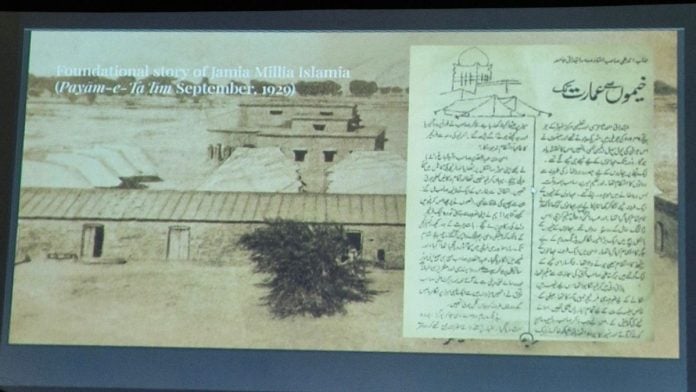
First up was Anab Naiyer, who spoke about Jamia’s oldest surviving publication, a small magazine called Payam-e-Talim, which began publishing in 1926 and ran for decades on very little money, kept alive by alumni donations.
Its early issues were around 14 pages long, but covered a wide range of topics. Alongside university news, fundraising and educational debates, there were pieces on literature and science, as well as features on student life.
Naiyer said the publication also carried translations of thinkers such as Plato, Kant, Rousseau and JS Mill, along with articles on crafts and practical activities such as preserving plants, making paper flowers, beekeeping and creating scrapbooks.
She argued that the magazine was closely tied to Jamia’s experiment with Nayi Taleem (new pedagogy), or learning through activity.
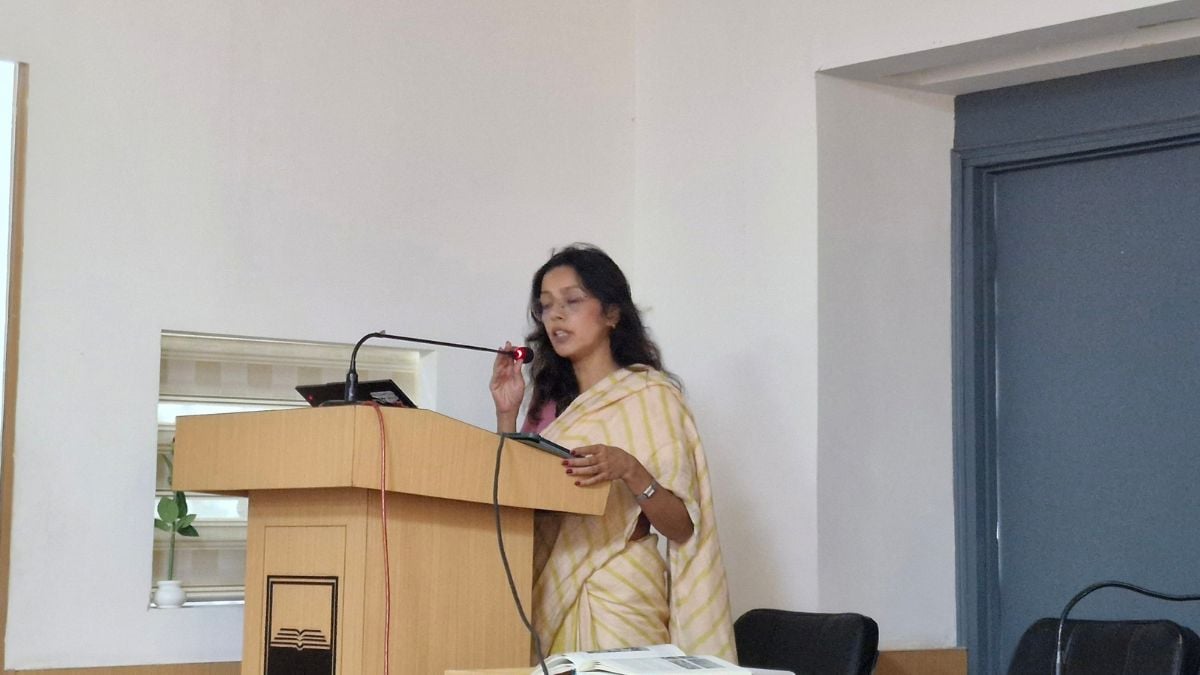
“Academic subjects such as mathematics, social studies and language were taught through hands-on engagement with productive craft like spinning, weaving, gardening, soap making, etc,” she said.
According to Naiyer, the magazine reflected an educational model in which knowledge was not meant to remain confined to the classroom.
As she went through the magazine’s yellowed pages on the projector, the audience squinted at the screen, trying to make out the text and illustrations.
The magazine logo carried a torch and the words Jaago aur Jagao – wake up and awaken others.
“Jaagna is not enough,” Naiyer said. “You also have to awaken other people.”
The magazine, she argued, was helping create more than a readership. “It was creating a kind of reading public around Jamia that also offered ideas about what it meant to be a student, a teacher and a person associated with the university,” she said.
Also read: From Jama Masjid to Yamuna floodplains, what made Delhi the city it is today?
Jamia, the neighbourhood and the idea of home
Ghazala Jamil’s discussion then moved from Jamia’s educational history to the neighbourhood around it.
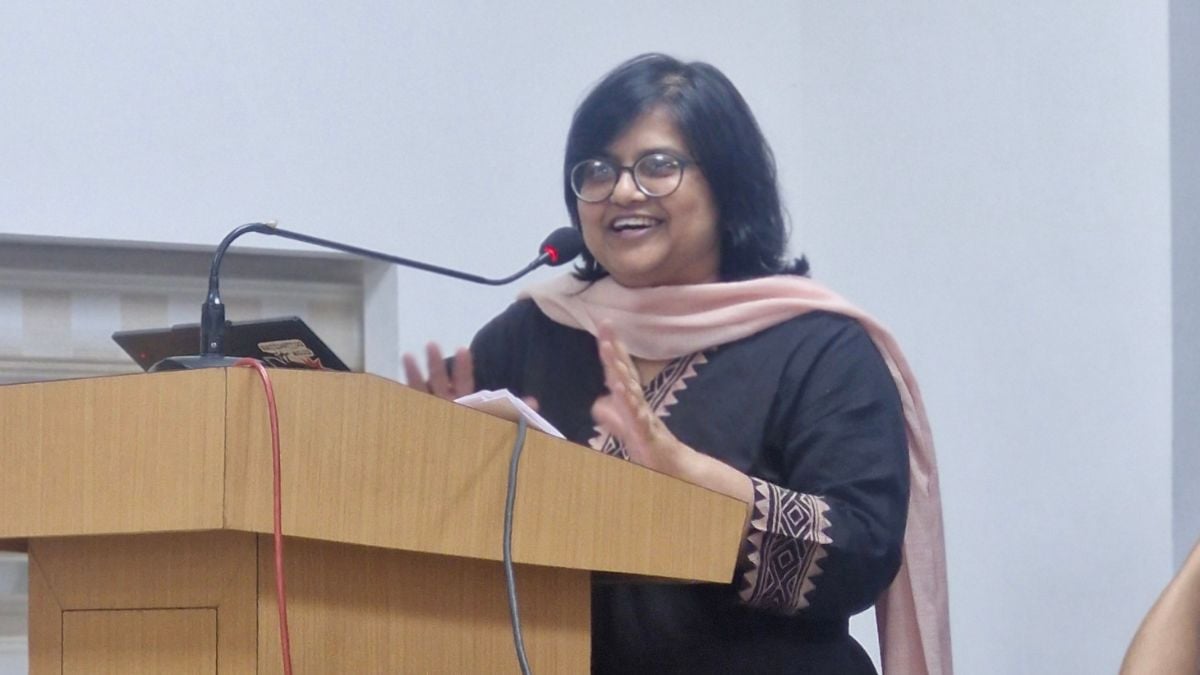
“At Okhla where I get off / I pass my parents / strolling by the Jamuna River,” Jamil began with Agha Shahid Ali, whose poem imagines a journey into 1948 Okhla and an encounter with his parents as younger versions of themselves. The poem brought together the university, the neighbourhood, and family history: Shahid Ali’s father was a faculty member at Jamia, and his parents met there.
Jamil then turned to Pakistani feminist poet Fahmida Riaz. She came to India in the early 1980s and spent 1982-83 as a poet-in-residence at Jamia after facing political persecution in Pakistan. Reciting Fahmida’s poem, Dilli teri chaanv badi qahri, Ghazala said, “Tu sada suhaagan ho maañ ri / Mujhe apni tod nibhaana hai,” addressing Delhi as a mother where she found asylum.
For Jamil, the two stories offered a way to think about the university not only as an institution, but as a place where people formed ideas of home and belonging and carried them with them.
“That sense of movement was also part of Jamia’s own history,” she added.
The university began in Aligarh, moved to Delhi and settled in what is now Jamia Nagar, an area that was still largely agricultural at the time. In the 1980s, she recalled, people still referred to parts of the neighbourhood as Okhla “Gaon,” while Old Delhi was known as “the city”.
Jamil described Jamia as an “immigrant university” – an institution that had itself moved from one place to another before establishing itself in Delhi, and which then became a point around which communities developed.
“Jamia Nagar came up as a community of people around the university,” she said, describing the area as an intellectual community and public that developed alongside Jamia.
It was this history, of a university and a neighbourhood built in tandem, that Jamil used to question the word that had followed the area for decades — a ghetto. She said the way people associated this term with Jamia Nagar rarely accounted for its rich history.
“Jamia Nagar, I would say, is not a ghetto,” she said, pausing before adding, “and certainly Jamia University is not a ghetto.”
Also read: Jamia students back Jantar Mantar protesters, ask why no one stood with them
The change in Jamia’s shared world
Jamia alumnus Jamal Kidwai brought that changing landscape into sharper focus through memory.
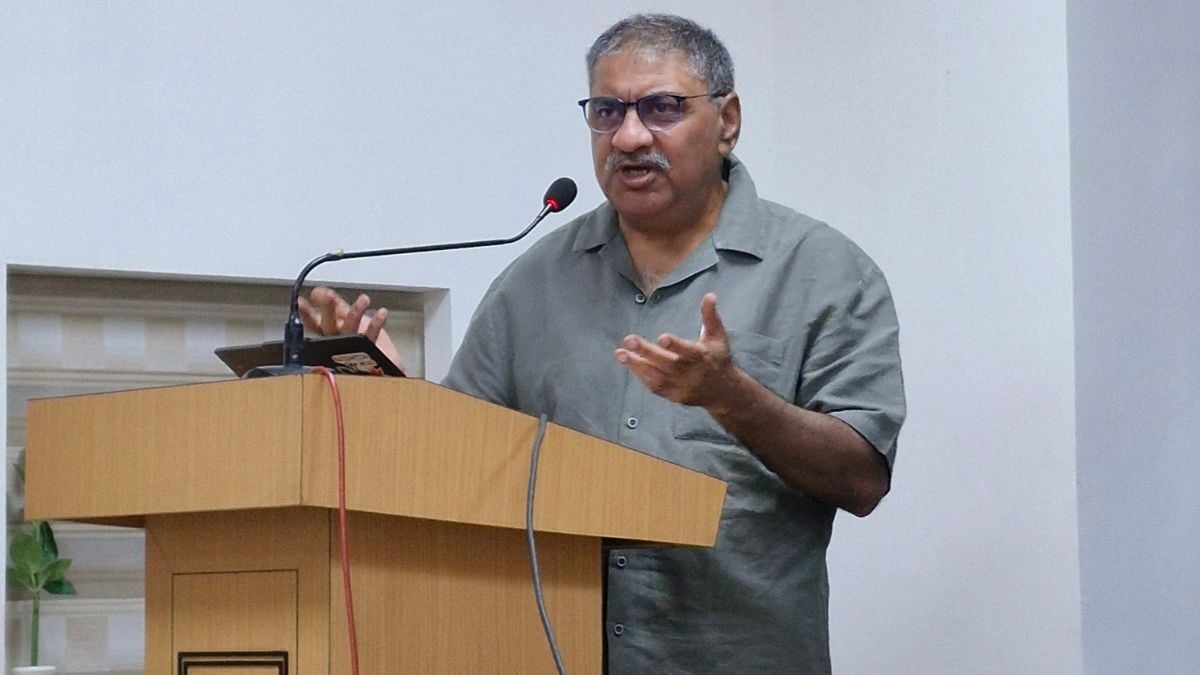
Speaking of Jamia in the 1970s and early 1980s, he recalled a much smaller neighbourhood: Jamia school and university, the teachers’ training college, Okhla village, and parts of areas like Noor Nagar and Batla House just beginning to develop.
“It was by and large a Jamia community. There was a lot of intermingling between the neighbourhood community and the Jamia academic community,” he recalled.
The boundaries between campus and neighbourhood were porous. He recalled how people from outside Jamia were allowed to use its grounds, often without strict security checks; how children went to watch sports day events, and how festivals like Holi and Diwali were celebrated on campus.
Kidwai also remembered children watching television at the hostel warden’s house.
“The politics of Jamia was very gentle,” he said. “It was all very, very shared.”
But that sense of shared space did not remain untouched. Kidwai traced the changes through the political churn of the 1980s and 1990s, when communal violence, the Shah Bano controversy, the Ram Janmabhoomi movement, the Mandal Commission and other political conflicts reshaped student politics and the neighbourhood.
Before 1980, he said, campus politics had a mild left-wing streak. Student groups like the AISF, some sympathetic teachers, but nothing organised around party lines. That changed once Jamia’s identity as a Muslim institution turned it into electoral currency.
“All these political parties had a stake here, because it was seen as a vote; it was seen as a political issue,” he said. “Jamia, being a Muslim institution, became an attractive mobilisation place for all the political parties. And that’s when the student politics transformed here.”
The university community itself split along these fault lines. “There was a group there, which was pro and anti,” he said of the Shah Bano debate. Student politics turned violent in ways that Kidwai had never seen before.
He recalled a once-lively hub of shops and restaurants near the campus turning into contested ground: “There was a lot of violence; brutal incidents of very bad violence happened there.”
Against that history, Kidwai pointed to the present movements that felt different – the anti-CAA protests of 2019.
“During the CAA movement, Jamia was right up front, and it was the university which actually took the lead,” he said, describing it as a return to something older in the university’s character.
“One was reminded of the old Jamia, which was nationalist, or secular, or what we call the constitutionalist tradition. This was where Jamia kind of re-asserted itself.”
By the time the session ended, the fully seated room began emptying in twos and threes, conversations spilling into the small space outside the hall. The crowd, mostly composed of Jamia alumni and current students, stood around exchanging names, batches and hostel blocks, reconnecting across generations of the same university.
(Edited by Prashant Dixit)