



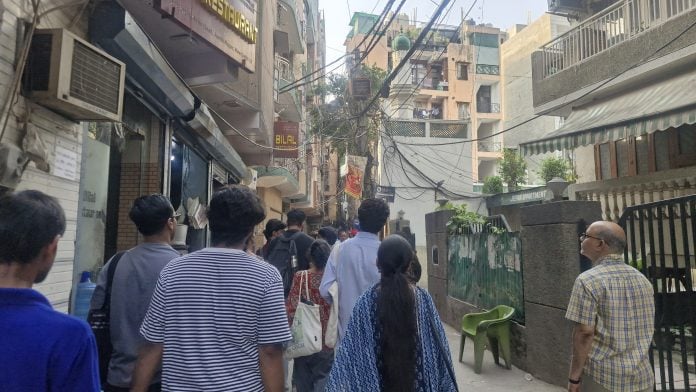
New Delhi: Delhi’s neighbourhoods reflect more than what is laid out in maps and master plans. “Where people live, what gets built around them, which communities are pushed to the edges and how a neighbourhood comes to be seen from outside are all part of the city’s geography,” said DAG member Monami Goswami.
Rather than information, the journal carried questions for the participants: What kind of movement does this street allow? What makes it difficult? Can one tell where one building ends and another begins? What would it be like to live in one of these buildings?
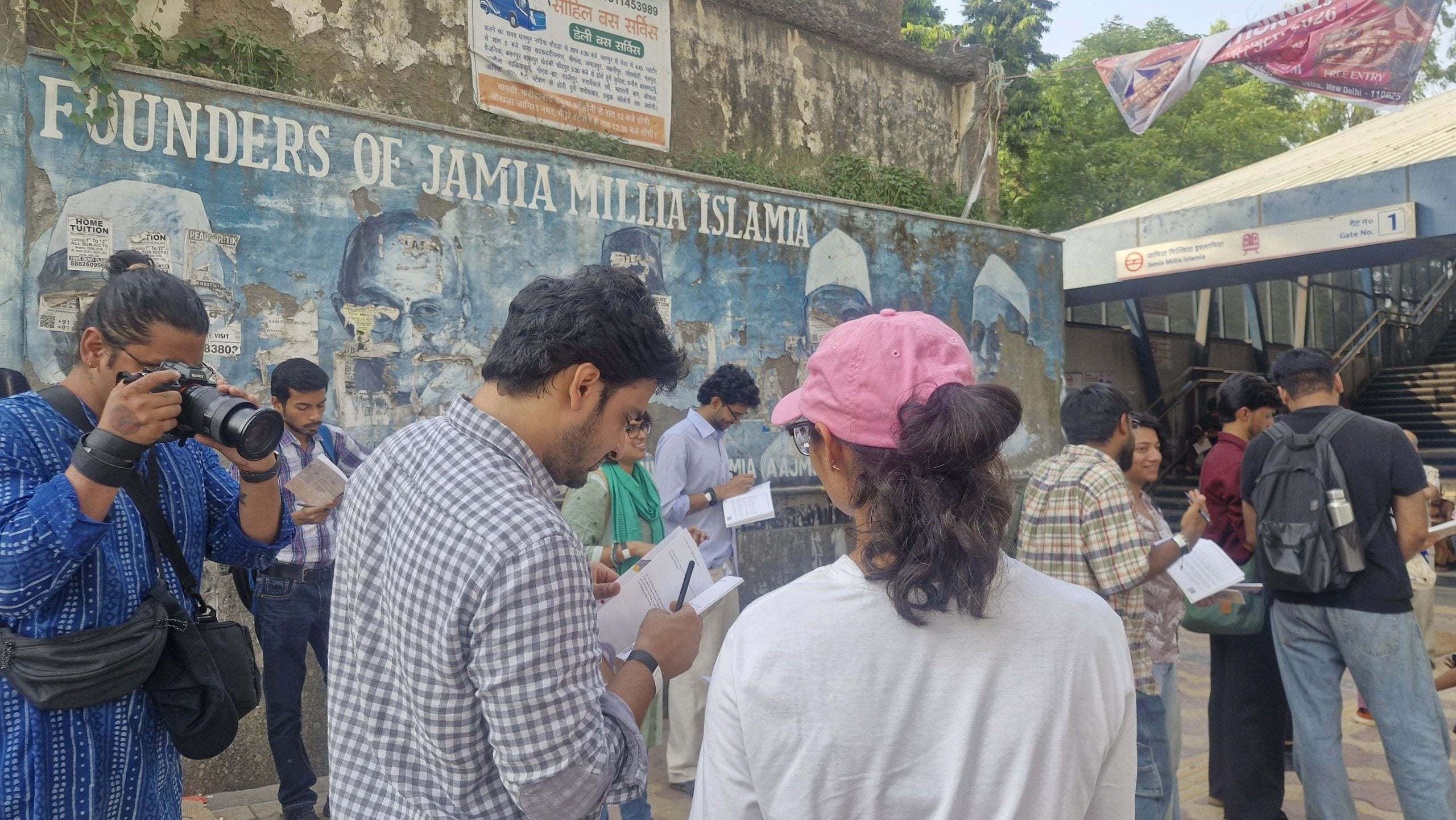
The questions would follow them through several stops at Jamia Nagar – Jamia Metro, Tikona Park, Jama Masjid, the accompanying lanes, and finally the Yamuna floodplains, allowing the neighbourhood to unfold in layers.
How Jamia Nagar came into being
Delhi Art Gallery (DAG) member Monami Goswami began the session at the first stop, standing near the metro bridge, traffic humming behind her.
“Cities don’t just happen; they’re built. And who ends up living where is very often not something people choose for themselves”, she told the group. “It is a result of many historical and social reasons.”
Delhi’s master plans, she said, are full of promising language – “resilient,” “inclusive” infrastructure.
“But on the ground, in a neighbourhood like Jamia Nagar, that language rarely translates into anything visible,” she said. She pointed out how the area doesn’t even have a playground.
Going back to the 1960s, she emphasised how Delhi’s master plans either left the area’s residents off the map entirely or classified it as a lal dora zone – a way of marking a place as unsanctioned.
The distinction sounded abstract until the group began walking.
Participants were asked to set off in pairs and trios rather than as a single procession. Some paused at shopfronts along the lane opposite the station, taking in the surroundings, while others waited at the road’s edge before crossing. “God, how do I cross it?” one participant said, as the traffic moved past.
Tikona Park
By the time the group regathered at the second stop, Tikona Park, the faint sound of the Asr (late afternoon prayer) could be heard.
At Tikona Park, poet and social activist Rachit took over the session. He traced the neighbourhood’s growth from agricultural fields around the university to a site of refuge after the anti-Sikh riots and later the Babri Masjid demolition, when families from UP and Bihar settled here for safety and proximity.
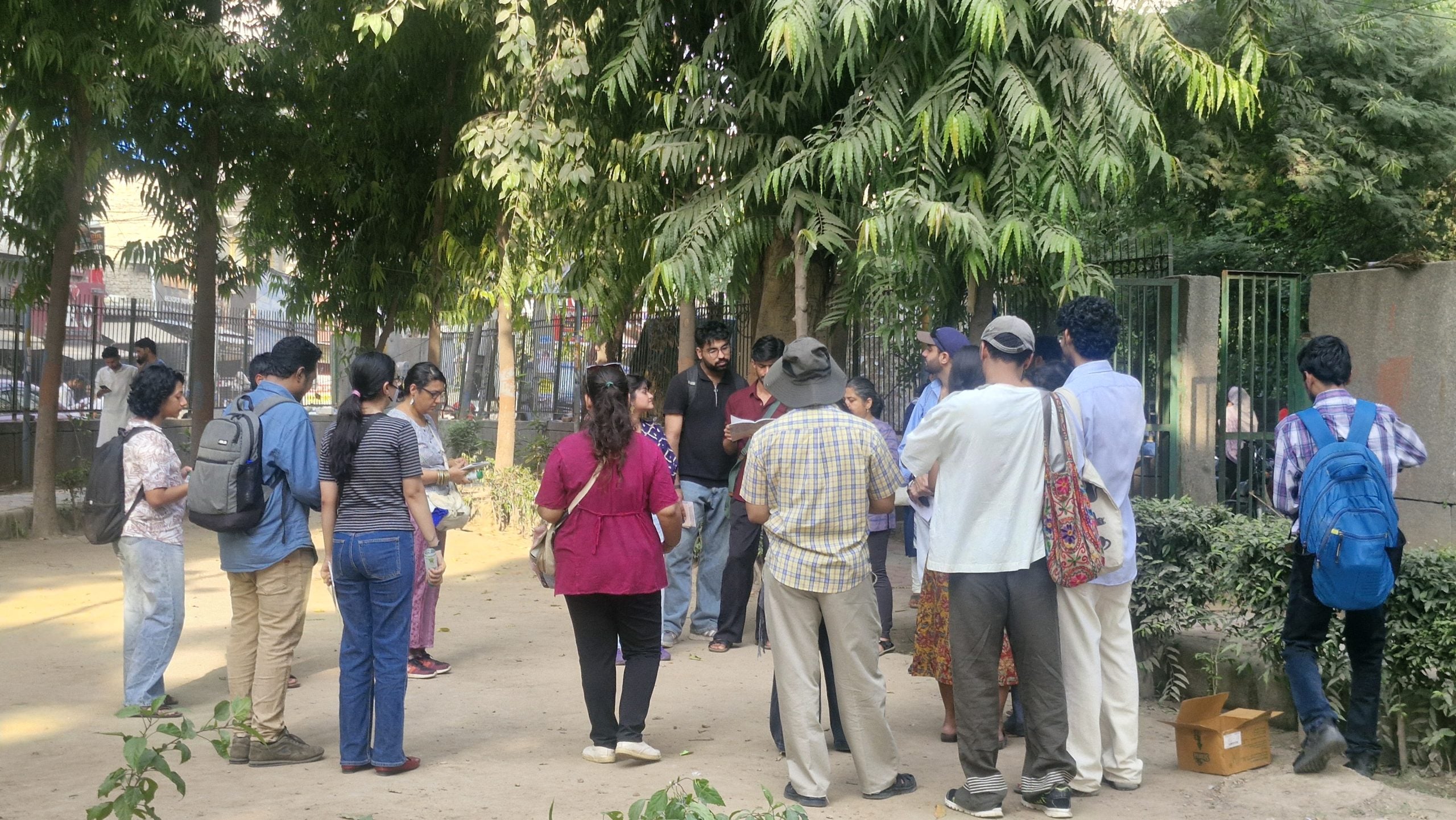
That expansion, he said, happened without the facilities to match it. “Lack of sanitation, schools, and healthcare pushed the area into the shape of what gets casually called a ghetto. The Jamia that we see right now is a bit of its politics, is a bit of its culture. But it’s a lot about how it feels on the outside, how it’s profiled from the outside,” he said.
Before the walk resumed toward the Jama Masjid, he read out lines from Dastur, a nazm (a poem) by the Pakistani poet Habib Jalib.
“Deep jis ka mahallaat hi mein jale, chand logon ki khushiyon ko le kar chale…” Rachit recited, referring to the poem’s critique of a system built to serve only a fortunate few.
Rachit asked participants to carry the poem with them rather than simply listen to it – to notice whether a word, an image, or a passing thought stayed with them as they walked, and to jot it down in their journals if it did.
“Walk, stop, reflect, resume,” he told them, urging the group to move through the neighbourhood at their own pace and let the surroundings shape the way they read the poem.
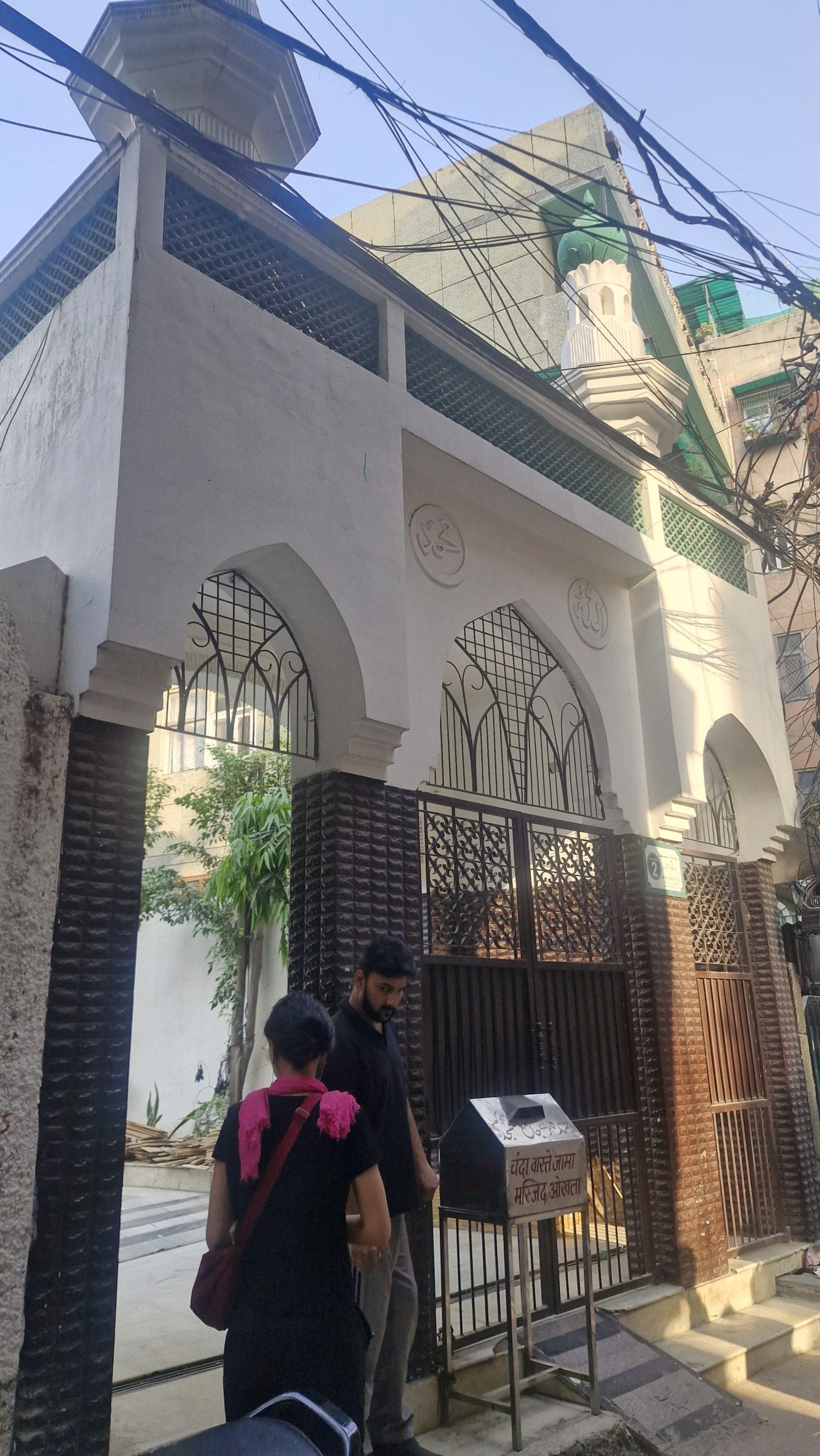
The Jama Masjid
The lanes towards Jama Masjid, the third spot, narrowed further. Food shops opened onto the street, pedestrians squeezed past e-rickshaws at the corners, as the group walked in a queue.
At Jama masjid, the Asr prayer had just ended. Some residents coming out of the mosque glanced at the gathering curiously, while a few paused to listen before continuing on their way.
From there, the conversation returned to the streets and to what the walkers had noticed since leaving Tikona Park.
The answers were immediate and varied. One participant mentioned a foul smell; another pointed to the congested streets. A third noticed something different: unlike some other low-income neighbourhoods, Jamia Nagar did not immediately show the class markers she expected to see.
“You can easily spot some very expensive cars and quality brands. Even some of the shops are not what you would normally find in ‘ghetto’ areas, catering to low-income communities. There’s a ramen shop, there’s a gaming shop,” she said.
The observation brought Goswami back to the word “ghetto” itself, and how easily it can reduce a neighbourhood to its congestion, lack of infrastructure, or perceived class.
“A ghetto is never a place people choose willingly; it is the outcome of discrimination, of communities pushed together for safety rather than drawn together by preference,” she said.
Rachit then closed the stop with “Ye Hai Jamia Ki Ladkiyan,” a poem by Aamir Aziz written around the anti-CAA protests of 2019, when Jamia Nagar briefly unexpectedly became a centre of resistance. According to Rachit, this was a reputation the neighbourhood carried until the pandemic, after which, he noted, it came to be known widely for its food outlets.
Yamuna Floodplains
Then came the walk toward the final stop, the Yamuna floodplains.
“As we start walking towards the floodplains, the landscape may begin to change. The density may recede a little; it may also get pushed, or rather relegated to the peripheries along with the sight and sound,” Rachit said.
The DAG team suggested taking rickshaws but recommended walking for the fuller sensory experience. Almost everyone chose to walk.
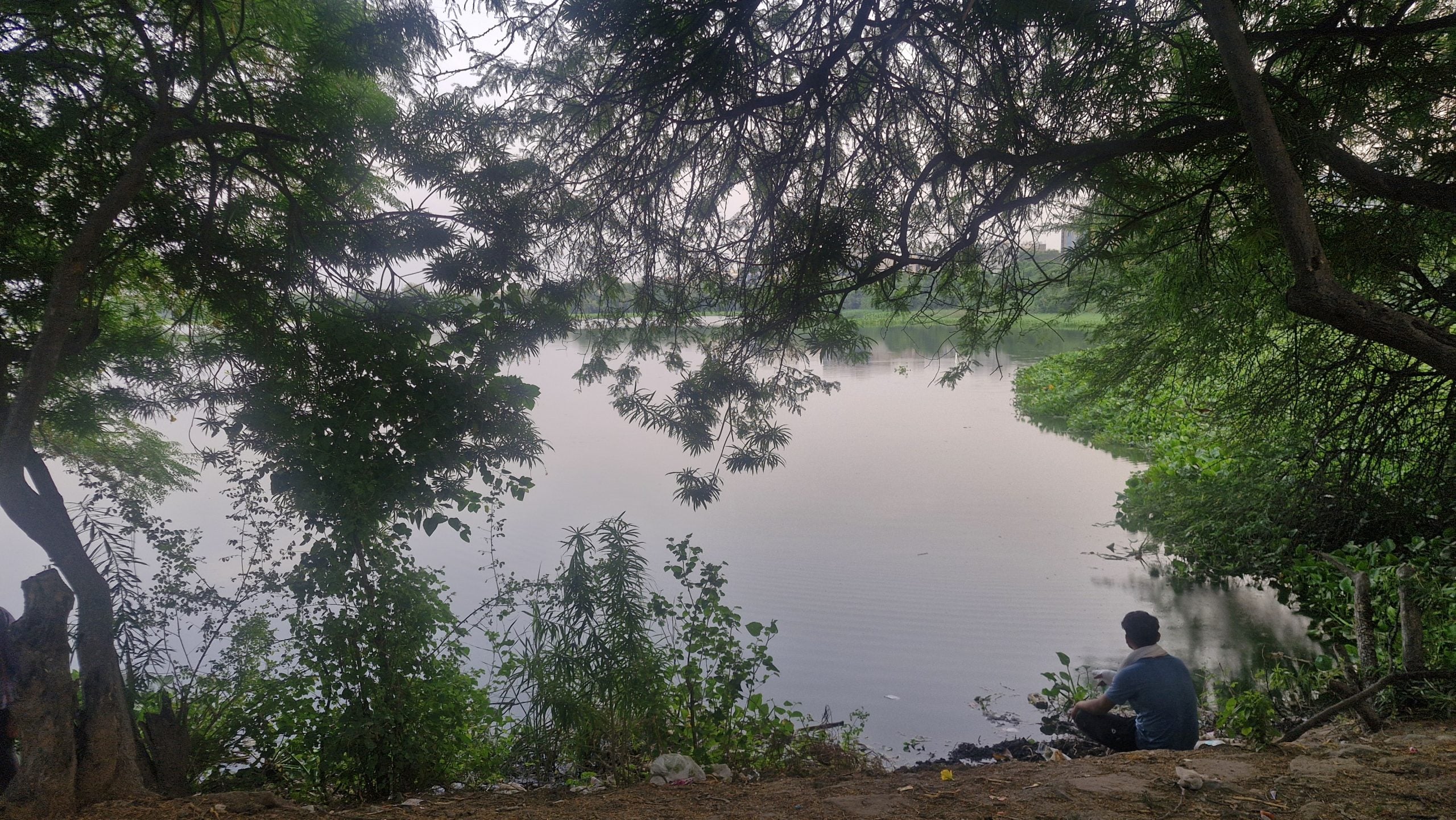
The route passed through busy lanes and khacchar (donkey) stables before gradually growing quieter. The sun had begun to soften, and people stopped to photograph the changing landscape. When the Yamuna finally opened up before them, the sudden expanse felt markedly different from the mohallas they had just crossed.
“It feels like the city has faced away from the rivers,” one participant remarked.
Rachit then recited lines from his poem, “Dariya, baadal, aur baadshah.”
“The river takes shelter in the world tonight, her lashes ache with the weight of clouds,” he recited, describing how the poem brings together the river, the people living around it, and the city that has grown around them, reflecting on how both the river and its people can be pushed to the edges.
He then asked everyone to spend five minutes writing – not another answer to the journal’s questions, but a small passage capturing the afternoon. People scattered along the riverbank. While some wrote, some sketched faint images of the river, and the chatter fell away.
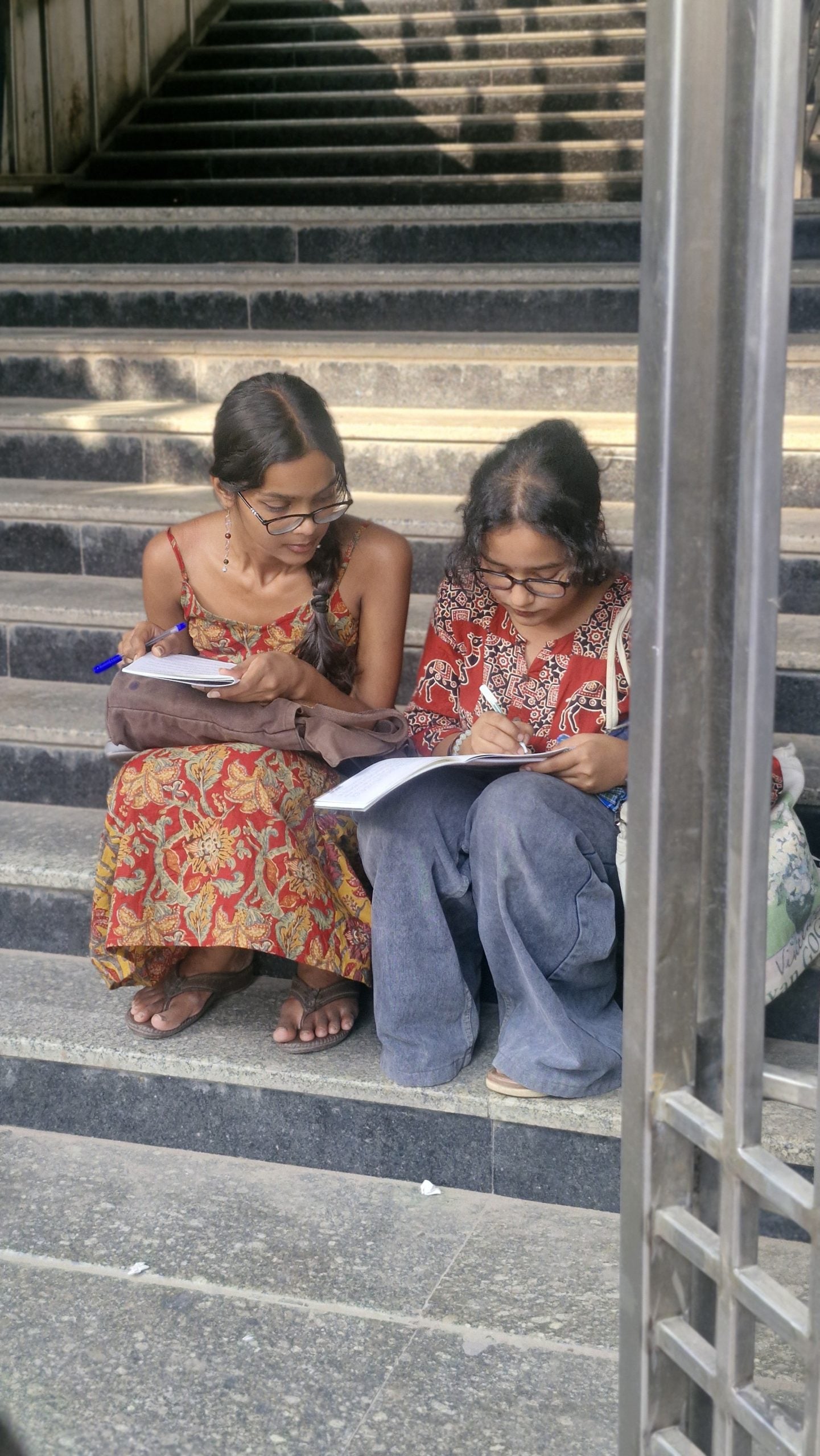
When the exercise ended, Rachit offered a final thought: “The Jamia Nagar mohalla could not come to us, so we had to come to it” – to walk its lanes, listen to its sounds, and let the neighbourhood reveal itself beyond the labels attached to it.
The organisers handed everyone a chocolate bar before the group dispersed. A few began the walk back; others stayed beside the river. The humidity had finally eased, and in the fading evening, the faint sound of the Maghrib prayer travelled across the open stretch as people slowly walked back into the Mohalla.
(Edited by Aakriti Handa)