



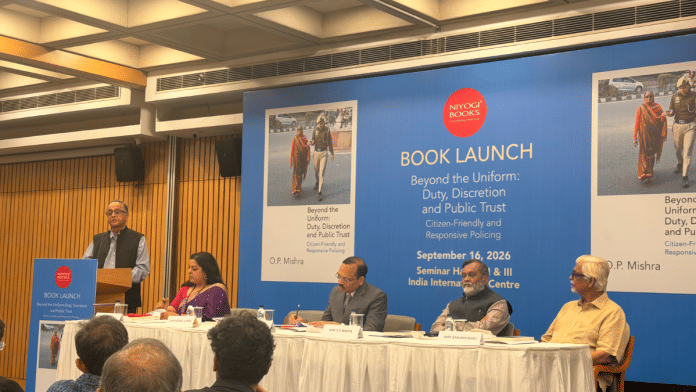
New Delhi: Policing works best when it is treated as a service, not a display of power, and the gap between the two is what is eroding public confidence in the force. That was the central argument at the book launch of former IPS officer OP Mishra’s Beyond The Uniform: Duty, Discretion and Public Trust. Chief Justice of India Justice Surya Kant was present as guest of honour at the event on 15 September at Delhi’s India International Centre.
“Trust deficit between police and citizens is a global phenomenon today,” Mishra said, a statement that anchored his talk and, in many ways, the book itself.
The room included many former South Block and Tilak Marg officials in attendance, along with politicians, diplomats, bureaucrats and academics. Former Union minister Kejriwal Kwan, Rajya Sabha MP Rajiv Shukla, Supreme Court secretary general Bharat Parashar, along with retired diplomats, senior bureaucrats and university professors filled the hall. Several of them, Mishra noted proudly, had travelled from outside the city just for the event.
Mishra, a veteran of the force, has served everywhere from the South District Delhi to the Chandigarh Police headquarter, began by thanking his mentor, Neeraj Kumar, under whom he trained as a young Assistant Commissioner in Greater Kailash in the early 1990s. Kumar also wrote the foreword of the book and was among the panellists for the launch.
Mishra explained that his new book reframes policing not as a “power centre” but as a service delivery mechanism—an idea he traced back to the Second Administrative Reforms Commission’s description of police stations as “service centres.” He added that registering an FIR is a basic function of the police, meant to facilitate a service to a victim in distress, but trust between police and citizens has eroded, not just in India, but globally.
More than a uniform
Mishra didn’t shy away from the force’s less-discussed struggles. Citing a global survey, he noted that one in every seven police officers worldwide suffers from post-traumatic stress disorder or depression. He also said that one in ten struggles with mental illnesses, a subject often treated as a taboo rather than being disclosed to peers.
“The welfare dimension, working conditions and mental health issues of police personnel are often overlooked while assessing the performance of the force,” he said.
Sanjaya Baru, the former media advisor to Prime Minister Manmohan Singh and a JNU classmate of Mishra’s from decades ago, was next to speak. Baru, ever the columnist, used his time at the mic to deliver a reality check on the publishing business as much as a tribute. Authors, he reminded the room, don’t get to stop working once the manuscript is done.
“Your job doesn’t end by writing a book. It ends only when you have been able to create sufficient noise around it so that people actually end up buying it,” he said.
Baru situated the book’s release against a bruising few weeks for police PR: from IPS Bushra Bano’s sudden transfer in Bengal to a Hyderabad police chief’s participation in a temple prayer session, both of which were amplified and scrutinised widely on social media.
“Police have got a bad name. There isn’t a day when there is no controversy around some incident or other in some corner of the country or other,” he said.
Addressing the trust deficit between citizens and the police forces, the political analyst said: “You don’t want to go to a police station. You want to solve the problem without going to a police station. You don’t know whether the problem will be addressed or not.”
In that climate, Baru said, a book built around an officer’s personal record of duty and discretion felt important.
Also Read: TM Krishna wants ‘Jana Gana Mana’ sung in every Indian language, in the same tune
Personal experience and public consensus
On the other hand, Mishra’s old boss and former Delhi Police Commissioner leaned into stories from his own tenure, including his time running Tihar Jail.
Kumar recalled how former criminals he had once arrested would greet him fondly during his rounds, and often shared anecdotes of how he had caught them. His central theme was the lack of supervisory follow-through in Indian policing. He recalled poring over charge sheets line-by-line as Commissioner, and how in the Nirbhaya case, a careless early draft had left the identity of the bus driver ambiguous.
“If everybody is busy assaulting the girl, then who is driving the bus? It was not clear in the charge sheet who the driver of the bus was,” he recalls asking his senior officer before directing them to make the fix.
Mishra said that this helped avoid the error from becoming the trial’s most contested point.
“This is just an example for me to emphasise that unless there is supervision… good penmanship and good capacity to read through the documents, and particularly through the charge sheet, is very, very important….We have this funny macho image of ourselves that we don’t have to read, we don’t have to write, we are just people who are in action,” he added.
On the layers of supervisory rank above an investigating officer, the retired IPS officer remained vague.
“How much contribution are these supervisory levels actually providing to the investigation? That is something to be seen and something to be improved upon,” he said.
CJI Surya Kant, who has known Mishra since his days as Police Secretary General in Chandigarh, when he was a judge of the Punjab and Haryana High Court, described the author as “an officer of exceptional integrity,” and a phrase he stood by.
The CJI structured his address around the book’s title, walking the room through duty, discretion and public trust as three “interlocking pillars” of constitutional policing. Duty, Kant said, isn’t confined to obedience to the law but is realised through the discipline of everyday preparation.
“Some of the finest police work is precisely that which prevents a difficult situation from even becoming a crisis,” the CJI said.
He was equally direct on discretion.
“The same legal power may be exercised with haste or with patience, mechanically or with understanding,” he added.
By the time the formal remarks wrapped up, the consensus in the room seemed to be that Beyond The Uniform had arrived at an opportune moment for the force’s public image.
(Edited by Insha Jalil Waziri)