





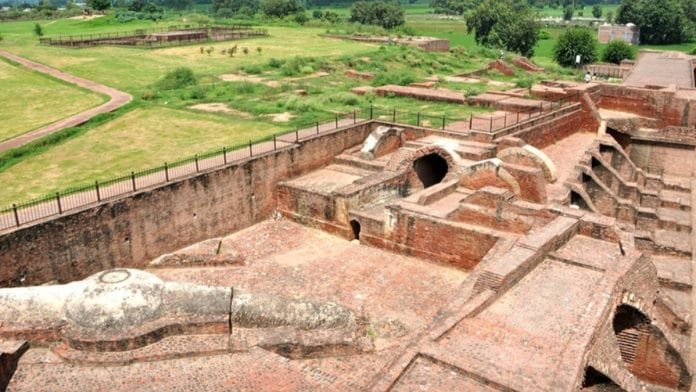


New Delhi: Harshavardhana, the last great ruler of early medieval India, moved his capital from Thanesar, Haryana, to Kannauj, Uttar Pradesh, in the sixth century. To trace the evidence, the Archaeological Survey of India extensively excavated his ancestral place in the 1980s but took four decades to finalise the report.
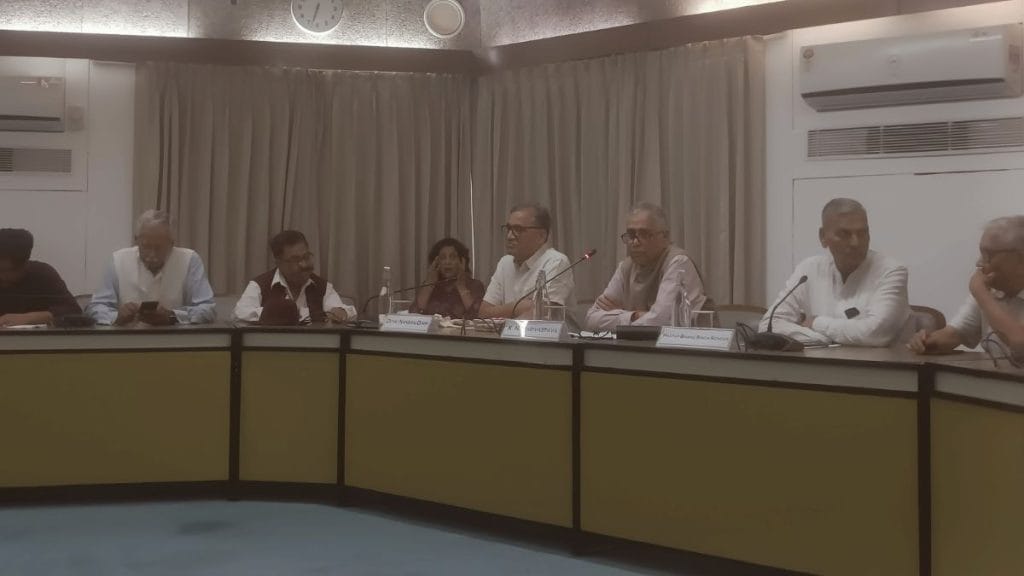
The lecture, titled Puspabhuti or Vardhana of Thanesar with special reference to excavation at Harsh ka Tila, Kurukhetra, Haryana, took place at the India International Centre (IIC), New Delhi, on Tuesday. In the lecture, archaeologist DN Dimri announced that the excavation report has been submitted to the Archaeological Survey of India (ASI) Director General, Yaduvbir Singh Rawat, after a significant delay.
IIC director and former DG of ASI KN Shrivastava chaired the lecture. Excavators of Harsh Ka Tila BM Pande and other senior ASI officials were present among the audience.
“Dimri was tasked to submit the excavation report, which he has already completed. We are hopeful that the report will be published very soon. And all those people who are interested in knowing the historical details of that period, they will definitely benefit immensely,” said Shrivastava.
‘I am guilty’
When excavators dig a site, it often takes several years to complete the final report. Similarly, in the case of Harsh Ka Tila, excavation began in 1987 under Pande’s direction, but after almost four decades, the final report was not yet completed.
“I’m guilty of not being able to prepare the report of the excavation which was carried out under my supervision,” said Pande.
The renewed focus on Harsh Ka Tila is not just about uncovering the remains of a settlement linked to Emperor Harshavardhana. It is also about rescuing decade-old archaeological work from institutional limbo.
Dimri said that Pande was very keen to write the report, but due to certain circumstances, he could not.
“So, I thought that I should initiate. I consulted him and visited Thanser and remained there for 15 days at my own cost and have tried to write,” said Dimri, who is the former joint director general of ASI.
Dimri recalled that archaeologist Vasant Swarnakar was in the Chandigarh circle nearly a decade ago as a Superintendent Archaeologist and had deputed one of his juniors to write the report.
But years have passed, and the drawing of the site has completely faded. Dimri said that there is nothing to work out from the old drawing.
“I was under the impression that whatever structures have been excavated, they have already been conserved here. So, let us prepare the drawing of these structures, which are already exposed here and prepare a complete report,” he added.
That is the only part left, and the rest of the report has been done, Dimri said, adding, “I thought that I should not keep it with me, and after consulting Pande, I handed over the report to DG ASI.”
As DG Rawat is his classmate, he assured him that he would get it published.
However, assurances would not be enough as ASI has no printers to publish its reports. Recently, the organisation invited a tender application to get printers.
Also read: Babur’s Baburi to Salim-Anarkali—an evening of Mughal romances in Delhi
A flourishing settlement over centuries
Shrivastava said the excavation also indicates a flourishing settlement that existed at the site.
Harsh ka Tila, one of the most important political power centres in North India, is situated in Kurukshetra, and the site has revealed remains of successive cultural phases, starting from the Kushan to the late Mughal period without any gaps. The site has residential buildings, including a palace complex from the post-Gupta period.
Dimri said that during the excavation, Painted Grey Ware (PGW) pottery was also found, but not in the stratified deposit. Veteran archaeologist BB Lal linked PGW pottery with the Mahabharata.
“But from the kind of PGW shards we have recovered, it appeared that there was a PGW settlement near the Harsh ka Tila,” said Dimri, showing different kinds of potteries and artefacts unearthed during the excavation.
It included knife-edge potteries from the Rajput period to Mughal period pottery and artefacts such as bull figurines from the Kushana period, male and female figurines.
Dimri said that Harshavardhana’s Thanesar has been extensively excavated, but Kannauj, where he spent most of his time, has never been excavated by ASI.
“We require to excavate Kannauj properly and link the archaeological evidence of the Vardhana period to Thanesar and Kannauj,” he said.
Also read: Audience at Irish embassy’s music event became the choir themselves
Why Harshavardhan shifted his capital
Around 612 CE, Harshavardhan shifted his capital from Thanesar to Kannauj. According to Dimri, the strategic location of Kannauj was important as it is situated at the fertile Ganga-Yamuna Doab, providing a more cultured and easily defensible position for controlling Northern India compared to Thanesar.
“Kannauj was the better place to administrate the entire region of the Vardhana period,” said Dimri, adding that Kannauj’s location on the Ganga river facilitated trade and communication across the empire and allowed him to direct his military campaign towards the East, including Bengal.
Dimri said that as there was no successor after Harshvardhana, the Vardhana dynasty declined.
But in India’s ancient history, Harshavardhan was an important figure. Shrivastava said Harsh Ka Tila is a very interesting site, and significant history is attached to it.
“King Harshavardhan was one of the many celebrated kings that this country has. He ruled the northern part of the country and was the one who really popularised the Kumbh festival. He gave Kumbh a pan-India kind of recognition,” said Shrivastava, adding that the tradition has been continued since then.
Shrivastava said he was also very secular in the sense that he was a born Hindu, but later on he converted to Buddhism.
“But his respect for Hindu religion, for Jainism and other religions was very profound,” he said, adding that ASI brings out the credible evidence of his time.
(Edited by Saptak Datta)