







New Delhi: For years, the conversation around India’s low female workforce participation has centred on one explanation: social norms. But what if the bigger problem is not that women are unwilling or unable to work, but that the economy is not creating enough jobs worth taking?
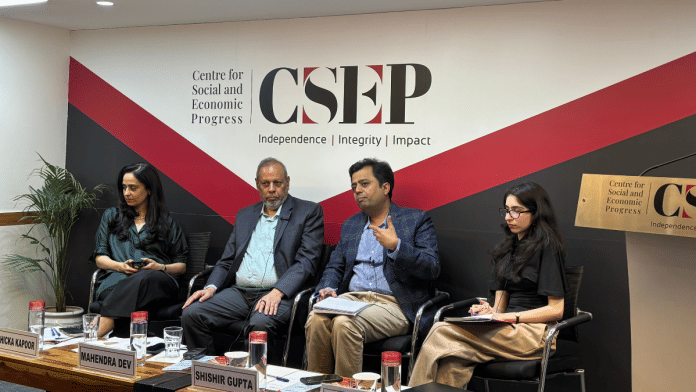
That was the central argument at a seminar titled “Why Do Fewer Women Work in India? Demand Matters”, organised by the Centre for Social and Economic Progress (CSEP) in Delhi on 10 July. The discussion centred on a new paper by CSEP researchers Aalhya Sabharwal and Shishir Gupta, which argues that while education, safety and gender norms remain important, India also needs a stronger labour demand if it hopes to bring more women into paid employment. To match the female labour force participation rates of developed economies by 2047, the paper estimates that India would need to add at least 90 million more women to its workforce, potentially increasing the GDP by more than $700 billion at current productivity levels—or as much as $1.4 trillion if 80 per cent of women move into non-agricultural work.
The seminar was chaired by Mahendra Dev, Chairman of the Economic Advisory Council to the Prime Minister. Franziska Ohnsorge, Chief Economist for South Asia at the World Bank, joined virtually. Radhicka Kapoor, Senior Employment Specialist at the International Labour Organisation (ILO), and CSEP Senior Fellow Shishir Gupta also joined the panel. The discussion drew academics, policymakers and researchers, many of whom stayed on for an extended discussion.
Presenting the paper, Sabharwal noted that India’s female labour force participation rate stands at about 35 per cent, still low compared to other countries. She said 72 per cent of the recent increase in women’s participation came from agriculture and self-employment, while only 28 per cent came from non-agricultural employment. With youth unemployment hovering around 40 per cent, she argued that improving social norms alone would not be enough if the economy failed to generate quality jobs.
“Our underlying basic argument is that we don’t want to just focus on improving women’s share in participation, but more on increasing the size of the pie—the employment overall,” Sabharwal said.
Also Read: From Chawri Bazar to Wimbledon—Kuremal Kulfi goes international
A comparison of labour participation
Drawing comparisons with Bangladesh and the Philippines, researchers argued that stronger labour demand, particularly through labour-intensive exports, has played a major role in increasing women’s employment. Bangladesh’s ready-made garments industry, whose share in exports has grown from around 4 per cent in 1983 to nearly 80 per cent today, illustrates how export-led manufacturing can pull women into the workforce. Within India, the paper contrasts Bihar, where low income levels remain a major constraint on women’s employment, in Himachal Pradesh, where higher female participation reflects both stronger economic conditions and greater female employment intensity.
They further recommended enhancing labour market flexibility, encouraging export-led growth in labour-intensive sectors such as textiles, rationalising tariffs, and increasing investments in health and education—industries that both generate employment and employ relatively larger numbers of women.
Opening the discussion, Dev said that the paper effectively shifted attention towards labour demand, while also urging participants to look beyond the number of jobs being created.
“A million jobs in construction, government, health care and business services may have very different effects on women,” he observed, asking which sectors and locations are most likely to draw women into paid employment. Referring to experiences from countries such as Bangladesh and the Philippines, he also questioned whether there were common lessons from Asian economies that had managed to increase women’s participation through different paths of economic development.
Ohnsorge welcomed the paper’s emphasis on demand, saying discussions around women’s employment have focused too heavily on supply-side factors.
“It’s a lack of labour demand that affects both women and men. The breakthrough in employment may only come once we have a big break in demand,” she said.
While Bangladesh’s garment industry had transformed women’s employment, Ohnsorge cautioned that the average retirement age for women in the sector is 35 years, highlighting the need for sustainable career opportunities. She also pointed to Saudi Arabia’s sharp rise in female labour force participation after legal reforms coincided with stronger labour demand, adding that India’s expanding trade agreements, which now cover economies accounting for roughly 60 per cent of global GDP, up from around 30 per cent, could provide a similar demand-side boost.
Meanwhile, Kapoor described the paper as an important contribution to a growing body of research examining labour demand, an area she said had received far less attention than supply-side explanations.
“I think increasingly female labour force participation is not just a social and moral imperative, but also an economic imperative,” she said.
While endorsing the paper’s broad policy recommendations, Kapoor argued that the discussion should move beyond employment numbers to examine the quality of work available to women. She noted that the share of rural women in self-employment had increased from 58 per cent to 74 per cent, much of it as unpaid family work, highlighting the need to distinguish between labour force participation and decent work.
“How do you actually first identify and prioritise sectors which can create decent work opportunities for women?” she asked, calling for greater attention to rural-urban differences, occupational segregation and the barriers firms face in hiring more women.
The discussion that followed widened the debate beyond the paper’s findings, with participants raising questions about childcare and the care economy, rural-urban differences, state-level variations, the upcoming impact of AI, labour laws and maternity benefits, and the quality of jobs available to women. Speakers repeatedly returned to the idea that higher participation alone is not enough—India must create better-paying, more secure employment and build an ecosystem that enables women to enter, remain and advance in the workforce.
(Edited by Insha Jalil Waziri)