







New Delhi: As Artificial Intelligence is rapidly entering almost all workplaces, a group of writers, publishers and editors gathered in Delhi on Wednesday and turned it into a question of labour, language, proof and trust. If a machine can market books, typeset pages, rewrite sentences, imitate a writer’s voice or borrow the structure of an article, then what exactly is left for the publisher, editor, writer or reader to believe in?
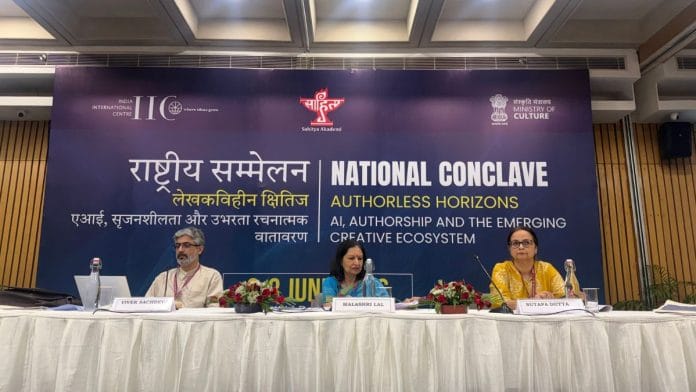
The questions came up on the final day of the national conclave, ‘Authorless Horizons: AI, Authorship, and the Emerging Creative Ecosystem’, jointly organised by the India International Centre and Sahitya Akademi. The two-day conclave took place at the national capital’s India International Centre.
The first session of Day 2, ‘Reimagining Publishing: Literary Dissemination in the AI Ecosystem’, stayed close to the machinery of publishing: marketing, editing, typesetting, plagiarism and the question of what happens when AI becomes part of the workflow.
‘No harm in using AI for marketing’
For Manish Khurana, publisher at Bloomsbury Publishing India, AI is already in the workflow. It could help with marketing, especially social media campaigns, by tracking performance and helping publishers modify strategy. It could also assist with typesetting, layout and design.
“For marketing, I think there is no harm in using AI tools. Ultimately, the idea behind publishing a book is to make it available to a larger audience. If we are producing books, we have to sell them,” he said.
The line, for Khurana, is editing.
“I have my doubts,” he said. An editor, he argued, has to understand ‘the voice of the author’ and what the author is trying to say. AI, to him, remained ‘very predictive’, and that predictability could ‘hamper your editorial judgment’. Proofreading, too, he said, could not be left entirely to AI.
The liveliest moment came when Bharat Bhushan, senior journalist and columnist, moved the discussion from books to journalism. He described commissioning an article from an academic on Gaza and later being told by the author that another newspaper article had stolen not the words, but the structure and arguments.
“If AI plagiarises, who gets punished? Who is responsible? Who do I complain to?” he asked. The problem, he said, was proof. Was the structure enough? What happens when copying is not verbatim?
Ravi Singh, publisher and co-founder of Speaking Tiger, did not have an easy answer. Plagiarism, he said, is easiest to prove only when there are ‘direct lifts’. When the question is of plot, structure, influence or imitation, the line becomes thinner. “What is original? Your voice may be, how you say something,” he said.
That unease widened into labour. Bhushan pointed out that the newsroom had already lost the proofreader and digital reporters were often writers, sub-editors and publishers of their own copy. Khurana said publishing workers would have to retrain themselves, while Singh acknowledged that teams would become ‘smaller’.
Also read: AI can be a helper, not creator, says Gajendra Singh Shekhawat in Delhi
‘AI cannot replace human expression’
The next session, ‘The Writer’s Perspective: Engaging with AI in Creative Practice’, turned from institution to individual. Professor Malashri Lal, who chaired the session, began with a question about how readers choose books. Do they buy a book because an algorithm recommends it, because of a review, or because they trust the writer?
Lal quoted Pico Iyer’s line, “You can’t outsource humanity to artificial intelligence,” and then tested AI on a subject from her own area of work. She asked it to write a short conversation between Michael Madhusudan Dutt and a modern woman researcher. The answer turned Dutt into a grand, suffering genius.
One AI-generated line read: ‘Genius demands a heavy toll. I lived fiercely, loved deeply, and created passionately. My wealth vanished, but my words endured.’ Lal’s response was blunt: ‘What rubbish.’ To her, it was a ‘complete reversal of the truth’, possibly because the platform did not have enough Bengali material and context.
That became one of the more useful Indian questions of the morning. If AI is trained unevenly, what happens to translation? Lal argued that the translator is also a ‘co-creator’ and that creative practice must include translation practice. The issue was not just whether AI could produce smooth English prose, but whether it could understand the cultural and moral weight behind a language.
Vivek Sachdeva, professor and dean, Guru Gobind Singh Indraprastha University, placed the anxiety in a longer history of technology. Cinema, he said, was itself a child of technology, and music had been transformed by recording, circulation and electronic instruments. But AI, for him, raised a different challenge. It could increase efficiency and productivity, but if it began doing the intellectual work of writing poems, stories, music and films, the question became existential.
“AI cannot and should not replace human expression,” he said. “Humans become human by feeling emotions, by expressing their ideas and creating new things.”
Professor Sutapa Dutta brought the discussion down to research practice. She recalled a time when students relied on libraries, physical books, and even copying unavailable material by hand. More recently, as visiting faculty at the University of Pennsylvania, she said that ‘humans were conspicuous by their absence’ in aiding her research. The library buildings and archives existed, but the most important tool was the ‘palm-sized mobile’ in her hand.
The conclave stayed largely within the careful language of academia. But outside such rooms, the question has already become more urgent. In May, Granta published Jamir Nazir’s ‘The Serpent in the Grove’, the Caribbean regional winner of the 2026 Commonwealth Short Story Prize, and the story soon faced allegations of AI use.
WIRED reported that three of the five regional winners faced such allegations, while the Commonwealth Foundation said it was reviewing the claims but had concerns about AI detectors, consent and ownership.
Tarini Unnikrishnan is an alum of ThePrint School of Journalism, currently interning at ThePrint.
(Edited by Saptak Datta)