







New Delhi: An unsettling image of the ‘authorless horizon’ shadowed the room. For the next several hours, speakers and the audience tried to navigate this new labyrinth. At times, the discussions even spilled outside the rooms and into the corridors, continuing over cups of tea.
“Plagiarism has always existed. AI is basically plagiarism,” said a woman exiting the room during a break. The two others nodded along in agreement.
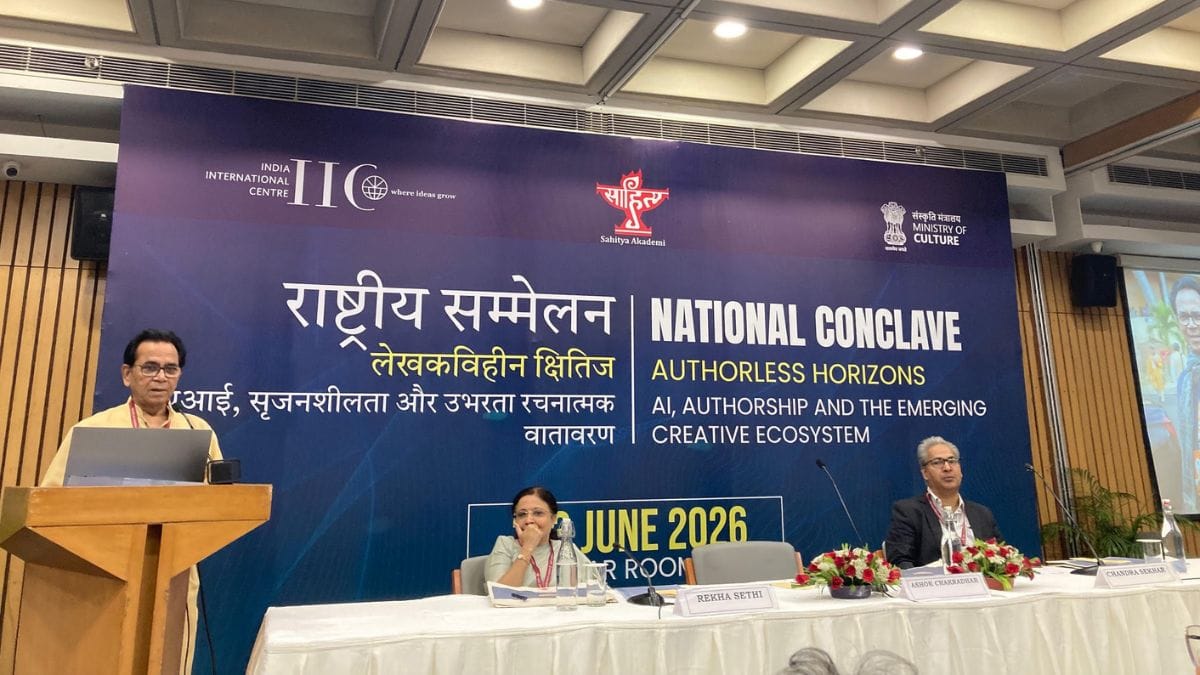
The two-day national conclave, titled ‘Authorless Horizons: AI, Authorship and the Emerging Creative Ecosystem’, opened Tuesday at the India International Centre (IIC). It brought together writers, publishers, academics, policymakers, and students. The conclave has been organised in collaboration with Sahitya Akademi.
The discussion opened with reflections on the unsettling implications of an authorless horizon. The title, however, drew praises for its literary framing even before the session commenced.
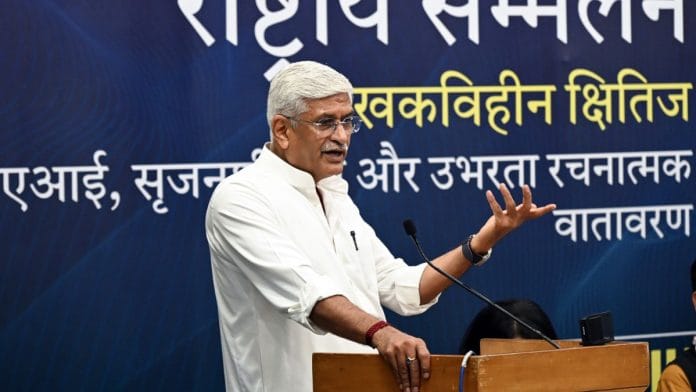
Chief guest Gajendra Singh Shekhawat, Minister of Culture and Tourism, opened the inaugural address by acknowledging the inevitability of AI’s entry into everyday life. Reaching back to his own graduation days, when computers were beginning to enter public discourse, he noted that this is not the first time technology has invited anxieties.
But since technology is moving at a speed where it has developed its own intelligence, he said, it is only natural to have questions and gather together to address them.
“Technology has now reached a point where it can write, create images, produce videos, compose music, and, more importantly, even hold conversations. So, a natural question arises in our minds: who will be the writer in the future?” Shekhawat said in Hindi.
Yet, he argued that words imprinted on paper do not, in themselves, translate into writing.
“Writing is not merely describing the event. When we read Raidas or Premchand, we are not merely reading their words, but conversing with the consciousness of life,” he added. “Poetry is not written with words or mind, if one believes that, they are wrong—it arises from experiences and struggles of the writer. I don’t think AI, for now, can reach the level of creativity that is tied to the experiences of a person.”
In the midst of anticipation and anxiety, he also reframed authorship as a question not limited to ownership but also responsibility, urging that “AI sahayak ho sakta hai, sarjak nahi”—AI can be a helper, not the creator.
‘Pannini meets the algorithm’
Delivering the keynote address, professor Girish Nath Jha’s introduction quickly gathered laughter from the audience. A Professor of Computational Linguistics at Jawaharlal Nehru University, Jha’s work sits at the intersection where ‘Pannini meets the algorithm’—between ancient textual traditions and the transformative possibilities of artificial intelligence.
According to him, as expectations from AI continue to rise, there is a growing need to tighten guardrails.
Citing systems such as OpenAI’s GPT series, Google’s PaLM models, and Meta’s LLaMA models, he stressed how these are trained on massive datasets, where “open source is not always open source”.
A key concern Jha raised was the overwhelming dominance of English-language data in training datasets, while languages such as Hindi account for a small fraction of available digital text, leading to uneven model performance across languages.
As a professor, he is now on alert when he detects “unusually sophisticated” language in his students’ papers. This job, he says, cannot be outsourced entirely to AI detectors and must increasingly involve human judgement in all fields.
“AI detectors are not always foolproof. We need to train human beings to check such content—especially linguists and literature specialists,” Jha noted in Hindi.
Also read: Mother Dairy launches new naturally degradable milk pouches. Took 4 yrs to make
‘A democratiser and disputer’
Professor Rekha Sethi, a scholar, translator, and Vice-Principal of Indraprastha College for Women, New Delhi, took the conversation forward in the discussion on ‘Writing in the Age of AI: Redefining Creativity and Human Expression’. She took the audience back many years to a time when the IIC witnessed a similar discussion on the humanities in the age of the internet.
Building on that reflection, she argued that technology has always functioned as both a democratiser and a disrupter. “There is no one way to look at it,” she said.
Engaged in exploring the intricate relationship between literature and society, Sethi described literature as something that unfolds in slow movements of solitude and leaves behind silence.
“Human lives are not tidy. Literature lives in the slow movement from inarticulate experience to a shareable form, where every line is a decision about what world is made visible and what voice is allowed to speak,” she said.
That creativity lies in disruptions that break patterns. But AI can only follow patterns. It can’t disrupt them.
Writer’s block has a nostalgic corner in Sethi’s memory. “Earlier, the challenge was to begin with blank paper. Now it is no longer a challenge. The page is overspilling with words. That is where meaning becomes necessary,” she added.
Sethi mentioned the recent case of Nobel Prize-winning writer Olga Tokarczuk. In a discussion, Tokarczuk described AI as “an asset of incredible proportions” in literary fiction.
“Often I just throw an idea to the machine with the request: ‘Darling, how could we develop this beautifully?’” Tokarczuk had said.
Her readers, however, were disappointed. Many pointed to the plight of Tokarczuk’s translator, who spent seven years translating her work line by line. Building on this, Sethi raised a question: who bears responsibility in such cases, and what does it imply for fairness and ethics in translation and authorship?
For professor Malashri Lal, former Dean of the University of Delhi and senior consultant to the Ministry of Culture, the responsibility in using AI tools lies with the writer and their self-restraint.
While she expressed openness to using AI as a tool for research material, she drew a clear boundary when it comes to authorship.
“Personally, I put faith in AI when it comes to tracking research material that will eventually feed into creative output, but it would be unethical to present the final product as an original piece of writing if it is not so,” she said.
Pointing to the growing capability of AI as a translator, Lal urged a forward-looking approach situated in a moral framework.
“Morality is the yardstick by which the translator decides how much to accept of the AI-driven translation as a functional tool, and how much to alter it as an idea conveying matter,” she noted firmly.
The library that learned to read
For now, Ashok Chakradhar, poet, author, and humourist, has figured out his own yardstick for engaging with AI—one that involves measuring the distance from the ‘digital window’.
In a satirical poem, he urged the need to close the “digital khidki” at the right moment, before one falls under its pull. He left the audience with a metaphor.
“Imagine AI as a library for us, but slowly that library has also learnt to read—that is where the problem arises. If the library had only given us information, we would have respected it. But you ask two things, and it adds six on its own—that is where one needs to draw a line.”
(Edited by Prasanna Bachchhav)