


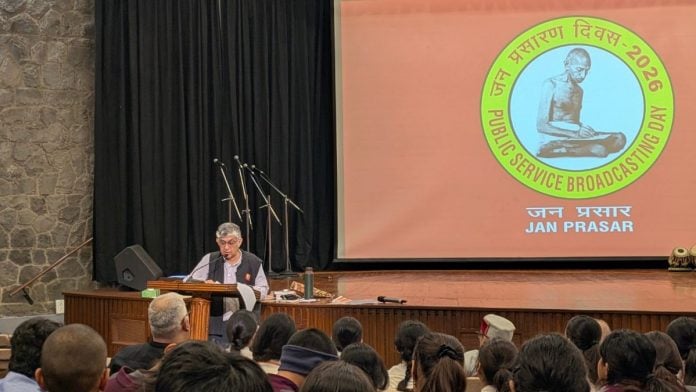
New Delhi: Jan Prasar celebrated the Public Service Broadcasting Day (Jan Prasaran Divas) with a tribute to a young freedom-struggle broadcaster, Usha Mehta, who, at 22, ran the underground Congress Radio during the Quit India Movement.
The day commemorates MK Gandhi making his first and only live broadcast on All India Radio on 12 November 1947 when he addressed more than two lakh Partition refugees at the Kurukshetra camp from Broadcasting House, New Delhi. The day has been observed for the past 26 years to build awareness of public service broadcasting values.
At an event at the India International Centre on Thursday, school students from across the city joined the discussion on the role of media in a democracy. The programme began with a moving performance of the Bangla song ‘Anandaloke’ by school students. A ceremonial lamp was then lit, followed by a recitation of Rabindranath Tagore’s poem Where The Mind is Without Fear.
Vinay Kumar, former associate editor of The Hindu, then recounted the story of Usha Mehta. He told the students – from Manthan School, Blue Bells International School and Cambridge School – how Mehta was moved by Gandhi’s “Do or die” call. She, along with a small band of activists, were on air within a week to share the latest news.
Every broadcast began the same way.
“This is Congress Radio calling on 42.34 metres from somewhere in India,” he said.
The station carried news that the censored press would not touch, from the Jamshedpur strike to police firing on protesters.
“When the newspapers dared not touch upon these subjects, it was only the Congress Radio which could defy the orders and tell the people what actually was happening,” Mehta had said in a later interview, as quoted by Kumar.
To evade the police, the team moved locations six or seven times in about three months.
On 12 November 1942, exactly 84 years ago, police raided the radio station as it played Vande Mataram in its final broadcast, Kumar said. Mehta was arrested and sentenced to four years in prison. She refused offers of release, and of study abroad, in exchange for naming Ram Manohar Lohia.
“Usha, you are no longer a revolutionary, you have become a revolution yourself,” Kumar said, reading out a letter from her father.
After her release in April 1946, Mehta went on to earn a PhD in Gandhian thought, taught at Wilson College and the University of Bombay, and received the Padma Vibhushan in 1998.
“One young student against the mighty British Empire,” Kumar said. “The contribution Usha Mehta made shall always remain a source of inspiration for all of us.”
Also Read: Calcutta in the rear-view mirror. Yellow taxis get a photographic tribute
A reciprocal bargain
Suhas Borker, media person and Convener of Jan Prasar, argued that public service broadcasting rests on a reciprocal bargain. The public provides funding, spectrum access and legal protection for autonomy, and the broadcaster returns accuracy, impartiality, universal access and diverse voices.
“A public service broadcaster should be independent of the government, and also independent of the private sector,” Borker said.
He described the airwaves as a public resource.
“They don’t belong to the government, they belong to the people,” he said, recalling Jan Prasar’s slogan, “Aakash Ki Tarange Hamari Hain.”
Borker explained to the students the case for a licence fee through “bus syndrome.” You do not board a bus without a ticket, he said, and likewise a broadcaster that takes no money from its audience goes “on their own trip.”
“They are taking you for a free ride,” he said.
He pointed to the BBC and South Africa’s SABC as licence-fee models and suggested a one-time levy on electronic goods, as in Scandinavian countries. He also recalled that Nehru had spoken in 1948 of eventually following the BBC model. He contrasted it to the present-day government control over the media.
In his closing slide, he described public service broadcasting as the mechanism “that helps sustain the long conversation a society has with itself.”
When the contract breaks and audiences start viewing a broadcaster as a government mouthpiece, he warned, legitimacy collapses.
“Critical thinking is very important for this interaction. This whole thing is about critical thinking,” he told the students. “You must think for yourself.”
The address was followed by questions from the students. Three of the students, who asked the most poignant questions, were rewarded with books.
“There is no shame in admitting that the media is not doing its duty properly today,” Kumar said, arguing that the press can still ask hard questions about cost overruns and delays in public projects.
“The costs go up,” he said. “The press can at least ask these questions.”