





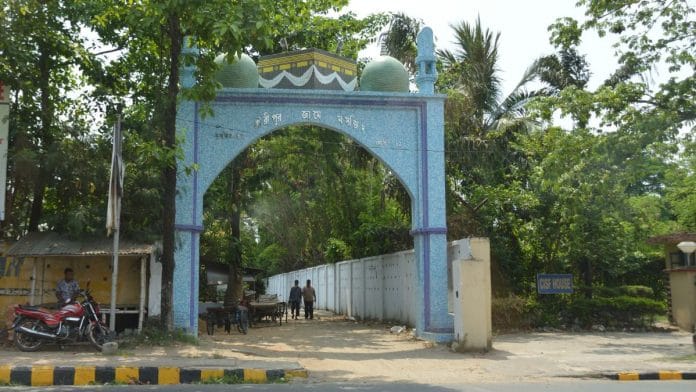


Kolkata: A 136-year-old mosque located inside Kolkata’s Netaji Subhas Chandra Bose International Airport has become the latest flashpoint between West Bengal’s ruling BJP government and the Opposition. However, the proposed relocation of the Bankra Mosque, also known as the Gauripur Jama Masjid, has also raised hackles of radicals beyond India’s borders, sparking cross-border protests in Bangladesh.
Protesters in neighbouring Bangladesh had hit the streets, demanding the death penalty for West Bengal BJP MLA Sourav Sikdar, who has been most vocal about the relocation and in whose constituency, Dum Dum, the airport falls.
“I don’t care if I am on the kill list of radicals in West Bengal or Bangladesh or they demand my death penalty. The mosque’s relocation is necessary both for the airport’s modernisation and from a security standpoint,” Sikdar told ThePrint. Sikdar said the state government is making all efforts to carry out the relocation soon.
Religious sentiment or safety?
Till 10 July this year, devotees could access the Bankra Mosque by simply presenting an Aadhaar card. The Central Industrial Security Force personnel would screen and escort them through Gate No. 8 on Jessore Road in a bus.
Located barely 165 metres from the Kolkata airport’s secondary runway, way shorter than the international safety standard of 240 metres, the mosque predates Kolkata’s only airport, operational since 1924. Since 11 July, prayers inside the mosque have been officially stopped. The BJP has argued that the mosque has stood in the way of not just the airport’s safety, but also its modernisation.
BJP leaders argued that national security and passenger safety must override other concerns, criticising past delays as appeasement politics.
“Ever since I was a student, I used to read in the newspaper that due to a mosque at Kolkata airport, the runway cannot be constructed and no previous government interfered due to appeasement politics. Now that our government is in power, we don’t believe in appeasement politics. The mosque will be relocated,” Union minister Sukanta Majumdar told the press recently, announcing the shifting of the mosque.
Sikdar said that the Bankra Mosque stands on land belonging to the Airports Authority of India.
“The Centre had already taken a decision. Prohibitory orders under Section 163 of the Bharatiya Nagarik Suraksha Sanhita had been imposed locally, restricting public gatherings around the mosque,” he said.
Sikdar said both technical experts and pilots had long expressed concerns about the mosque’s location.
“The mosque could pose operational challenges during aircraft landings under adverse weather conditions. Then there is the question of the legality of the land on which the mosque stands. There is no valid documentation for the mosque,” he said, adding that the mosque is located in the high-security Level-3 Zone through which flights of the Prime Minister, the Chief Minister and other VIPs operate.
Jamiat Ulema-e-Hind’s Bengal unit chief Siddiqullah Chowdhury, who is a former state minister, has accused the West Bengal government of harassing devotees.
“This is unfair. All people are aware that an airport is a high security zone. There was never an incident of security breach and yet Gate No 8 has been closed. We will request the airport authorities to reopen the gate and seek a clarification from the Centre on the security issues being raised,” he said.
Also read: Under fire over ‘ties with Hasina’, Bangladesh President Shahabuddin resigns 2 yrs ahead of term-end
‘Can mar relations with Bangladesh’
The Mamata Banerjee-led TMC, meanwhile, emphasised that any relocation must proceed carefully through proper legal steps and direct talks with community stakeholders.
“I oppose this sudden decision to stop people from visiting the mosque. Talks on how to relocate it were held earlier as well. I think it should be done after talking to the Muslim community,” TMC MP Saugata Roy has told the press.
Sikdar said that Chowdhury had accused him of instigating people.
“It is uncanny how on the very next day, a protest in Bangladesh demanded my death sentence. There might be some connection. The central government agencies should investigate the matter,” he added.
Bangladeshi press has reported that a group of protesters gathered outside Bangladesh’s national mosque, Baitul Mukarram, in Dhaka on 17 July, carrying banners which described Sikdar as a “Khal Nayak” for shifting a mosque. The demonstrators demanded that Sikdar be “hanged till death”.
A Bangladeshi journalist who did not wish to be named told ThePrint the relocation of the mosque has become one more issue for the country’s Islamist parties and organisations to fan anti-India sentiment.
“Even since the BJP government came to power in West Bengal, the Bangladeshi press has regularly reported how Muslims are being targeted, whether by so-called bulldozer action on illegal encroachments, ban on beef and now proposed relocation of a mosque,” the journalist said, adding how such “motivated reportage” is hampering relations between the two countries.
As the outrage escalated online and in public rallies, radical and extremist groups in Bangladesh expanded their rhetoric beyond calls for legal action, allegedly placing Sikdar’s name on extrajudicial target or “kill lists.”
“I am aware of this,” Sikdar said. “My government has tightened law and order mechanisms and such activities are no longer possible in India. But in Bangladesh, they are saying such things openly,” he said.
Sikdar said his family hails from East Bengal, which is now Bangladesh, and he shares friendly relations with not just many common Bangladeshis but also the country’s political elite like former Prime Minister Sheikh Hasina’s son Sajeeb Wazed Joy.
“Bangladesh is our friendly neighbour. I request the Tarique Rahman government not to allow such demonstrations that could potentially mar relations with India,” he said.
(Edited by Saptak Datta)