





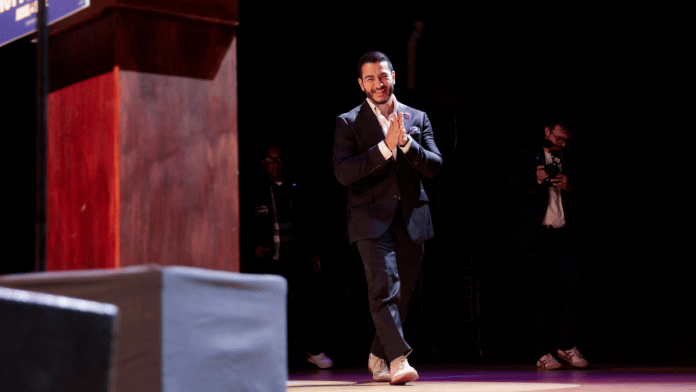


New Delhi: Before he became one of the Democratic Party’s rising progressive stars, Abdul El-Sayed was rebuilding Detroit’s public health system. The 41-year-old physician and epidemiologist has emerged as the face of the Party’s resurgent left after defeating Congresswoman Haley Stevens in Michigan’s Democratic Senate primary.
Speaking to the press following his 4 August victory, El-Sayed said, “We took on a machine.”
“You are not supposed to be able to beat $70 million of outside spending. And what we showed is that the power of our many is greater than the power of their money,” he added. The remark captured the central message of his campaign: grassroots organising could overcome the influence of big-money politics.
Living the American Dream
Born in the Detroit suburb of Rochester Hills, El-Sayed grew up in a family that valued education and public service. His father moved to the United States from Egypt in the late 1970s to pursue a PhD in engineering at Wayne State University. El-Sayed studied at the University of Michigan before becoming a Rhodes Scholar. In 2011, he received a D.Phil. in public health from Oriel College, University of Oxford. He later earned his medical degree from Columbia University, where he eventually taught epidemiology, before choosing public health over clinical practice.
When he was 30 years old, El-Sayed was appointed executive director and health officer of the Detroit Health Department. During his tenure, he helped rebuild the city’s public health infrastructure after years of bankruptcy. He later led Wayne County’s Department of Health, Human and Veterans Services, before resigning in 2025 to enter the Senate race.
El-Sayed represents the Democratic Party’s progressive wing. His campaign has championed Medicare for All (tax-funded national health insurance), higher taxes on billionaires and stronger labour protections. He has also emerged as one of the Party’s most outspoken critics of the US’s unconditional military aid to Israel amid the ongoing genocide in Gaza.
Also Read: Republicans are calling out Mamdani’s city-owned grocery stores. Elon Musk has joined in
Making waves
In an interview with CNN, El-Sayed said that he opposed unconditional military aid for any country—including Israel, Egypt, Pakistan, Saudi Arabia and the UAE.
“We’ve got communities in my state where the median income is $14,000. They have a right to their tax dollars,” he said, arguing that US money should be spent on “healthcare in Michigan and schools in Michigan and roads in Michigan” rather than funding a foreign military “engaged in human rights abuses.”
His positions, however, have made him one of the Democratic Party’s most polarising figures.
Speaking at a rally in Las Vegas on 5 August, President Donald Trump accused El-Sayed of being a “communist” who “hates Israel” and “hates Jews”.
“He’s a man of hate, and now he’s going around saying, ‘No, I love everybody.’ He doesn’t love everybody. Put him in office, you’re going to find out what he loves,” Trump said.
But not all are so critical of the Egyptian’s victory, a feat that has been widely celebrated by the Democratic left. New York City Mayor Zohran Mamdani joked about El-Sayed’s strength and his ability to lift weights; he also added that he is not “in any way a mini-Mamdani”.
“I am proud to be part of a movement of politicians and candidates who are looking to put working-class Americans back at the heart of our politics,” Mamdani said, casting El-Sayed’s win as part of a broader progressive resurgence.
If El-Sayed defeats Republican Mike Rogers in November, he will become the first Muslim elected to the US Senate. Win or lose, his rise from the son of Egyptian immigrants and a public health official to one of the most prominent voices of the Democratic left signals how debates over economic inequality, healthcare and international tensions are reshaping American politics.
(Edited by Insha Jalil Waziri)