





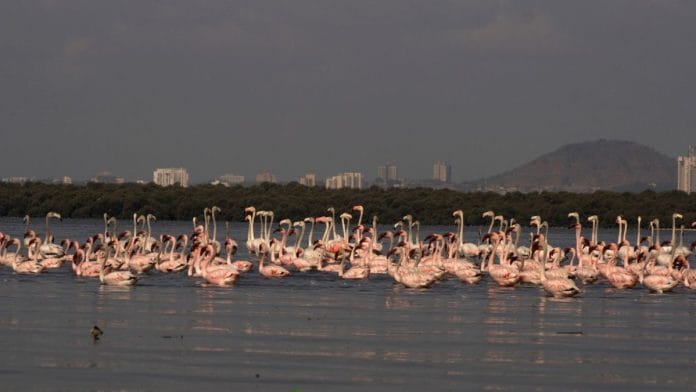


New Delhi: Six hundred flamingos in Spain’s Fuente de Piedra lagoon are ready to travel.
Over the weekend, hundreds of conservationists in Spain’s Fuente de Piedra lagoon gathered flamingos at dawn and readied them for the upcoming migration. It involved fitting metal identification rings and running them through medical checkups.
These identification rings will allow the biologists to track flamingos as they migrate with their colonies.
This is not new for Fuente de Piedra, a wetland in Spain. The process of fitting rings around flamingo chicks dates back to 1986 and is known as the Flamingo Ringing Festival, which turns 40 this year. To carry out the ringing process, 400 volunteers are authorised every year. The ringing festival, however, saw a pause during the two years of the pandemic.
At dawn, adult flamingos take flight to forage for food – that’s when volunteers gather the chicks for ringing. The movement is driven by water levels. As the levels drop, adult flamingos fly to Huelva and Doñana during the day in search of food. After a full day’s search, they return at night to feed their young, who are by then ringed.
“The ringing of Greater Flamingo chicks is a highly organised affair and run with military precision. The group of volunteers embark during the cover of darkness slowly and silently encircling the nursery of young,” said a report by the Andalucía bird society.
Also Read: Speed up process to protect DPS Flamingo Lake in Navi Mumbai: Environmentalists to govt
The Indian Connection
These flamingos travel to India as well. The migration to India is witnessed between October and March. They are mostly found in Rann of Kutch, Sambhar Lake, Sundarbans and Pulicat Lake.
Rann of Kutch is also known as Flamingo City, as thousands of flamingos land at its shallow wetlands.
An IFS officer, Himanshu Tyagi, writes that birds have supraorbital glands to survive the saline waters of Kutch.
“Flamingos have specialised supraorbital glands near their eyes that act as biological desalination plants – filtering excess salt from their blood and excreting it through their nostrils,” Tyagi wrote on X. “Their long legs and webbed feet are built for briny landscapes, and unlike most animals, their skin is resistant to the corrosive effects of highly alkaline water.”
The flamingos travel thousands of miles in search of food and favourable conditions such as shallow water and safety. The Indian subcontinent becomes a winter refuge and feeding ground for them.
Their migration is termed a “vital ecological event” as it triggers tourism and conservation opportunities. They don’t only come from Spain, but also from Central Asia and the Middle East, countries including Kazakhstan, Mongolia, Iran, Afghanistan and Israel.
(Edited by Maryam Hassan)