



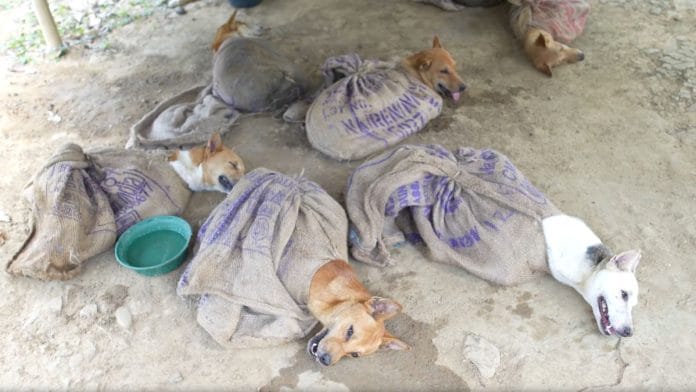
New Delhi: The Assam Police, along with four animal welfare organisations, rescued 26 dogs in Karbi Anglong district on Wednesday. The dogs were allegedly being taken to be slaughtered.
Human World for Animals, one of the animal bodies involved in the operation, said a truck transporting the dogs was intercepted. The animals were found stuffed in jute sacks with their mouths tied.
They were initially kept in police custody before being taken to Just Be Friendly’s Integrated Care and Resource Centre for Animal Welfare in Guwahati for veterinary treatment.
Keren Nazareth, senior director, companion animals and engagement, Humane World for Animals India, said that dog meat trade has become organised over the years and operates largely in the Northeast region.
“India’s dog meat trade operates largely out of sight, in parts of the Northeast and along supply routes that reach well beyond it. It is illegal, it is cruel, and it is far more organised than most people imagine,” Nazareth told ThePrint.
Also read: 30 dog meat traders, 3 wholesalers from Nagaland switch to mushroom farming, pickle making
Dog trade in India
Dogs are often stolen from the streets or from their families and are then transported across borders at night.
According to Humane World, dog consumption has been the highest in Mizoram, where dog meat, or “uisa”, is sold from shops. In Nagaland, poor women vendors often resort to selling dog meat to earn money.
Nazareth argued that when these women are given an alternative, a lot of them opt to leave immediately.
“Their stories are of extreme hardship, social stigma and the toll the trade took on their families’ well-being and their own health. They do not describe a practice they wished to protect, but a livelihood they had little choice but to accept. Ending the trade is not straightforward, but it can be made possible if all stakeholders truly are determined,” she said.
In June, ThePrint had reported that wholesale dog meat sellers in Nagaland were shifting to mushroom farming and pickle making. The state’s major sellers left the trade between May and June 2026. They voluntarily surrendered 18 dogs, deciding to leave the trade permanently. Their exit would disrupt the flow of dogs into the markets across Nagaland. All the rescued dogs were examined, vaccinated and microchipped, before being adopted by the communities in Nagaland.
(Edited by Aamaan Alam Khan)