



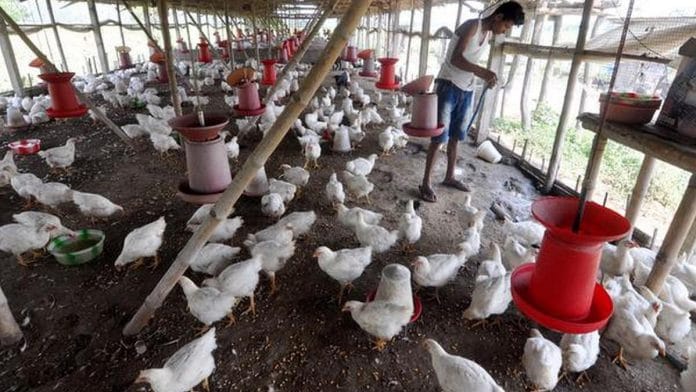

New Delhi: An investigation of 21 layer-hen poultry facilities across Haryana, Punjab, Madhya Pradesh and Tamil Nadu has documented severe overcrowding, routine debeaking, widespread injuries, poor waste management and limited biosecurity measures.
The probe, led by Sentient, an international non-profit, examined private battery-cage operations with estimated capacities ranging from about 3,000 to 200,000 hens. The report found that the problems appeared systemic rather than isolated.
“The consistency of what our investigators documented across 21 facilities is deeply concerning,” Sentient CEO Abhishek Pandey noted in a press release.
“Practices such as severe overcrowding, routine debeaking, untreated injuries, poor waste management and weak biosecurity should not be accepted as business as usual,” he added.
The findings, he stated, point to a systemic gap between the standards that are expected and the conditions animals and workers may actually experience on the ground.
“Stronger enforcement, regular inspections and meaningful accountability are urgently needed to ensure that poultry production does not come at the cost of animal welfare, hygiene or public health,” the report read.
The status of poultry facilities in India
Investigators discovered that nearly all observed hens showed injuries around the neck apparently caused by repeated contact with metal cage bars. Wing injuries, broken legs, bleeding, skin conditions and severe physical weakness were also common.
The report noted that some birds were unable to stand, while others had signs of debeaking, visible injuries and blood loss. In one facility, a worker was seen performing the procedure and even invited investigators to take part.
Hens displayed continuous loud vocalisation and strong fear responses. Aggression over limited space was observed, with weaker birds attacked and in some cases killed. Rough handling of birds, including chicks being thrown after debeaking, was also noted.
In several instances, dead hens were inside and outside cages. Staff at some sites reported roughly five to ten deaths per shed, though independent verification of mortality rates was not possible.
Also Read: US trade deal is good news for poultry industry. MP soya farmers couldn’t produce enough
The hygiene factor
The report also noted the poor hygiene conditions, with manure accumulated beneath cages, sometimes for an entire production cycle. Investigators recorded strong ammonia-like odours, rodents, cockroaches, stagnant water and mosquito larvae.
Feed in some units showed signs consistent with fungal growth or contamination. Further, waste and wastewater management was found inadequate, with blocked drains, overflowing water and large piles of manure. Even the carcass disposal methods were outdated, and some included burial, burning and incineration. In one case, carcasses were reportedly dumped near a highway without burial or incineration.
Biosecurity measures were largely absent. Apparent protocols were observed at only one facility. Masks and other personal protective equipment were generally not provided or used.
Investigators also noted that children were working at some units, collecting eggs and cleaning premises, also without protective gear. Several facilities stood 10–400 metres from residential areas, and all were located near a national highway.
In Madhya Pradesh, none of the seven facilities examined reportedly held Consent to Establish or Consent to Operate from the Madhya Pradesh Pollution Control Board. Complaints about some sites had been filed in 2024 alleging siting violations and missing consents, yet the 2026 visits indicated limited visible enforcement beyond a general public notice.
Sentient, an organisation that documents animal-welfare concerns, said that the findings highlight the need for stronger monitoring and enforcement of existing animal-welfare, environmental, public-health and poultry-sector regulations.