





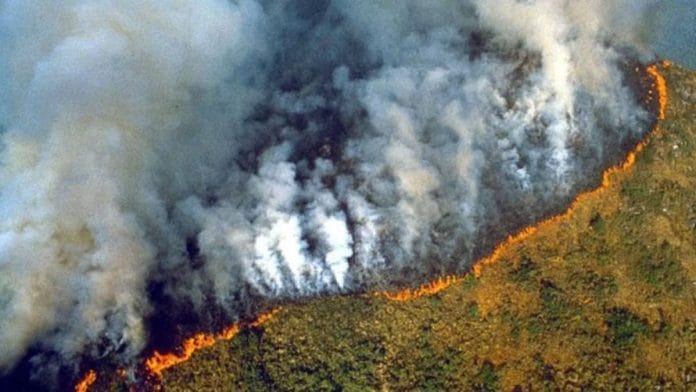

New Delhi: The year 2025 saw the most expensive wildfires in the world, according to a new study in Nature Reviews Earth and Environment, published on 1 June. Even though the total area burnt this year was the lowest since 2002, the scale of the fires and the losses incurred still made 2025 wildfires one of the ‘costliest natural disasters in world history.’
One of the biggest contributors to the high losses from wildfires in 2025 was the California wildfires in January 2025, which ripped through Los Angeles, causing around $140 billion in total losses.
“The wildfires of 2025 demonstrate that without decisive action, societies will continue to face escalating human, economic and environmental risks in an era of more extreme fires,” said Matthew Jones, researcher at the Tyndall Centre for Climate Change Research and one of the authors of the report, in a press release.
In terms of total land burnt, the world saw 335 million hectares worth of wildfires, and 11 billion tonnes of carbon dioxide (CO2) emissions — these are the lowest figures the world has seen since 2002.
However, across the US, UK, South Korea, Canada, and Europe, the major wildfires of 2025 managed to cause huge damage to ecosystems, lives and livelihoods. Wildfire-related deaths globally led to 90 fatalities and over 3,00,000 evacuations. Moreover, the report also said that in 2025, the authors observed changes in the pattern of wildfires.
“As savannah fires decline, extreme and destructive wildfires are increasingly emerging in temperate and high-latitude regions, where fuel-rich forests can burn with unprecedented intensity,” said the report.
For example, in 2025, South Korea, which is a temperate region, saw its deadliest wildfire outbreak from March to May, which killed over 30 people. Similarly, in Spain, Portugal and France, too, the fires in 2025 broke decades-old records and evacuated hundreds of thousands of people.
Meanwhile, the UK recorded its ‘highest burned area’ in history, including its first documented ‘megafire’ in Scotland, exceeding 10,000 hectares in 2025.
“The co-occurrence of multiple devastating fires is particularly problematic, hampering resource sharing between countries and putting more civilians at risk,” said Crystal Kolden, professor at the University of California, Merced and one of the co-authors, in a press release. “Unfortunately, future fire projections show these types of outbreaks will only increase.”
Also read: India’s bats to Australia’s Koalas—animals around the world are dying from heat stress
Canadian wildfires – third year in a row
The report was written by a group of international scientists led by Jones of the University of East Anglia in the UK. Apart from analysing the losses and the areas burnt in different countries, it also had a section on the boreal wildfires in Canada, which broke records for the third year in a row.
The boreal forest in Canada is one of the largest natural ecosystems in North America, and is home to a majority of the wildlife found in the country. As a hilly region with deciduous trees, the area is not used to wildfires; however, since 2023, the forests have seen wildfires every year.
“Between 2023 and 2025, Canadian wildfires released more CO₂ than during the entire preceding 15-year period, driven by persistent burning in carbon-rich forest ecosystems,” said the report.
In 2025, the regions experiencing the highest fire and CO2 emissions activity included Ontario, Manitoba, and Saskatchewan. These numbers, according to the report, are concerning because of the nature of the forest itself.
For certain forest types, like savannahs, wildfires are a natural occurrence and part of the growth of the forest – they remove old wood and lead to the growth of new, native species. However, the boreal forests are not accustomed to fires, and the losses incurred from repeated wildfire activity would lead to ecosystem degradation and lower forest recovery as time goes on.
(Edited by Ratan Priya)