





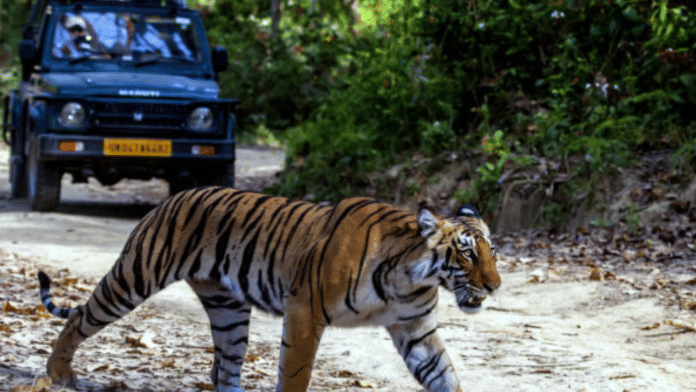


New Delhi: A recent study by the Centre for Cellular and Molecular Biology found that wildlife tourism in five tiger reserves is raising stress levels in Indian tigers and affecting the breeding area choices of tigresses.
Tigresses are retreating deeper into forest areas to find undisturbed locations to breed. But with wildlife safaris snaking through large sections of the forest, it is getting harder for them to find peace.
“Sometimes there are over 30 to 40 vehicles looking at one tiger, making noise, taking photos. Often the tiger runs away and hides for hours waiting for the crowds to pass,” the study’s lead author, G Umapathy, told ThePrint.
The study, conducted by scientists at the Council of Scientific and Industrial Research (CSIR)—Centre for Cellular and Molecular Biology (CCMB) was published in the Zoological Society of London journal Animal Conservation on 7 May.
While it is not news that Indian tigers are stressed, the study found that stress markers are higher in tigers closer to human habitations or tourism routes.
Also read: Kanha tiger cub died of respiratory failure. Forest officials rule out starvation
How did they find out?
Researchers followed tigers in five tiger reserves in India—Corbett, Tadoba-Andhari, Kanha, Bandhavgarh and Periyar—over a two-year period. They collected 728 samples of tiger scat (faeces) between 2020 and 2023 belonging to 610 tigers to measure stress and reproductive hormones without disturbing the animals.
The team looked at stress hormones (glucocorticoids) and reproductive hormones (progesterone) in female tigers. The results revealed that tigers living near tourism roads—areas with frequent safaris—showed especially high stress levels.
Researchers also found that tigers inside the core areas of the forests grew stressed when tourism increased.
“There is a higher density of tigers in core zones, which could mean more conflict, and possibly more illegal activities which could also stress them out,” said Umapathy.
Several wildlife tourism roads are built around water sources because tigers are likely to be spotted there. Researchers warned that if tigers continue to be disturbed in such areas, it could affect their long-term reproduction cycles.
Also read: 5 tiger deaths in one week in Kanha reserve. Officials suspect canine distemper virus
Long-term impact
Umapathy says that several studies on elephants have shown that a stressed baby elephant grows into an adult that behaves abnormally. Tigers are likely to be affected in similar ways.
“Take humans for example. If someone has a traumatic childhood, it has a lasting impact on their adult life too,” said Umapathy.
He warns that if such disturbance continues, there are two potential ‘worst case scenarios’. One is that the tiger population could retreat to core areas, leading to a denser population of tigers, which may cause more conflict within the species.
“We also found that stressed female tigers were unlikely to reproduce,” added Umapathy. This was particularly visible in Tadoba and Bandhavgarh.
“Tigresses prefer to breed in quiet parts of forests. However, it’s becoming difficult to find such suitable areas,” Umapathy said.
To remedy the situation, scientists have recommended that the number of vehicles entering tiger reserves be reduced to make sure there is no crowding around tigers. They have also suggested reducing the duration of each safari.
“This study is a fine example of how molecular biology and physiology can be brought to bear directly on one of India’s most important conservation priorities,” said Dr Vinay Nandicoori, Director, CSIR–CCMB, in a press release.
“We are not arguing against wildlife tourism, which plays a vital role in conservation funding and supports rural livelihoods,” said Umapathy. “But our findings make a clear scientific case that the way tourism is regulated, vehicle numbers, safari timings, road density and the protection of breeding areas, needs to be informed by what the animals are actually telling us through their physiology.”
(Edited by Theres Sudeep)