





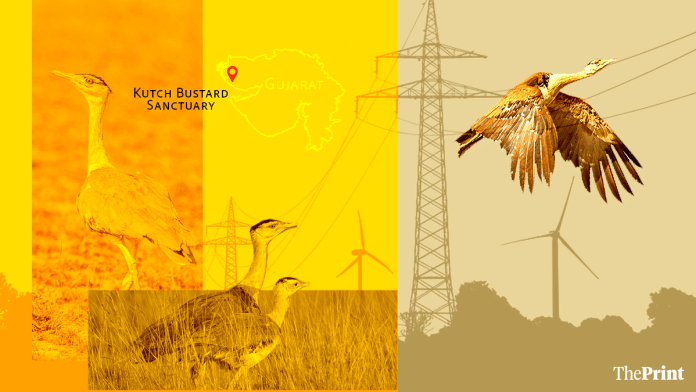


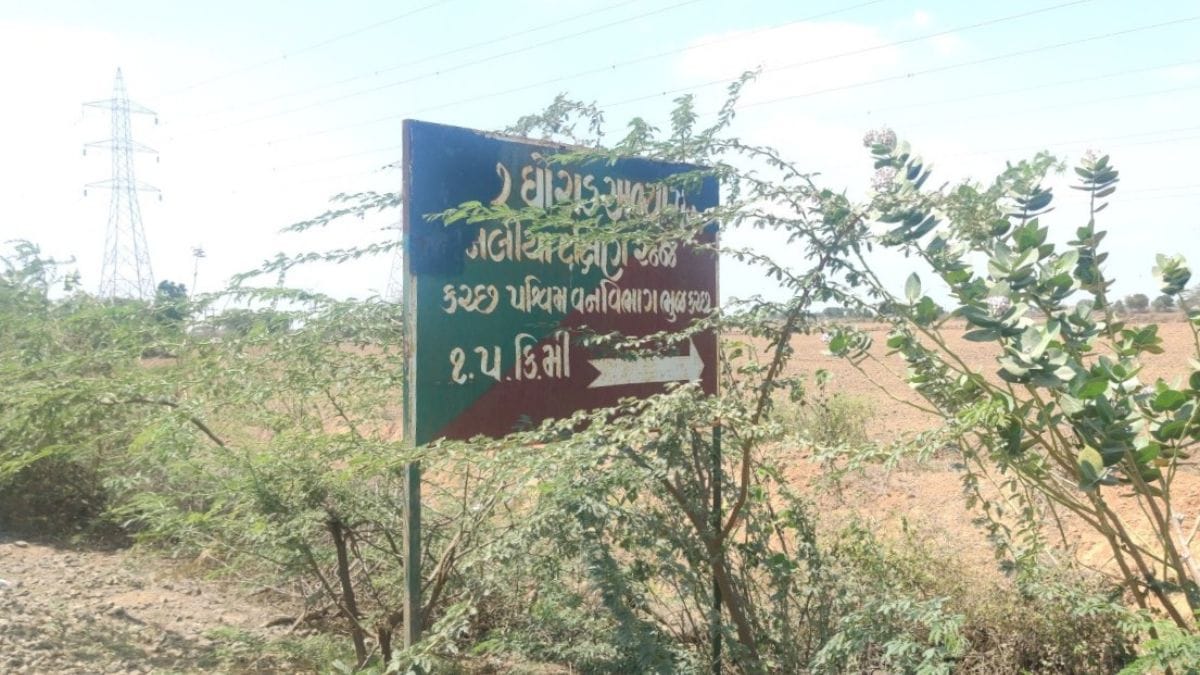
Naliya (Gujarat): A signboard at the entrance marks one of India’s smallest wildlife sanctuaries—2.02 sq km of grassland, smaller than many Delhi colonies. A few metres away, a power line runs overhead. In the middle, wind turbines turn against the sky.
This is what conservation looks like in Abdasa taluka of Naliya in Kutch, Gujarat.
In late March, Union Environment Minister Bhupender Yadav announced that a Great Indian Bustard chick had been born in Kutch for the first time in a decade. The government called it a “major milestone”.
But within a month, the chick was gone.
The bird—hatched at the Kutch Bustard Sanctuary on 26 March through an experimental method called Jumpstart—could not be located by teams from the Gujarat forest department and the Wildlife Institute of India (WII) after three to four days of searching.
The forest department and WII officials suspect the chick may have fallen to predators—jackals, foxes, feral cats, mongooses, birds of prey, or monitor lizards. They said such outcomes were not uncommon, and the programme would continue.
Gujarat sees a GIB chick after a decade, through a novel conservation measure – the jumpstart approach, coordinated by the Ministry, State Forest Departments of Rajasthan and Gujarat, and Wildlife Institute of India.
Envisioned by PM Shri @narendramodi ji in 2011 to conserve… pic.twitter.com/oE2DYTZBUF
— Bhupender Yadav (@byadavbjp) March 28, 2026
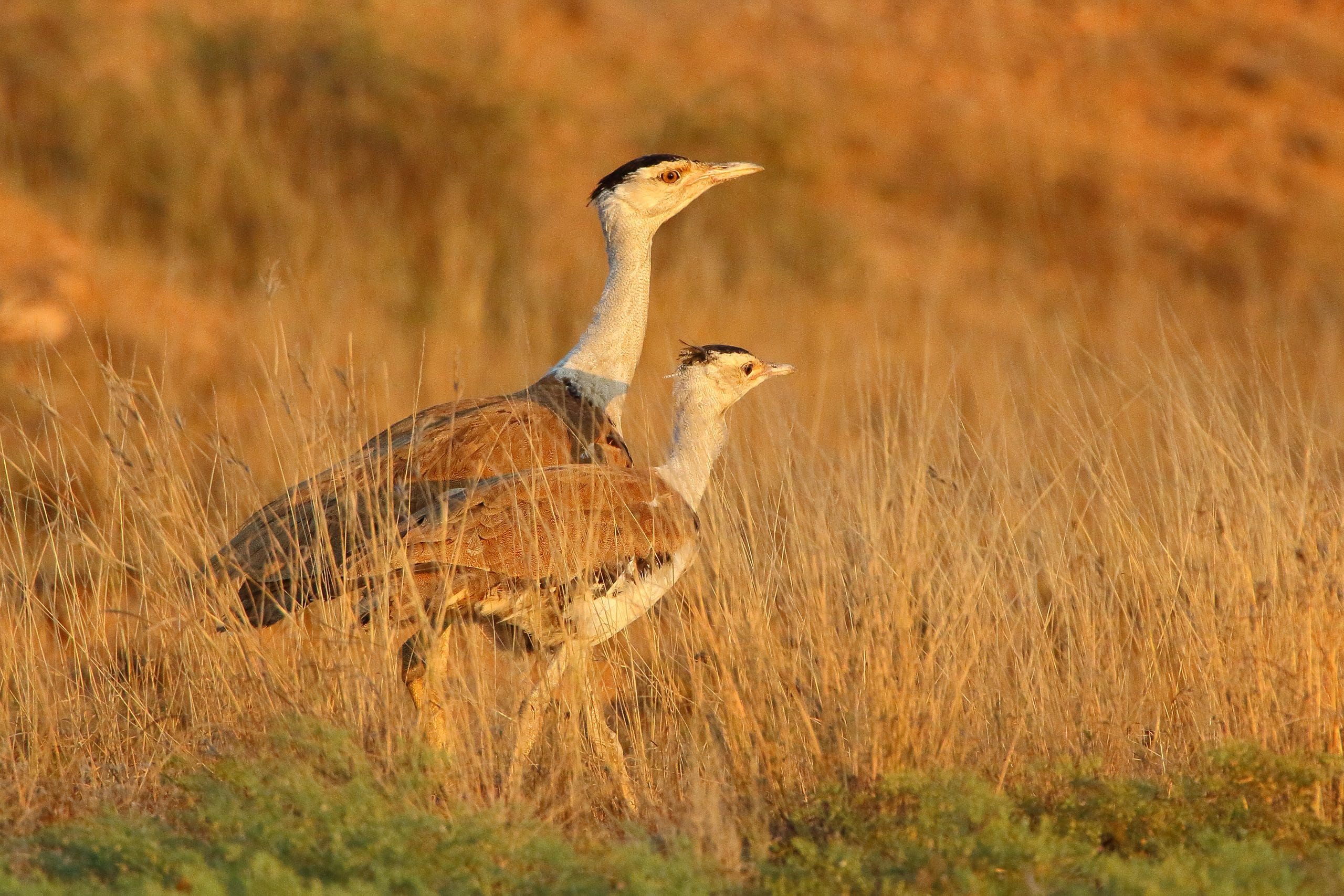
The Great Indian Bustard—’Ghorad’ in local Kutchi, or ardeotis nigriceps in scientific terms—was once found across 11 Indian states, with an estimated 1,260 birds in the 1960s, according to WII. It is now critically endangered, and its population down to 150—most of them in Rajasthan and Gujarat, and even fewer in Maharashtra, Karnataka and Andhra Pradesh.
In Kutch, where 48 GIBs lived between 2007 and 2010, three females remain. No male has been recorded here since 2016, forest department officials say.
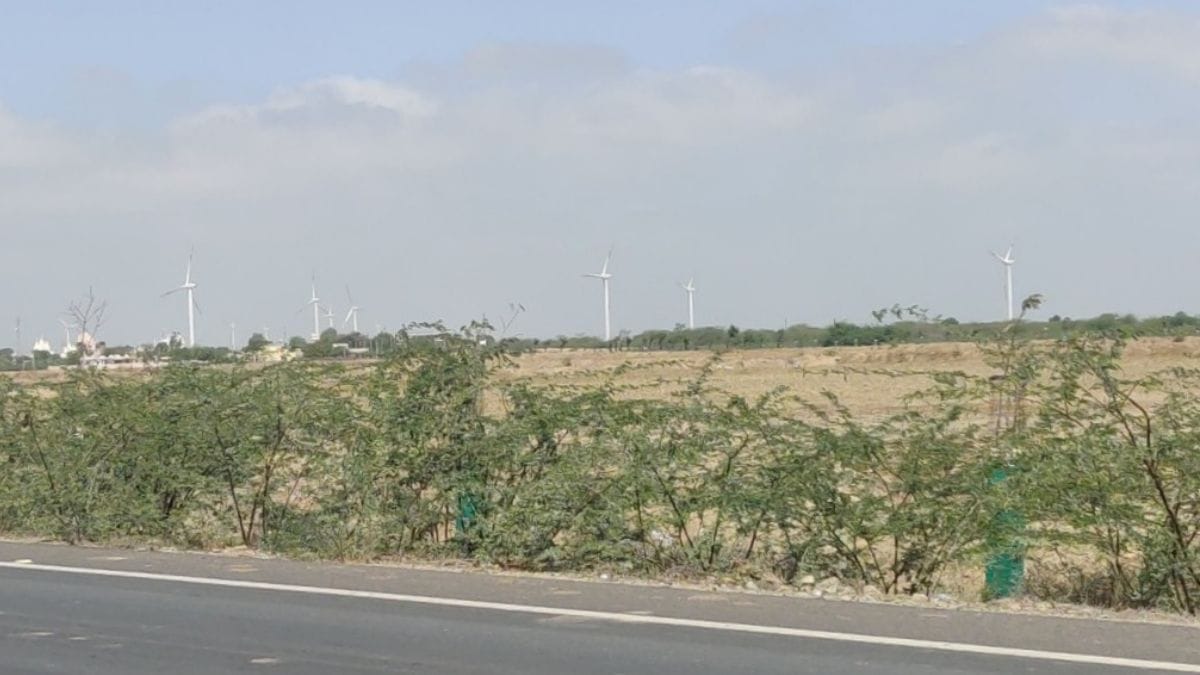
Besides being a conservation zone, Abdasa has also been a wind energy development hub since the late 1990s. Its flat, open terrain that the Great Indian Bustard needs is also what makes this corner of Gujarat one of the country’s most productive wind corridors. Hundreds of turbines have come up, and with them, hundreds of kilometres of transmission lines threading through the grassland.
Part of this contrasting landscape of Abdasa has also played out in a legal tug of war between conservation and development. The picture that emerges is not of a conservation success story. It is, instead, the story of a bird being kept from dying faster.
The operation & what it cannot do
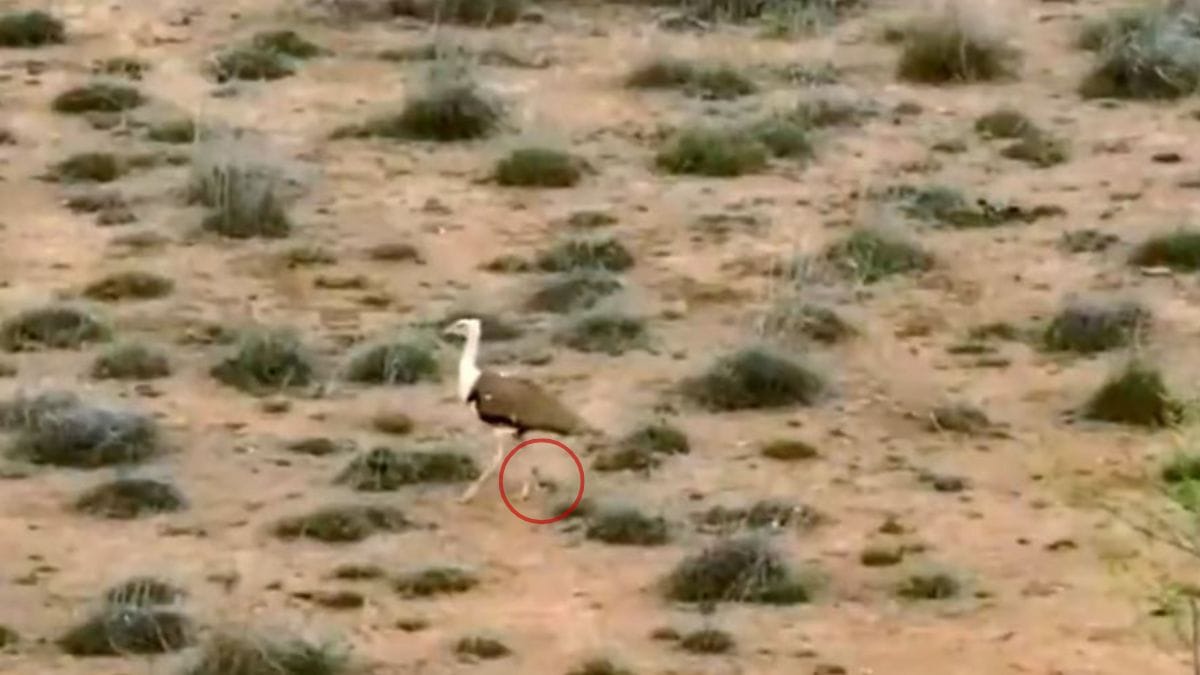
Though there aren’t any male GIBs in Kutch, the three female birds go through the full nesting cycle. They have been laying infertile eggs for years.
In concept, Jumpstart is simple. The infertile egg is quietly replaced with a fertile one from a captive breeding facility in Rajasthan, so the female Great Indian Bustard incubates it unknowingly. In practice, a successful swap-and-hatch is extraordinarily difficult.
In August 2025, the forest department and WII identified and tagged a female Great Indian Bustard that laid an infertile egg. Its replacement travelled 770km by road from Sam in Rajasthan’s Jaisalmer to Abdasa via a halt-free corridor of 19 hours in a handheld portable incubator.
Dheeraj Mittal, the Conservator of Forests (Kutch) who led Jumpstart under Project GIB, explained the coordination involved. “First, the bird should be nesting. Then, somebody has to observe that it has laid an egg. And once it has laid an egg, at the same time, you should have an available fertile egg at the Jaisalmer facility, and of the same age or time class,” he said.
All of it had to happen simultaneously. “Here the bird was being monitored and our teams at WII found a matching egg. That’s how the egg was transported here.”
Acceptance by the mother after a swap is not guaranteed. GIBs can detect when a nest has been disturbed or when a human imprint has been left on the egg or its surroundings. If she senses interference, she can abandon it.
“We got lucky the GIB hatched it. We got lucky that a bird came out of it as a hatchling. We got lucky the mother took it around, made the chick walk along with her. It continued for almost a month,” Mittal said.
Mittal used the analogy of a satellite to explain the complexity of the process. “You have launched the satellite. The next stage is that it should establish in its orbit. Similarly, we could achieve the hatching of a chick, but we could not achieve its survival,” he said.
There may be several reasons for this: a mother bird that had never before raised young, and a sanctuary enclosed only by a fence through which smaller predators can pass without difficulty.
The Gujarat forest department’s own statement, issued in late April after the chick’s disappearance, acknowledged that “while this method (Jumpstart) proves effective in reducing egg predation, it does not necessarily increase the likelihood of the chick’s survival after hatching”.
The odds were not great regardless, the statement added, saying that just around 40 percent of GIB eggs laid in the wild hatch successfully. Even when they hatch, nearly 60 percent of the chicks do not survive beyond two months.
It is after a two-month mark that chances of survival increase significantly, Mittal said.
Mittal said attempting Jumpstart took a while “because you have to have enough eggs to do that”.
The decline of Great Indian Bustard in India is believed to have been driven by three key causes–hunting, loss of habitat, and more recently, due to collisions with power lines.
“So, we have a dwindling population in Rajasthan also. It is not that you went to the market and bought eggs. Rajasthan has to agree to share the eggs, and should have enough in their facilities,” he said.
Every egg transferred to Gujarat is one fewer for the captive breeding programme in Jaisalmer. “It is not a delay. It is a work of acute precision,” he said.
Kutch now has two tagged females, not just one. The next attempt, Mittal said, will draw on the experience gained. “We have learned so many things while doing this for the first time. And we will be doing it much better next time,” he said.
There’s no specific timeline for the next attempt because the exact stage of nesting and availability of fertile eggs is variable.
A new 30-kilometre predator-proof fence—one-inch mesh, six to seven feet high, recurved at the top—is being planned to protect the birds from predators. “We are sure that we will do it this year only,” Mittal said.
Work is yet to begin.
Also Read: Health vs. Heat—New study shows how India really wants its climate change messages delivered
Where does the Great Indian Bustard go from here?
The Jumpstart approach was possible because India’s captive Great Indian Bustard breeding programme grew from 16 birds in 2019, when the Sam Conservation Centre in Jaisalmer was established, to 86 across two facilities by early 2026. The first chick born through artificial insemination at the facilities hatched only in October 2024.
#WATCH | Jaisalmer, Rajasthan: In a major milestone for Great Indian Bustard (GIB) conservation, two new chicks have hatched at Ramdevra and Sudasari breeding centres using Artificial Insemination (AI) technology. With this, the total GIB population across facilities managed by… pic.twitter.com/Cj7bjk5w52
— ANI (@ANI) May 13, 2026
In the coming months, captive-bred GIBs are expected to be soft-released into the wild—a process in which birds are gradually acclimated to semi-wild conditions before full release—in Rajasthan. By 2028, captive-bred GIBs are scheduled for release in Abdasa too, according to an expert committee report submitted to the Supreme Court.
The problem is what comes after.
The expert committee said in its report that GIBs require a range exceeding 100 sqkm per individual. It said the species will only persist if more than 25 percent of its landscape has perennial grassland cover.
At the moment, that threshold is not being met in Abdasa.
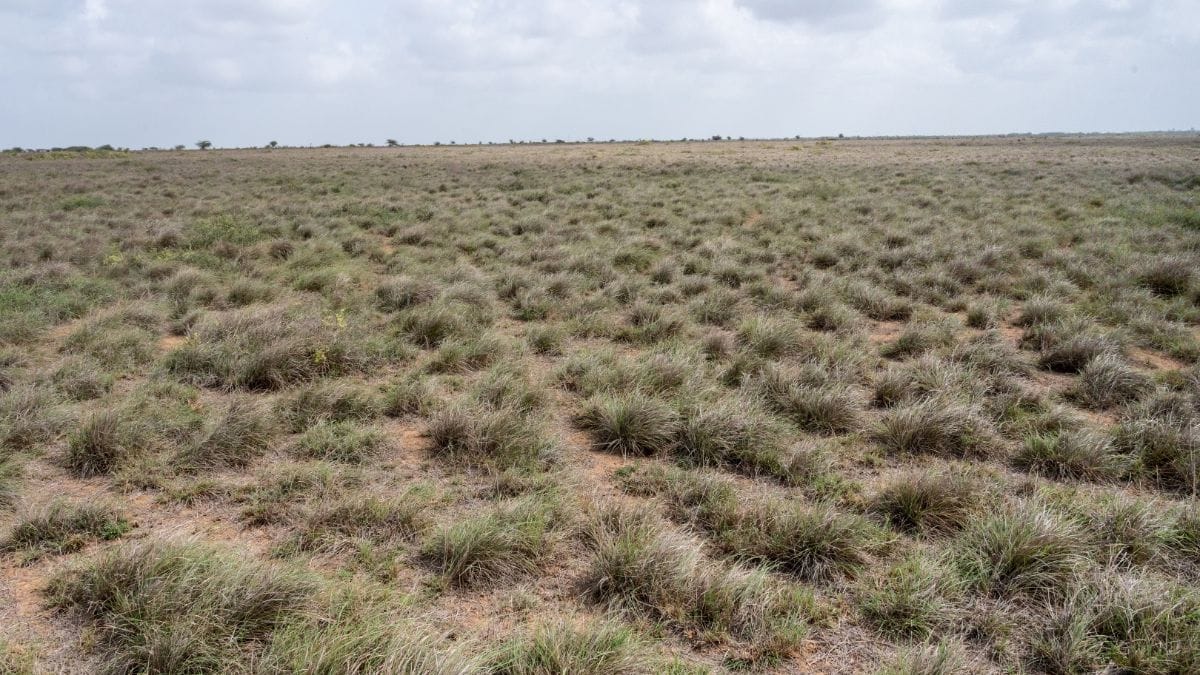
One of the reasons for it is prosopis juliflora—an invasive shrub introduced to Kutch decades ago as part of government-driven afforestation drives. The shrub has colonised vast stretches of the area in Naliya.
The Great Indian Bustard needs open ground to forage, display and detect predators. Prosopis eliminates all three. Removal work has been underway for years, but the infestation remains extensive.
Windmills, power lines & a court order not implemented
The road from Bhuj to Naliya—around 120 km apart—goes through transmission lines that cut across or run alongside it. This includes 33 kV distribution lines; 66 kV lines that carry power generated by wind farms out to the main grid; and in stretches, taller pylons of higher-voltage infrastructure in open grasslands.
Conservationists and locals say collision with power lines is the single largest threat to GIBs in India today.
This is because the GIB has poor frontal vision—its eyes are set on the sides of its head, built for scanning the ground. At speed and altitude, the bird cannot see transmission lines in time to avoid them.
WII has, through multiple studies, estimated that 18 GIBs die annually from power line collisions across the country. For a species with numbers limited to a few hundreds, any fatalities are consequential.
The removal or relocation of power lines, both in Rajasthan and Gujarat, reached the Supreme Court in 2019, when wildlife activist and former bureaucrat M.K. Ranjitsinh Jhala filed a public interest litigation (PIL), arguing that overhead wires were accelerating GIB’s population decline.
The top court made its first intervention on the PIL in 2021, ordering the underground relocation of all overhead power lines across 99,000 sq km of GIB habitat across the two states, including the Kutch sanctuary. Renewable energy companies—which operate around 50 GW of capacity valued at approximately Rs 1.5 lakh crore in Gujarat and Rajasthan—would have to bear the costs of such a move.
The central government immediately challenged the directive, with the environment and power ministries jointly arguing that a blanket mandate to relocate overhead electricity lines was “practically impossible”.
In March 2024, the Supreme Court modified its order and reduced the zone to be protected from 99,000 sqkm to 13,163 sq km.
It further expanded a three-member expert panel formed earlier into a nine-member committee, and tasked it with working out a line-by-line compromise on existing power infrastructure.
On 19 December 2025, Justices P.S. Narasimha and A.S. Chandurkar delivered the latest judgment, again revising habitat to be protected to 14,753 sq km (14,013 sq km in Rajasthan and 740 sq km in Gujarat). The bench reiterated that Great Indian Bustard protection was “non-negotiable”.
The court also ordered that no new wind turbines or large solar parks be set up, nor existing projects expanded, within this zone. Referring specifically to Abdasa, the bench directed immediate undergrounding or rerouting of four 33 kV lines totalling 79.2 km within the protected habitat.
These overhead lines have not been removed as yet. Asked about it, the forest department did not provide any data on completed work.
On compliance with the SC order, Mittal said the court’s directive for existing power lines fell into three categories: lines that must go entirely, lines that must be realigned or undergrounded, and lines that may remain with case-by-case mitigation measures.
He said for one of the lines operated by the Gujarat Energy Transmission Corporation (GETCO), the forest department was consulting WII for a mitigation measure. “On our side, we are doing everything as per the Supreme Court judgment. There is no question of not following and complying to the honourable court’s judgment,” he said.
In the December ruling, the court also told the Centre to form a compliance and monitoring committee within three months. That deadline passed in March, without any formation of a panel.
ThePrint also found out the expert committee, expanded in 2024, submitted a Gujarat-specific report to the Supreme Court earlier this month. In it was a formal dissent note by Dr Devesh Gadhvi, who warned that recommendations adopted for Abdasa “may pose a higher threat to the existing population of GIB and Lesser Florican, and even more to the future captive-bred birds to be released by the year 2028”.
The dissent also referred to a 400 kV Bhachunda-Varsana line, a high-voltage transmission line whose pylons had already been erected within the Great Indian Bustard habitat despite the earlier three-member panel declining to ratify the route on grounds of bird collision risk.
Dr Devesh Gadhvi argued that this line must either be rerouted alongside an existing 220 kV corridor, or fitted with bird flight diverters (spinning or swinging devices attached to wires at regular intervals to make them visible to birds).
More broadly, the note urged that all overhead lines of 33 kV and above within the protected GIB area be undergrounded or rerouted entirely, not managed in place with diverters.
“We need to leave some areas and skies sacrosanct for the birds to survive, so that the upcoming generation can witness this natural heritage of our country,” it read.
A power sector official sitting as a special government invitee on the same committee filed counter-comments to this dissent. The official said he was “not in agreement to the undergrounding of 66 kV and higher voltage overhead electric lines”, and that undergrounding was “not a solution to increase the population of the birds of any kind”.
The same expert committee report noted that 95 sqkm of area from a 677 sqkm buffer zone in Naliya–mapped out as a GIB movement corridor around the protected habitat–had been removed as an ‘additionally important area’ to accommodate energy infrastructure already in place.
30 km away, a project that works
In Kanakpur village, about 30 km from the GIB sanctuary, the Corbett Foundation has been doing conservation work of a less headline-friendly kind since 2009. It does not involve egg transfers or portable incubators. Instead, it involves removal of prosopis and grass seeds, and a sustained conversation with villagers to transform 81 hectares, or nearly one sqkm, of community land that had been lying barren.
The logic here was indirect but consequential. This panchayat land is not a GIB habitat. But converting this barren area into pastures for grazing by cattle takes off the pressure that would otherwise fall on the open scrubland around the sanctuary that the birds do use. When the village cattle have adequate fodder here, they do not push into the areas where female GIBs nest. The disturbance stays away from the places where it most matters.
Dr Devesh Gadhvi, deputy director and head of ornithology, research and sustainability at the Corbett Foundation, explained the mechanism. Dr Gadhvi has worked in the Abdasa landscape for nearly two decades and is the only independent wildlife conservationist on the expert committee appointed by the Supreme Court, with extensive work experience on the Great Indian Bustard and its associated habitat.
“The Ghorad needs open grassland. When we develop the gauchar here, the cattle pressure on those core areas reduces,” he said.
Vadilal Bhai Parbat Bhai Pokar, a civil engineer who came back to his farmland in Kanakpur, described how the village got involved in the process. “The village did not have a single acre of gauchar land,” he said.
The panchayat and gauchar committee worked with the foundation and the government to convert barren community land into common pastureland, he said. Today, 350 desi Kankrej cows graze it. The biodiversity follows—birds, small creatures, and, at the margins, the Ghorad finding the open terrain they need in the areas beyond.
“The gauchar sustains the cattle. The cattle sustain the community. And the open land sustains biodiversity,” he said.
Vidhi Modi, senior research fellow at the Corbett Foundation, explained the restoration method developed in collaboration with the village. “We have trained villagers to adhere to a ‘no grazing during the monsoon’ system, which allows grass seeds to grow and complete their lifecycle. This approach supports the development of grass tussocks, making the efforts sustainable in the long run,” she said.
Adding, “After the monsoon, typically in November, once the grass seeds fall off, we cut the grasses, make small bales, and sun-dry them. In January, we gather the dried bales and store them in the village godown to be used during summer or drought periods when grass is scarce.”
On the techniques used across different plots, she said: “The grass cultivation techniques vary depending on the degradation stage. If the area has grass tussocks that are just overgrazed, no ploughing or cultivation is necessary; protection during the monsoon suffices.
“If there is a significant invasion, uprooting prosopis juliflora with an excavator is required. For land already used for agriculture, ploughing may be needed; otherwise, seed broadcasting or the saucer-pit method is suitable. Sometimes, grass saplings are grown in nurseries and transplanted, but this depends on rainfall. Overall, we aim to minimise human intervention.”
Modi added, “The village is now self-reliant regarding fodder for their livestock. We are proud to see the strong sense of ownership developed among the villagers for this unique project. They now take the lead and inform us that it is the right time for grass cutting. We will start it in a few days.”
Approximately 180 acres have been restored in Kanakpur, while around 200 acres have been restored in Vadapaddhar village. Additionally, another 100 acres are currently being restored in Rapar Gadhvali village.
What’s next for the Great Indian Bustard?
The expert committee’s Abdasa report listed 33 species of birds–among them two critically endangered, four endangered and 13 vulnerable–whose habitats overlap with the GIBs in the area. It pointed out that Kutch held the distinction of being the only place in India where three bustard species–GIBs, lesser florican and Asian houbara–co-exist.
Asked what was the next step, Mittal said the predator-proof fence would be set up this year, and the habitat action plan will be finalised with WII’s inputs. More Jumpstart attempts will follow. “Now we can do it with two birds, as and when an opportunity arises,” he said.
The same question posed to Dr Devesh Gadhvi elicited a different answer. “The project to save GIBs depends on how the directions from the Hon’ble Supreme Court are followed and implemented by 2028,” he said.
(Edited by Prerna Madan)
Also Read: Monkey see, monkey eat dirt—The social science behind primate ‘self-medication’